

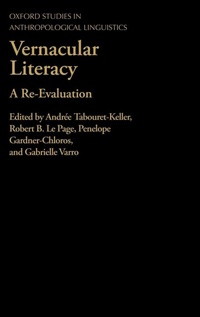
Vernacular Literacy
A Re-Evaluation
Published on 11. September 1997
Book
Hardback
380 pages
978-0-19-823635-1 (ISBN)
Description
Illiteracy problems are worldwide, and growing. Political and economic factors are often in conflict over which language to use for basic education and how it should be taught. There is increasing pressure on the resources available for using literacy in coping with the rapid population increase, the spread of disease, and poor development.
The editors and contributors to this volume are members of The International Group for the Study of Language Standardization and the Vernacularization of Literacy (IGLSVL), with unrivalled direct personal experience of literacy and language problems in the second half of the twentieth century. The contributors take the UNESCO publication, The Use of Vernacular Languages in Education, as their starting point. Published in 1953, this work was optimistic about the future of literacy. The contributors assess the nature and significance of the events that have taken place since then, providing a global overview. The discussions are supported by case-studies of campaigns to promote vernacular languages and examples of how people relate to their languages in different cultures. Most importantly, they question traditional notions of, and provide a non-Western perspective on, the uses and value of literacy.
The editors and contributors to this volume are members of The International Group for the Study of Language Standardization and the Vernacularization of Literacy (IGLSVL), with unrivalled direct personal experience of literacy and language problems in the second half of the twentieth century. The contributors take the UNESCO publication, The Use of Vernacular Languages in Education, as their starting point. Published in 1953, this work was optimistic about the future of literacy. The contributors assess the nature and significance of the events that have taken place since then, providing a global overview. The discussions are supported by case-studies of campaigns to promote vernacular languages and examples of how people relate to their languages in different cultures. Most importantly, they question traditional notions of, and provide a non-Western perspective on, the uses and value of literacy.
Reviews / Votes
the book is intended to provide something of a retrospective of the world wide literacy situation since ... 1953. ... provides numerous examples of local languages which have been written and standardised ... I have only praise for the level of organisation of the book ... all of the references appear together at the end of the book, along with a complete index, saving the reader valuable time. * Carol Benson, Language and Education, Vol 14: 1, 2000 * This is quite a complex book, but one which raises a host of theoretical and practical issues relating to the future of vernacular literacies. * National Literacy Trust * A number of key issues of great complexity is raised by the papers in this book. No attentive reader could emerge from these pages able to utter glib programmatic definitions or characterisations of literacy development needs and difficulties. A multi-authored and very wide-ranging book. A valuable publication for its reports from the field. - Geoff Hall - Journal of Sociolinguistics 3/3 1999More details
Series
Language
English
Place of publication
Oxford
United Kingdom
Publishing group
Oxford University Press
Target group
College/higher education
Professional and scholarly
Illustrations
tables
Dimensions
Height: 240 mm
Width: 161 mm
Thickness: 25 mm
Weight
734 gr
ISBN-13
978-0-19-823635-1 (9780198236351)
Copyright in bibliographic data and cover images is held by Nielsen Book Services Limited or by the publishers or by their respective licensors: all rights reserved.
Schweitzer Classification
Persons
Editor
ProfessorProfessor, University of Strasbourg
Professor Emeritus of Language and LinguisticsProfessor Emeritus of Language and Linguistics, University of York
Lecturer in LinguisticsLecturer in Linguistics, Birkbeck College, London
Research ScholarResearch Scholar, Centre Nationale de la Recherche Scientifique (CNRS), Paris