

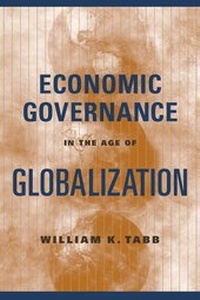
Economic Governance in the Age of Globalization
Published on 2. June 2004
Book
Hardback
528 pages
978-0-231-13154-4 (ISBN)
Description
Rapid growth, reduced poverty, and stable societies: the announced benefits of the world economy celebrated by neoliberal proponents of "the Washington consensus" have failed to materialize. What does this failure mean for future world order and the U.S. role as global hegemon? Addressing this crucial question, William Tabb argues that global economic institutions such as the World Bank and the International Monetary Fund constitute a nascent international state for which all previous models of sovereignty, accountability and equity are inadequate. Integrating economics and political science, Tabb traces the emergence of this global state from the closing days of World War II and examines its future prospects. Even as the United States will continue to dominate the emerging structures of world governance, Tabb maintains, it will have to change the assumptions behind its championing of classical models of international free trade. A new financial architecture must encompass debt forgiveness, multilateral agreements on investment, and a more inclusive model of growth in the twenty-first century.
Reviews / Votes
The best critical analysis of the constructing of current economic governance institutions and agendas. Throughout this analysis Tabb shows us how partial a map of this process has been produced by the main scholarly traditions on the subject. This juxtaposition illuminates the contingent character of the current system and the work that can be done to develop alternative objectives. -- Saskia Sassen, author of Losing Control? Sovereignty in an Age of Globalization This is definitely an original and constructive contribution. The book is well written and engaging and the arguments are clear and well formulated. -- Christopher Chase-Dunn, University of California, Riverside The book does a wonderful job of laying out the dilemmas of the current incomplete attempts to govern the global economy, placing them in a historical context that allows us to see viable alternatives. -- Craig N. Murphy, Wellesley College and chair, Academic Council on the U.N. System (2002-2004) His book is an original contribution to the discussion on the current state of globalization. -- Oliver Marnet Journal of Economic Issues Tabb's manuscript on this subject is not a traditional research monograph... He offers a strong critical assessment of the neoliberal economic agenda. -- David H. Bearce International Journal Up-to-date... unusually well informed about the academic literature across economics, IR, IPE, and security studies. -- Robert Hunter Wade Perspectives on Politics The book clearly identifies links between politics and economics in the age of globalization and puts them in an interesting historical perspective -- Dirk-Jan Koch Development and ChangeMore details
Language
English
Place of publication
New York
United States
Target group
Professional and scholarly
Product notice
Trade binding
Weight
836 gr
ISBN-13
978-0-231-13154-4 (9780231131544)
Copyright in bibliographic data and cover images is held by Nielsen Book Services Limited or by the publishers or by their respective licensors: all rights reserved.
Schweitzer Classification
Other editions
Additional editions
William Tabb
Economic Governance in the Age of Globalization
E-Book
11/2015
1st Edition
De Gruyter
from
€43.95
Available for download
William K. Tabb
Economic Governance in the Age of Globalization
Book
06/2004
Columbia University Press
€52.08
Shipment within 10-20 days
Person
William K. Tabb is professor of economics at Queens College and (sometimes) professor of political science at the Graduate School of the City University of New York. His previous books include The Amoral Elephant, Reconstructing Political Economy, and The Postwar Japanese System.
Content
1. Introduction 2. The Verb and the Noun 3. Debating Globalization 4. The Nature and Scope of International Political Economics 5. The Postwar Economic Order and Global State Economic Governance Institutions 6. Clubs, Soft Law and International Financial Institutions 7. Finance: Orthodox and Heterodox 8. The Bretton Woods Institutions 9. Transnational Corporations and Trade Theory 10. From International Trade Organization to World Trade Organization 11. Market Efficiency Versus Labor Rights and Environmental Protection 12. Redecorating and New Architecture 13. The Evolving International Political Economy References