

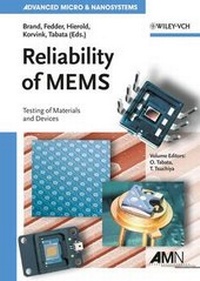
Reliability of MEMS
Testing of Materials and Devices
1st Edition
Published on 12. December 2007
Book
Hardback
XX, 304 pages
978-3-527-31494-2 (ISBN)
Description
This first book to cover exclusively and in detail the principles, tools and methods for determining the reliability of microelectromechanical materials, components and devices covers both component materials as well as entire MEMS devices. Divided into two major parts, following a general introductory chapter to reliability issues, the first part looks at the mechanical properties of the materials used in MEMS, explaining in detail the necessary measuring technologies -- nanoindenters, bulge methods, bending tests, tensile tests, and others. Part Two treats the actual devices, organized by important device categories such as pressure sensors, inertial sensors, RF MEMS, and optical MEMS.
Reviews / Votes
"The book will undoubtedly be of interest to MEMS practitioners and researchers." (Journal of Applied Electrochemistry, February 2008)All prices
More details
Series
Edition
1. Auflage
Language
English
Place of publication
Berlin
Germany
Target group
Professional and scholarly
Illustrations
25
204 s/w Abbildungen, 25 s/w Tabellen
Dimensions
Height: 24 cm
Width: 17 cm
Thickness: 2 cm
Weight
748 gr
ISBN-13
978-3-527-31494-2 (9783527314942)
Schweitzer Classification
Other editions
Additional editions
Book
04/2013
1st Edition
Wiley-VCH
€96.90
Article exhausted; check different version
E-Book
03/2013
1st Edition
Wiley-VCH
€86.99
Available for download
Persons
Osamu Tabata received his Ph.D. degree from Nagoya Institute of Technology, Japan, in 1993. From 1981 to 1996, he performed industrial research at Toyota Central Research and Development Laboratories in Aichi, Japan. He then joined the Department of Mechanical Engineering of Ritsumeikan University in Shiga, Japan, and spent Guest Professorships at IMTEK Freiburg, Germany, and at ETH Zurich, Switzerland. In 2003, he joined the Kyoto University, Japan. Currently, he is the Professor at Micro Engineering Department. Professor Tabata is engaged in the research of micro/nano processes, MEMS and micro/nano system synthetic engineering (SENS). He was honored with the Science News Award in 1987, Presentation Paper Award in 1992, and received the R&D 100 Award in 1993 and 1998, Best Poster Award of 19th Sensor Symposium on Sensors, Micromachines, and Applied Systems in 2002, Best Patent Award from Ritsumeikan University in 2004. He is a senior member of the Institute of Electrical Engineers of Japan, a member of the Japan Society of Mechanical Engineers and a senior member of the Institute of Electrical and Electronics Engineers.
Toshiyuki Tsuchiya received his Ph.D. degree from Nagoya University, Japan, in 2002. From 1993 to 2004, he carried out industrial research at Toyota Central Research and Development Laboratories in Aichi, Japan. In 2004, he joined the Department of Mechanical Engineering of Kyoto University and is currently Associate Professor in the Department of Microengineering. Toshiyuki Tsuchiya's current research is focused on mechanical properties evaluation of micro/nano materials and MEMS and micro/nano system synthetic engineering (SENS). He received the R&D 100 Award in 1998.
Toshiyuki Tsuchiya received his Ph.D. degree from Nagoya University, Japan, in 2002. From 1993 to 2004, he carried out industrial research at Toyota Central Research and Development Laboratories in Aichi, Japan. In 2004, he joined the Department of Mechanical Engineering of Kyoto University and is currently Associate Professor in the Department of Microengineering. Toshiyuki Tsuchiya's current research is focused on mechanical properties evaluation of micro/nano materials and MEMS and micro/nano system synthetic engineering (SENS). He received the R&D 100 Award in 1998.
Content
Evaluation of Mechanical Properties of MEMS Materials and their Standardization
Elastoplastic Indentation Contact Mechanics of Homogeneous Materials and Coating-Substrate Systems
Thin-film Characterization Using the Bulge Test
Uniaxial Tensile Test for MEMS Materials
On-chip Testing of MEMS
Reliability of a Capacitive Pressure Sensore
Inertial Sensors
High-accuracy, High-reliability MEMS Accelerometer
Reliability of MEMS Variable Optical Attenuator
Eco Scan MEMS Resonant Mirror
Elastoplastic Indentation Contact Mechanics of Homogeneous Materials and Coating-Substrate Systems
Thin-film Characterization Using the Bulge Test
Uniaxial Tensile Test for MEMS Materials
On-chip Testing of MEMS
Reliability of a Capacitive Pressure Sensore
Inertial Sensors
High-accuracy, High-reliability MEMS Accelerometer
Reliability of MEMS Variable Optical Attenuator
Eco Scan MEMS Resonant Mirror