

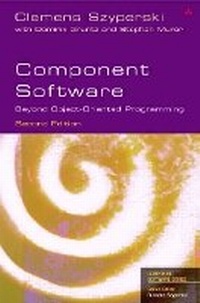
Component Software
Beyond Object-Oriented Programming
2nd Edition
Published on 15. November 2002
Book
Paperback/Softback
624 pages
978-0-201-74572-6 (ISBN)
Description
The author describes his book as a "unique blend of market and technology coverage, broad and fair coverage of current technologies and a deep discussion of real problems with their solutions where known".
The first edition won the "Jolt Award" became the leading book on the market to combine explanations of what the key technologies are, how to use them and why they are important in the software market-place, and look at these in terms of both the technical and business issues. The book was also the first to define components and clarify the key questions surrounding them, show how they are key to software design and offer a historical overview of their development.
The first edition won the "Jolt Award" became the leading book on the market to combine explanations of what the key technologies are, how to use them and why they are important in the software market-place, and look at these in terms of both the technical and business issues. The book was also the first to define components and clarify the key questions surrounding them, show how they are key to software design and offer a historical overview of their development.
More details
Series
Edition
2nd edition
Language
English
Place of publication
Boston
United States
Publishing group
Pearson Education (US)
Target group
Professional and scholarly
Dimensions
Height: 237 mm
Width: 160 mm
Thickness: 33 mm
Weight
1000 gr
ISBN-13
978-0-201-74572-6 (9780201745726)
Copyright in bibliographic data and cover images is held by Nielsen Book Services Limited or by the publishers or by their respective licensors: all rights reserved.
Schweitzer Classification
Other editions
New editions
Book
11/2011
2nd Edition
Addison Wesley
€70.57
Shipment within 10-20 days
Person
Clemens Szperski joined Microsoft Research at its Remond, Washington Facility in 1999 to continue his work component software. In 1992 he received a PhD in Computer Science from the Swiss Federal Institute of Technology, Zurich where he designed and implemented the extensible operating system Ethos. In 1993 he co-founded Oberon Microsystems, Inc developer of BlackBox Component Builder, first marketed in 1994 and one of the first development environments and component frameworks designed specifically for component-oriented programming projects.
Content
I. MOTIVATION: COMPONENTS AND MARKETS
1. Introduction
2. Market versus technology
3. Standards
II. FOUNDATION
4. What a component is and is not
5. Components, interfaces, and re-entrance
6. Polymorphism
7. Object versus class composition, or how to avoid inheritance
8. Aspects of scale and granularity
9. Patterns, frameworks, architectures
10. Programming: shades of gray
11. What others say
III. COMPONENT MODELS AND PLATFORMS
12. Object and component 'wiring' standards
14. The Microsoft way: COM, OLE/ActiveX, COM+, and .NET CLR 15. The Sun way: Java, JavaBeans, EJB, and Java 2 editions
16. More customs than customers?
17. Strategic comparison
18. Efforts on domain standards
19. Open problems
IV. COMPONENTS MEET ARCHITECTURE AND PROCESS
20. Component architecture
21. Component frameworks
22. Component development
23. Component distribution and acquisition
24. Component assembly
25. On the horizon
V. MARKETS AND COMPONENTS
26. Future markets
27. New professions
28. A component marketing paradox
Epilogue
Appendix A. Java versus C# versus Component Pascal
Bibliography
Glossary
Index
1. Introduction
2. Market versus technology
3. Standards
II. FOUNDATION
4. What a component is and is not
5. Components, interfaces, and re-entrance
6. Polymorphism
7. Object versus class composition, or how to avoid inheritance
8. Aspects of scale and granularity
9. Patterns, frameworks, architectures
10. Programming: shades of gray
11. What others say
III. COMPONENT MODELS AND PLATFORMS
12. Object and component 'wiring' standards
14. The Microsoft way: COM, OLE/ActiveX, COM+, and .NET CLR 15. The Sun way: Java, JavaBeans, EJB, and Java 2 editions
16. More customs than customers?
17. Strategic comparison
18. Efforts on domain standards
19. Open problems
IV. COMPONENTS MEET ARCHITECTURE AND PROCESS
20. Component architecture
21. Component frameworks
22. Component development
23. Component distribution and acquisition
24. Component assembly
25. On the horizon
V. MARKETS AND COMPONENTS
26. Future markets
27. New professions
28. A component marketing paradox
Epilogue
Appendix A. Java versus C# versus Component Pascal
Bibliography
Glossary
Index