

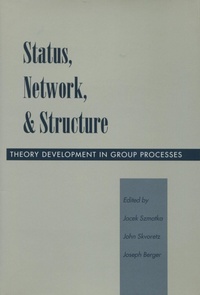
Status, Network, and Structure
Theory Development in Group Processes
Published on 1. October 1997
Book
Hardback
484 pages
978-0-8047-2844-7 (ISBN)
Description
This book challenges much that has been written about the decline of sociology as a vital, essential area of inquiry into the human condition. Against this Greek chorus of woe, these papers show by example that sociology can make progress, select significant problems, and cumulate an integrated and coherent set of findings and theoretical understandings.
Although the twenty papers in the book engage a wide variety of issues, they are united by their adherence to one of the most active and successful traditions in sociology, the group process tradition. Group process research programs can examine tractable problems posed by social psychological phenomena for which sociology has the best methods of study; they have the potential for a hardware-based, technological research front that discovers new phenomena; and they come closest of all approaches in sociological research to using cognitive criteria in the choice of problems and to studying immutable phenomena. The overall aim of the book is to provide models for researchers struggling to develop, construct, and integrate coherent sociological theory and knowledge.
The papers are grouped around three themes: (1) the problem of theory construction in sociology, including what is meant by "theory" and the methods of testing it, particularly empirical testing; (2) the extension and elaboration of existing theories of group processes, notably in the study of status, sentiment, and the comparison process; and (3) the theoretical issues at the intersection of social structures, the pattern of connection in social networks, and the process of rational choice.
Although the twenty papers in the book engage a wide variety of issues, they are united by their adherence to one of the most active and successful traditions in sociology, the group process tradition. Group process research programs can examine tractable problems posed by social psychological phenomena for which sociology has the best methods of study; they have the potential for a hardware-based, technological research front that discovers new phenomena; and they come closest of all approaches in sociological research to using cognitive criteria in the choice of problems and to studying immutable phenomena. The overall aim of the book is to provide models for researchers struggling to develop, construct, and integrate coherent sociological theory and knowledge.
The papers are grouped around three themes: (1) the problem of theory construction in sociology, including what is meant by "theory" and the methods of testing it, particularly empirical testing; (2) the extension and elaboration of existing theories of group processes, notably in the study of status, sentiment, and the comparison process; and (3) the theoretical issues at the intersection of social structures, the pattern of connection in social networks, and the process of rational choice.
Reviews / Votes
"There is nothing in the literature like this exciting project. The authors are among the best and the brightest in the theory-driven research tradition of world social science, particularly sociology. Here are major researchers coming together and explaining their latest research or articulating their vision of how to build a social science. All the articles are well written, and there is not a single weak one in the collection."-Jonathan Turner,University of California, RiversideMore details
Edition
New edition
Language
English
Place of publication
Palo Alto
United States
Target group
College/higher education
Professional and scholarly
Edition type
New edition
Product notice
Cloth
Illustrations
34 Figures, 38 Tables, 2 Charts
Dimensions
Height: 229 mm
Width: 152 mm
Thickness: 32 mm
Weight
866 gr
ISBN-13
978-0-8047-2844-7 (9780804728447)
Copyright in bibliographic data and cover images is held by Nielsen Book Services Limited or by the publishers or by their respective licensors: all rights reserved.
Schweitzer Classification
Persons
Jacek Szmatka is Professor of Sociology at Jagiellonian University, Poland and Adjunct Professor of Sociology at the University of South Carolina. John Skvoretz is Carolina Distinguished Professor of Sociology at the University of South Carolina. Joseph Berger is Professor of Sociology at Stanford University and co-editor, with Morris Zelditch, of Theoretical Research Programs: Studies in Theory Growth (Stanford, 1993)
Content
Introduction Jacek Szmatka, John Skvoretz and Joseph Berger; Part I. Theory Construction, Tests, and Strategies: 1. Building and testing multilevel theories Barry Markovsky; 2. Theoretical research programs: a reformulation Joseph Berger and Morris Zelditch Jr; 3. Use of computer simulation for theory development: an evolving component of sociological research programs Barbara F. Meeker and Robert K. Leik; 4. Testing elementary theory for universality Jacek Szmatka; 5. Informal theory testing through mathematical analysis M. Hamit Fisek; Part II. Status, Sentiments, and Comparison Processes: 6. Social structural analysis and status generalization: the contributions and potential of expectation states theory J. David Knottnerus; 7. Where do status value beliefs come from? New developments Cecilia L. Ridgeway; 8. Status, emotion, and structural power Michael J. Lovaglia; 9. Status, affect, and multiple standards for competence Martha Foschi; 10. Operation of status in the middle grades: recent complications Elizabeth G. Cohen and Rachel A. Lotan; 11. Derivation of predictions in comparison theory: foundations of the macromodel approach Guillermina Jasso; Part III. Structure, Social Networks, and Rational Choice: 12. Structural formulations and elementary theory David Willer and Jacek Szmatka; 13. Power and dependence in exchange networks: a comment on structural measures of power Karen S. Cook, Toshio Yamagishi, and Shawn Donnelly; 14. Toward a formal theory of equilibrium in network exchange systems Tadeusz Sozanski; 15. Strategy in exchange networks: exploitation versus accommodation Phillip Bonacich and Elisa Jayne Bienenstock; 16. Synthesizing theories of deviance and control: with steps toward a dynamic sociocultural network model Thomas J. Fararo and John Skvoretz; 17. Affective attachments to nested groups: the role of rational choice processes Edward J. Lawler; 18. Endorsement as nonlegitimate domination: an application of experimental research to historical settings Richard Bell.