

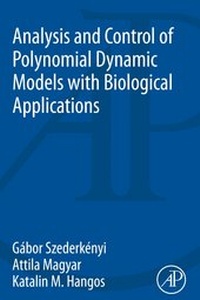
Analysis and Control of Polynomial Dynamic Models with Biological Applications
Published on 21. March 2018
Book
Paperback/Softback
184 pages
978-0-12-815495-3 (ISBN)
Description
Analysis and Control of Polynomial Dynamic Models with Biological Applications synthesizes three mathematical background areas (graphs, matrices and optimization) to solve problems in the biological sciences (in particular, dynamic analysis and controller design of QP and polynomial systems arising from predator-prey and biochemical models). The book puts a significant emphasis on applications, focusing on quasi-polynomial (QP, or generalized Lotka-Volterra) and kinetic systems (also called biochemical reaction networks or simply CRNs) since they are universal descriptors for smooth nonlinear systems and can represent all important dynamical phenomena that are present in biological (and also in general) dynamical systems.
More details
Language
English
Place of publication
San Diego
United States
Publishing group
Elsevier Science Publishing Co Inc
Target group
Professional and scholarly
The broad community of graduate students and researchers in science and engineering, interested in exploring nonlinear phenomena from a system's theory perspective. Additionally, chemical/biochemical engineers or applied mathematicians developing research in biological phenomena as well as theoretical biologists with interests in mathematical methods.
Dimensions
Height: 235 mm
Width: 191 mm
Weight
310 gr
ISBN-13
978-0-12-815495-3 (9780128154953)
Copyright in bibliographic data and cover images is held by Nielsen Book Services Limited or by the publishers or by their respective licensors: all rights reserved.
Schweitzer Classification
Other editions
Additional editions
Gabor Szederkenyi | Attila Magyar | Katalin M. Hangos
Analysis and Control of Polynomial Dynamic Models with Biological Applications
E-Book
03/2018
Academic Press
€69.95
Available for download
Persons
Gabor Szederkenyi received the M.Eng degree in computer engineering (University of Veszprem, 1998), his PhD in information sciences (University of Veszprem, 2002), and the DSc title in engineering sciences (Hungarian Academy of Sciences, 2013). Currently, he is a full professor at PPKE and the head of the Analysis and Control of Dynamical Systems research group. His main research interest is the computational analysis and control of nonlinear systems with special emphasis on reaction networks and kinetic models. He is the co-author of one book, several book chapters, more than 40 journal papers, and more than 60 conference papers on the theory and applicaton of the analysis and control of nonlinear systems. His education record includes BSc and MSc level courses on linear systems theory, nonlinear control and its application in robotics and in biological systems. The history of the scientific cooperation of the proposed three authors dates back to 2003. Since then, they have published more than 25 joint scientific papers in international journals and conference proceedings mostly related to the topic of the proposed book. The scientific background of the three authors are really complementary: Prof. Katalin Hangos is an internationally known expert in the modelling and control of thermodynamical and (bio)chemical systems, Dr. Attila Magyar has significant experience in the analysis, application and control of quasi-polynomial systems, while Prof. Gabor Szederkenyi has results on the optimization-based structural analysis and synthesis of kinetic systems. Moreover, all three authors have had continuous education and supervising experience both on the MSc and PhD levels at different universities. Attila Magyar received his MSc in computer science (University of Pannonia, 2004), his PhD in computer science (University of Pannonia, 2008), respectively. He is working at the Department of Electrical Engineering and Information Systems at University of Pannonia He is the member of the Research Laboratory of Intelligent Control Systems of the Faculty of Information Technology. His main research interests lie in nonlinear control, system identification and robotics. Katalin Hangos received her MSc in chemistry (ELTE TTK, 1976), her BSc in computer science (ELTE TTK, 1980), DSc (1993), and habilitations (chemical engineering, 1994, engineering informatics, 2000), respectively. She is the Research and Education Head of the Department of Electrical Engineering and Information Systems at University of Pannonia and the Head of the Process Control Research Group of the Computer and Automation Research Institute of Hung. Acad. Sci. She is also the Head of the Research Laboratory of Intelligent Control Systems of the Faculty of Information Technology. She is one of the very few female professors in process systems and control, who has a strong interdisciplinary background in systems and control theory and computer science, as well.Her main research interest lies in dynamic modelling of process systems for control and diagnostic purposes. She is a co-author of more than 100 papers on various aspects of modelling and control of process systems with nonlinear, stochastic, Petri net, qualitative and graph theory based models.
Author
Professor, Faculty of Information Technology and Bionics, Pazmany Peter Catholic University (PPKE), Budapest, Hungary
Ass. Professor, Department of Electrical Engineering and Information Systems, University of Pannonia, Vesyprem, Hungary
Res. Professor, Process Control Research Group, Institute for Computer Science and Control of Hungarian Academy of Sciences, Budapest, Hungary , and Professor, Department of Electrical Engineering and Information Systems, University of Pannonia, Veszprem, Hungary
Content
1. Introduction
2. Basic Notions
3. Model Transformations and Equivalence Classes
4. Model analysis
5. Stabilizing feedback control design
6. Case studies
Appendix
A. Notations and abbreviations
B. Mathematical tools
2. Basic Notions
3. Model Transformations and Equivalence Classes
4. Model analysis
5. Stabilizing feedback control design
6. Case studies
Appendix
A. Notations and abbreviations
B. Mathematical tools