

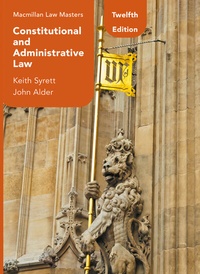
Constitutional and Administrative Law
Description
This textbook provides a thorough and accessible introduction to the basic principles of United Kingdom Constitutional and Administrative Law, including Human Rights Law. It has been revised and updated to reflect recent developments, both legal and political. The fundamental concepts of UK Constitutional and Administrative Law are explained in a clear, engaging, succinct style, making them straightforward for students to understand so they build up their knowledge of the subject systematically and thoroughly.
This book is also an essential starting point for more advanced law students and a valuable source of legal context for political science students alike. Both authoritative and accessible, it enables the reader to appreciate the nature and complexity of this most fundamental part of our legal system.
Reviews / Votes
Syrett and Alder have maintained the high standards of previous editions and offer comprehensive coverage of the post-Brexit constitutional order without compromising on the level of detail. Students and lecturers will find useful seminar materials in the end of chapter exercises. This book has a permanent place on my Public Law bookshelf. * Ali Raiss-Tousi, Anglia Ruskin University, London *More details
Other editions
Additional editions
Previous edition
Persons
Keith Syrett is Professor of Health Law and Policy at the University of Bristol Law School, where he teaches public law and health law. His interests include public health law, health systems and policy, global health law and goverance, and human rights.
John Alder is a former Professor of Law at Newcastle and Keele universities. His interests include constitutional and administrative law, housing law and environmental law.
Content
PART I: THE FRAMEWORK OF THE CONSTITUTION.- 1. Introduction: Constitutional Structures.- 2. Underlying Political Traditions.- 3. The Sources of the Constitution.- 4. Historical Landmarks.- 5. An Overview of the Main Institutions of the Constitution.- PART II FUNDAMENTAL PRINCIPLES.- 6. The Rule of Law.- 7. The Separation of Powers.- 8. Parliamentary Sovereignty.- PART III INTERNATIONAL ASPECTS OF THE CONSTITUTION.- 9. The State and the Outside World.- 10. The European Union and Brexit.- PART IV: GOVERNMENT INSTITUTIONS.- 11. Parliament: Constitutional Position.- 12. The Composition of Parliament and Parliamentary Elections.- 13. Parliamentary Procedure.- 14. The Crown.- 15. Ministers and Departments.- 16. Devolution.- PART V: ADMINISTRATIVE LAW.- 17. The Grounds of Judicial Review, I: Illegality and Ultra Vires.- 18. The Grounds of Judicial Review, II: Beyond Ultra Vires.- 19. Judicial Review Remedies and Procedure.- 20. Administrative Justice.- PART VI: FUNDAMENTAL RIGHTS.- 21. Human Rights and Civil Liberties.- 22. The Human Rights Act 1998.- 23. Freedoms of Expression and Assembly.- 24. Government Secrecy.- 25. Exceptional Powers: Security, Emergencies and Terrorism.