

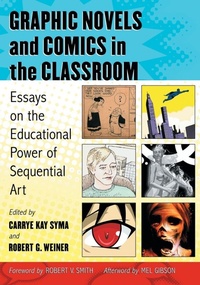
Graphic Novels and Comics in the Classroom
Essays on the Educational Power of Sequential Art
Published on 24. June 2013
Book
Paperback/Softback
296 pages
978-0-7864-5913-1 (ISBN)
Description
Sequential art combines the visual and the narrative in a way that readers have to interpret the images with the writing. Comics make a good fit with education because students are using a format that provides active engagement. This collection of essays is a wide-ranging look at current practices using comics and graphic novels in educational settings, from elementary schools through college. The contributors cover history, gender, the use of specific graphic novels, practical application and educational theory.
Instructors considering this book for use in a course may request an examination copy here.
Instructors considering this book for use in a course may request an examination copy here.
Reviews / Votes
"highly recommended"-Midwest Book Review; "With the publication of Graphic Novels and Comics in the Classroom, editors Carrye Kay Syma and Robert G. Weiner have given us a tangible artifact to testify to the pervasive applicability of comics in educational settings. Their contributors are serious scholars with serious ideas about teaching comic books. This is no laughing matter, but a credible means for bringing the impact of the comics form into the classrooms of the twenty-first century. The contributors represent a wide-range of intellectual disciplines where instruction in graphic storytelling form is finding a home in academia. The editors are to be praised for coordinating such a multi-disciplinary initiative, one that mirrors the emerging field of Comics Studies itself so well."-Matthew J. Smith, co-author of The Power of Comics: History, Form & Culture.More details
Language
English
Place of publication
Jefferson, NC
United States
Target group
College/higher education
Professional and scholarly
Interest Age: From 18 years
Product notice
Paperback (trade)
Illustrations
49 photos, notes, bibliographies, index
Dimensions
Height: 254 mm
Width: 178 mm
Thickness: 17 mm
Weight
569 gr
ISBN-13
978-0-7864-5913-1 (9780786459131)
Copyright in bibliographic data and cover images is held by Nielsen Book Services Limited or by the publishers or by their respective licensors: all rights reserved.
Schweitzer Classification
Persons
Carrye Kay Syma is an associate dean and librarian at Texas Tech University. Her research interests include graphic novels and sequential art in education, and women and self-harm. She has been published in Reference Services Review and College and Research Libraries News. Robert G. Weiner is the popular culture librarian at Texas Tech University. His work has been published in the Journal of Popular Culture, Public Library Quarterly, Journal of American Culture, International Journal of Comic Art and Popular Music and Society, and is the author/editor/coeditor of numerous books related to popular culture.
Content
Table of Contents
Acknowledgments
Foreword (Robert V. Smith)
Introduction (Robert G. Weiner and Carrye Kay Syma)
Part I: Signi?cance of Graphic Novels and Comics: Then and
Using Comics to Teach the Language Arts in the 1940s and 1950s (Carol L. Tilley)
Stigmatization, Multimodality and Metaphor: Comics in the Adult English as a Second Language Classroom (Alice Leber-Cook and Roy T. Cook)
The Attitudes of Some Students on the Use of Comics in Higher Education (Christina L. Blanch and Thalia M. Mulvihill)
Part II: Teaching Graphic Novels and Comics in the Classroom
"I can get college credit for reading Batman? That's a joke, right?" Confessions of a Fanboy Professor Teaching Comic Books (David Whitt)
"What the-?" Pre-Service Teachers Meet and Grapple Over Graphic Novels in the Classroom (James Bucky Carter)
Teaching Intertexuality and Parody Through the Graphic "Supertext": Martin Rowson's The Waste Land (1990) (Kevin M. Flanagan)
Part III: Graphic Novels and Comics, Beyond the Text
"Remember, remember the ?fth of November": Using Graphic Novels to Teach Dystopian Literature (Daniel Ian Rubin)
Exploring the Art in Sequential Art: An Art Historical Approach
Teaching Comics (Abram Fox)
On Teaching Comics and Graphic Novels in the Medieval and Renaissance Classroom (Christina C. Angel)
Leagues, Evildoers and Tales of Survival: Graphic Novels and the World History Classroom (Maryanne A. Rhett)
"Indisciplinary" Teaching: Comics Studies and Research Writing Pedagogy (Phillip Troutman)
Part IV: Speci?c Graphic Novels and Comics and Their Application in Educational Settings
Teaching "The Auto-Graphic Novel": Autobiographical Comics and the Ethics of Readership (Rebecca Scherr)
Teaching Theory Through Y: The Last Man (Timothy D. Arner)
Approaching Literacy Features Through the Graphic Novel Logicomix (Marianna Missiou and Yiannis Koukoulas)
Manga, the Atomic Bomb and the Challenges of Teaching Historical Atrocity: Keiji Nakazawa's Barefoot Gen (Jeremy R. Ricketts)174
Information Comics: Risks and Pitfalls (Felix Keller and Dorothea Oechslin)
Graphic N-extbooks: A Journey Beyond Traditional Textbooks (Jeremy Short, David Ketchen and Jeff Shelstad)
Part V: Cultural Implications of Graphic Novels and Comics
Beyond Borders: Teaching Global Awareness Through the Graphic Novel (Lan Dong)
The Bene?ts of Writing Comics (Diana Maliszewski)
Multicultural Education Through Graphic Novels (Rebecca M. Marrall)
"So, Joss, why do you always write these strong women characters?" Using Joss Whedon's Astonishing X-Men to Teach Feminism (Erin Hollis)
Sequential Art for Qualitative Research (Marcus B. Weaver-Hightower)
Afterword (Mel Gibson)
About the Contributors
Index
Acknowledgments
Foreword (Robert V. Smith)
Introduction (Robert G. Weiner and Carrye Kay Syma)
Part I: Signi?cance of Graphic Novels and Comics: Then and
Using Comics to Teach the Language Arts in the 1940s and 1950s (Carol L. Tilley)
Stigmatization, Multimodality and Metaphor: Comics in the Adult English as a Second Language Classroom (Alice Leber-Cook and Roy T. Cook)
The Attitudes of Some Students on the Use of Comics in Higher Education (Christina L. Blanch and Thalia M. Mulvihill)
Part II: Teaching Graphic Novels and Comics in the Classroom
"I can get college credit for reading Batman? That's a joke, right?" Confessions of a Fanboy Professor Teaching Comic Books (David Whitt)
"What the-?" Pre-Service Teachers Meet and Grapple Over Graphic Novels in the Classroom (James Bucky Carter)
Teaching Intertexuality and Parody Through the Graphic "Supertext": Martin Rowson's The Waste Land (1990) (Kevin M. Flanagan)
Part III: Graphic Novels and Comics, Beyond the Text
"Remember, remember the ?fth of November": Using Graphic Novels to Teach Dystopian Literature (Daniel Ian Rubin)
Exploring the Art in Sequential Art: An Art Historical Approach
Teaching Comics (Abram Fox)
On Teaching Comics and Graphic Novels in the Medieval and Renaissance Classroom (Christina C. Angel)
Leagues, Evildoers and Tales of Survival: Graphic Novels and the World History Classroom (Maryanne A. Rhett)
"Indisciplinary" Teaching: Comics Studies and Research Writing Pedagogy (Phillip Troutman)
Part IV: Speci?c Graphic Novels and Comics and Their Application in Educational Settings
Teaching "The Auto-Graphic Novel": Autobiographical Comics and the Ethics of Readership (Rebecca Scherr)
Teaching Theory Through Y: The Last Man (Timothy D. Arner)
Approaching Literacy Features Through the Graphic Novel Logicomix (Marianna Missiou and Yiannis Koukoulas)
Manga, the Atomic Bomb and the Challenges of Teaching Historical Atrocity: Keiji Nakazawa's Barefoot Gen (Jeremy R. Ricketts)174
Information Comics: Risks and Pitfalls (Felix Keller and Dorothea Oechslin)
Graphic N-extbooks: A Journey Beyond Traditional Textbooks (Jeremy Short, David Ketchen and Jeff Shelstad)
Part V: Cultural Implications of Graphic Novels and Comics
Beyond Borders: Teaching Global Awareness Through the Graphic Novel (Lan Dong)
The Bene?ts of Writing Comics (Diana Maliszewski)
Multicultural Education Through Graphic Novels (Rebecca M. Marrall)
"So, Joss, why do you always write these strong women characters?" Using Joss Whedon's Astonishing X-Men to Teach Feminism (Erin Hollis)
Sequential Art for Qualitative Research (Marcus B. Weaver-Hightower)
Afterword (Mel Gibson)
About the Contributors
Index