

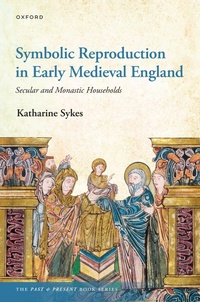
Symbolic Reproduction in Early Medieval England
Secular and Monastic Households
Published on 2. July 2024
Book
Hardback
240 pages
978-0-19-284475-0 (ISBN)
Description
In the early Middle Ages, the conversion of the early English kingdoms acted as a catalyst for significant social and cultural change. One of the most visible of these changes was the introduction of a new type of household: the monastic household. These reproduced through education and training, rather than biological means; their inhabitants practised celibacy as a lifelong state, rather than as a stage in the life course. Because monastic households depended on secular households to produce the next generation of recruits, previous studies have tended to view them as more mutable than their secular counterparts, which are implicitly regarded as natural and ahistorical.
Katharine Sykes charts some of the significant changes to the structure of households between the seventh to eleventh centuries, as ideas of spiritual, non-biological reproduction first fostered in monastic households were adopted in royal households in the tenth and eleventh centuries, and as ideas about kinship that were generated in secular households, such as the relationship between genealogy and inheritance, were picked up and applied by their monastic counterparts. In place of binary divisions between secular and monastic, biological and spiritual, real and imagined, Sykes demonstrates that different forms of kinship and reproduction in this period were intimately linked.
Katharine Sykes charts some of the significant changes to the structure of households between the seventh to eleventh centuries, as ideas of spiritual, non-biological reproduction first fostered in monastic households were adopted in royal households in the tenth and eleventh centuries, and as ideas about kinship that were generated in secular households, such as the relationship between genealogy and inheritance, were picked up and applied by their monastic counterparts. In place of binary divisions between secular and monastic, biological and spiritual, real and imagined, Sykes demonstrates that different forms of kinship and reproduction in this period were intimately linked.
Reviews / Votes
Symbolic Reproduction's insights about gender, authority, economy and kingship feel sharp and fresh, as well as grounded in the wider scholarly context. This book is a valuable addition to thescholarship about the place of the household and the experience of everyday life in the Middle Ages. * Louise Campion, Journal of Religious History *More details
Series
Language
English
Place of publication
Oxford
United Kingdom
Target group
College/higher education
Product notice
sewn/stitched
Cloth over boards
Dimensions
Height: 226 mm
Width: 155 mm
Thickness: 23 mm
Weight
522 gr
ISBN-13
978-0-19-284475-0 (9780192844750)
Copyright in bibliographic data and cover images is held by Nielsen Book Services Limited or by the publishers or by their respective licensors: all rights reserved.
Schweitzer Classification
Other editions
Additional editions
E-Book
07/2024
1st Edition
OUP eBook
€83.49
Available for download
E-Book
06/2024
1st Edition
OUP eBook
€83.49
Available for download
Person
Katharine Sykes is Associate Professor in Early Medieval History at the University of Birmingham. She studied Modern History (Oxford) and Medieval Studies (York), before completing a DPhil in Medieval History at Oxford. She held a series of research and teaching posts, including the John Cowdrey Junior Research Fellowship in Medieval History at St Edmund Hall, Oxford, before joining the University of Birmingham in 2016.
Content
Acknowledgements
Abbreviations
Introduction: the household in early medieval England
1: The reproduction of mothering: reconfiguring households in the seventh and eighth centuries
2: The traffic in women: gender, value, and exchange, 600-850
3: The mirror stage: reforming royal and monastic households, c.850-c.1100
4: Speculum of the other woman: embroidering maternal genealogies, c.950-c.1100
Conclusions: the reproduction of households in early medieval England
Bibliography
Index
Abbreviations
Introduction: the household in early medieval England
1: The reproduction of mothering: reconfiguring households in the seventh and eighth centuries
2: The traffic in women: gender, value, and exchange, 600-850
3: The mirror stage: reforming royal and monastic households, c.850-c.1100
4: Speculum of the other woman: embroidering maternal genealogies, c.950-c.1100
Conclusions: the reproduction of households in early medieval England
Bibliography
Index