

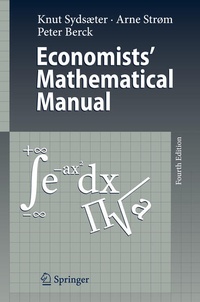
Economists' Mathematical Manual
4th Edition
Published on 19. July 2005
Book
Hardback
XII, 225 pages
978-3-540-26088-2 (ISBN)
Description
The fourth edition is augmented by more than 70 new formulas. In particular, we have included some key concepts and results from trade theory, games of incomplete information and combinatorics. In addition there are scattered additions of new formulas in many chapters. Again we are indebted to a number of people who has suggested corrections, - provements and new formulas. In particular, we would like to thank Jens-Henrik Madsen, Larry Karp, Harald Goldstein, and Geir Asheim. In a reference book, errors are particularly destructive. We hope that readers who ?nd our remaining errors will call them to our attention so that we may purge them from future editions. Oslo and Berkeley, May 2005 Knut Sydsaeter, Arne Strom, Peter Berck From the preface to the third edition Thepracticeofeconomicsrequiresawide-rangingknowledgeofformulasfrommat- matics, statistics, andmathematicaleconomics. Withthisvolumewehopetopresent a formulary tailored to the needs of students and working professionals in economics. In addition to a selection of mathematical and statistical formulas often used by economists, this volume contains many purely economic results and theorems.
It containsjusttheformulasandtheminimumcommentaryneededtorelearnthema- ematics involved. We have endeavored to state theorems at the level of generality economists might ?nd useful. In contrast to the economic maxim, "everything is twice more continuously di?erentiable than it needs to be", we have usually listed theregularityconditionsfortheoremstobetrue.Wehopethatwehaveachieveda level of explication that is accurate and useful without being pedantic.
It containsjusttheformulasandtheminimumcommentaryneededtorelearnthema- ematics involved. We have endeavored to state theorems at the level of generality economists might ?nd useful. In contrast to the economic maxim, "everything is twice more continuously di?erentiable than it needs to be", we have usually listed theregularityconditionsfortheoremstobetrue.Wehopethatwehaveachieveda level of explication that is accurate and useful without being pedantic.
More details
Edition
Fourth Edition 2005
Language
English
Place of publication
Berlin
Germany
Publishing group
Springer Berlin
Target group
Professional and scholarly
Research
Edition type
Revised edition
Illustrations
66 s/w Abbildungen
XII, 225 p. 66 illus.
Dimensions
Height: 241 mm
Width: 160 mm
Thickness: 18 mm
Weight
573 gr
ISBN-13
978-3-540-26088-2 (9783540260882)
DOI
10.1007/978-3-540-28518-2
Schweitzer Classification
Other editions
Additional editions
Knut Sydsaeter | Arne Strøm | Peter Berck
Economists' Mathematical Manual
Book
10/2010
4th Edition
Springer
€42.79
Shipment within 7-9 days
Knut Sydsaeter | Arne Strøm | Peter Berck
Economists' Mathematical Manual
E-Book
07/2010
4th Edition
Springer
€42.79
Available for download
Previous edition
Knut Sydsaeter | Arne Strøm | Peter Berck
Economists' Mathematical Manual
Book
08/2000
3rd Edition
Springer
€85.59
Article exhausted; check for reprint
Content
Set Theory. Relations. Functions.- Equations. Functions of one variable. Complex numbers.- Limits. Continuity. Differentiation (one variable).- Partial derivatives.- Elasticities. Elasticities of substitution.- Systems of equations.- Inequalities.- Series. Taylor's formula.- Integration.- Difference equations.- Differential equations.- Topology in Euclidean space.- Convexity.- Classical optimization.- Linear and nonlinear programming.- Calculus of variations and optimal control theory.- Discrete dynamic optimization.- Vectors in ?n. Abstract spaces.- Matrices.- Determinants.- Eigenvalues. Quadratic forms.- Special matrices. Leontief systems.- Kronecker products and the vec operator. Differentiation of vectors and matrices.- Comparative statics.- Properties of cost and profit functions.- Consumer theory.- Topics from trade theory.- Topics from finance and growth theory.- Risk and risk aversion theory.- Finance and stochastic calculus.- Non-cooperative game theory.- Combinatorics.- Probability and statistics.- Probability distributions.- Method of least squares.