

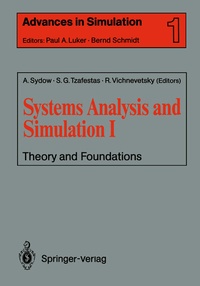
Systems Analysis and Simulation I
Theory and Foundations
Published on 1. November 1989
Book
Paperback/Softback
426 pages
978-0-387-97091-2 (ISBN)
Description
Computer simulation has developed into a powerful tool for problem solving in a variety of areas, in the sciences as well as in industrial environments. New developments such as parallel simulation techniques will further improve the efficiency of the tool. Decision support systems, either based on mathematical models or on knowledge based expert systems will make computer simulation accessible to more users, and will provide better environments for systems analysis, modeling and simulation.
Systems Analysis and
Simulation
presents the papers accepted for the 3rd International Symposium for Systems Analysis and Simulation held in Berlin (GDR) in September of 1988. The contributions selected for this two-volume set present the state of the art and current trends in computer simulation.
Volume I
emphasizes the theoretical foundations and the methodology for computer simulation and systems analysis.
Volume II
presents a variety of applications in fields such as manufacturing, robotics, economics, and biology.
More details
Series
Edition
Softcover reprint of the original 1st ed. 1988
Language
English
Place of publication
New York
United States
Target group
Professional and scholarly
Research
Illustrations
426 p.
Dimensions
Height: 244 mm
Width: 170 mm
Thickness: 24 mm
Weight
734 gr
ISBN-13
978-0-387-97091-2 (9780387970912)
DOI
10.1007/978-1-4684-6389-7
Schweitzer Classification
Other editions
Additional editions
Achim Sydow | Spyros G. Tzafestas | Robert Vichnevetsky
Systems Analysis and Simulation I
Theory and Foundations
E-Book
12/2012
Springer
€96.29
Available for download
Content
1. Methods and Fundamentals.- 1.1. Theory of Discrete Systems.- 1.2. Theory of Continuous Systems - Qualitative Theory.- 1.3. Decision Support Systems.- 1.4 Modelling.- 1.5. Multiobjective Optimization.- 1.6. Methods of Optimization and Control.- 2. Simulation Techniques.- 2.1. Simulation of Discrete Systems.- 2.2. Simulation of Continuous Systems.- 2.3. Parallel Simulation.- 2.4. Software Support.- 2.5. Simulation Environment.- 3. Methods of Knowledge Processing for Systems Analysis.