

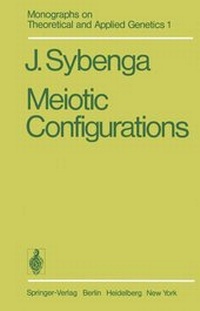
Meiotic Configurations
A Source of Information for Estimating Genetic Parameters
1st Edition
Published on 1. December 1975
Book
Hardback
X, 254 pages
978-3-540-07347-5 (ISBN)
Description
The aim of the monographs is to foster effective intra- and interdisciplinary communication between geneticists, and plant and animal breeders. This is to be achieved by publishing authoritative up-to-date texts; concise, but at the same time comprehensive, monographs, and multiauthor volumes on theoretical and applied genetics. The following broad fields of genetics and breeding are within the scope of the series: Evolutionary genetics Developmental genetics Population genetics Biochemical genetics Ecological genetics Somatic cell genetics Biometrical genetics Agricultural genetics Cytogenetics Mutation breeding Radiation genetics Breeding methodology Acceptable subjects for the Monographs on Theoretical and Applied Genetics are basic and applied aspects of genetic variation; genetic resources; genetic exchange and reproduction; mutagenesis; genotype-environment interaction; gene structure, regulation, action, expression and interaction; chromosomal and extrachromosomal inheritance of economic traits, and genetic models and simulations. September 1975 The Editors Preface Meiotic configurations are looked at from a special point of view in this book: the extraction from them of the maximal amount of quantitative information of genetic interest. Although this requires a certain understanding of their origin and consequences, much of what is known about chromosomes and their for mation into the special structures collected under the rather indiscriminate term I "configuration", is not considered relevant for this purpose, and simply neglected.
More details
Other editions
Additional editions
E-Book
12/2012
Springer
€96.29
Available for download
Book
12/2011
Springer
€106.99
Shipment within 7-9 days
Content
1. Introduction.- 1.1 Genetic Variation and Genetic Mechanisms.- 1.2 Meiosis as a Complex of Processes Regulating Recombination.- 1.3 The Three Central Elements of Meiosis: Chromosome Pairing, Crossing-over, Distribution.- 1.4 The Order of Analysis: Crossing-over-Chromosome Pairing-Distribution.- 1.5 The Nature and Quality of the Information Derived from Meiotic Configurations.- 2. The Analysis of Crossing-over.- 2.1 Unmarked Chromosomes.- 2.1.1 Crossing-over Estimated Directly from Chiasma Frequencies.- 2.1.1.1 Chiasma Frequency Estimates.- 2.1.1.2 Interference within Chromosomes.- 2.1.1.3 Interchromosome Effects.- 2.1.1.4 Chiasma Localization.- 2.1.1.5 Chiasma Frequency and Distribution in Relation to Internal and External Variables.- 2.1.2 Crossing-over Estimated by Inference from Metaphase Association in Diploids (Disomics) and Autotetraploids (Tetrasomics).- 2.1.2.1 The Relation between Metaphase Association and Crossing-over; Mapping Functions.- 2.1.2.2 Frequencies of Being "Bound" in Diploids (Disomics) and Autotetraploids (Tetrasomics).- 2.1.2.3 Interference.- 2.2 Marked Chromosomes: Structural Deviants.- 2.2.1 Telocentric Substitutions.- 2.2.2 Deficiencies.- 2.2.3 Inversions.- 2.2.3.1 Paracentric Inversions.- 2.2.3.1.1 Diplotene-Diakinesis.- 2.2.3.1.2 Anaphase.- 2.2.3.2 Pericentric Inversions.- 2.2.4 Reciprocal Translocations.- 2.2.4.1 Direct Estimates of Chiasma Frequencies.- 2.2.4.1.1 Metacentric Chromosomes.- 2.2.4.1.2 Acrocentric Chromosomes.- 2.2.4.2 Crossing-over Estimated from Metaphase Association.- 2.2.4.2.1 Metacentric Chromosomes.- 2.2.4.2.2 Interference.- 2.2.4.2.3 Interstitial Segments: Acrocentric and Metacentric Chromosomes.- 2.2.4.3 Crossing-over Estimated from Anaphase Segregations.- 2.2.4.4 Interchromosome Effects Involving Translocations.- 2.2.4.5 Telocentric Substitution in Reciprocal Translocations; Crossing-over Estimated from Metaphase Association; Interference.- 2.3 Numerical Markers.- 2.3.1 Primary Trisomics.- 2.3.2 Telocentric Trisomics and Monosomies for Normally Metacentric Chromosomes.- 3. The Analysis of Chromosome Pairing.- 3.1 Non-competitive Situations.- 3.1.1 Unmarked Chromosomes.- 3.1.2 The Relation between Cross-over Frequency and Synaptic Extent.- 3.1.3 The Location of Pairing Initiation.- 3.1.4 Indirect Observation: Post-Pachytene Configurations.- 3.2 Competitive Situations: Localization of Pairing Initiation Points; Pairing Differentiation.- 3.2.1 Trisomies.- 3.2.1.1 Primary Trisomies.- 3.2.1.2 Telocentric and Secondary Trisomies.- 3.2.1.3 Telocentric Trisomy in Telocentric Substitution.- 3.2.1.4 Translocation Trisomies and Telocentric Translocation Trisomies.- 3.2.1.5 Inversion Trisomies.- 3.2.2 Autopolyploids.- 3.2.2.1 Autopolyploids and Autopolysomics without Structural Rearrangements.- 3.2.2.2 Autopolyploids with Inversions.- 3.2.2.3 Autopolyploids with Translocations.- 3.2.3 Allopolyploids.- 3.2.3.1 New Allopolyploids (Amphidiploids).- 3.2.3.2 Established Allopolyploids.- 3.2.3.3 Secondary Association.- 4. The Analysis of Distribution: Centromere Coorientation.- 4.1 Orientation and Reorientation in Bivalents; Independence and Interdependence.- 4.2 Orientation and Reorientation in Multivalents; Interchange Heterozygotes and Polysomics.- References.- Author and Subject Index.