

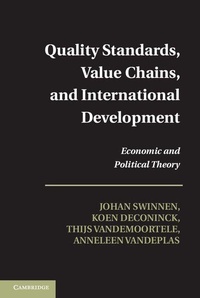
Quality Standards, Value Chains, and International Development
Economic and Political Theory
Published on 28. July 2015
Book
Hardback
342 pages
978-1-107-02591-2 (ISBN)
Description
Over the past decades, the world has witnessed an unprecedented growth in global value chains, propelled by increasingly demanding quality standards. These trends lead to concerns about the impact of value chains on development and poverty and about the possible protectionist nature of quality standards in rich countries. This book offers the first integrated theoretical analysis of the economic and political factors which determine the level of quality standards, as well as their economic effects along the value chain. Using realistic assumptions motivated by empirical research, the theoretical framework in this book makes it possible to study the efficiency effects as well as the distributional consequences of one of the most striking evolutions affecting global trade and development today.
Reviews / Votes
'With this book Jo Swinnen et al. make an important contribution to our understanding of the economics of standards. They develop an elegant theoretical approach to analyze the complex interplay between the different interest groups that can influence quality standards in food value chains. Who gains, who loses, and why do inefficient levels of standards persist? The book should entice others to test empirically the rich body of theoretical conclusions it offers.' Ken Ash, Director, Organisation for Economic Co-operation and Development 'Product quality standards in value chains are now central to development and trade policy. Swinnen et al. break new ground by laying out an intuitive theory of the role (and political economy) of product quality standards and then interpreting the growing - and mixed - empirical evidence on the topic through the lens of their theory. This breakthrough study should be a key reference for years to come.' Chris Barrett, Cornell University 'Value chains allow firms and farmers to connect to world markets if they satisfy product standards. Who sets standards? What are their effects? Who benefits? The analytical framework developed by the authors is a major contribution in understanding the political economy of standards and the impacts of value chain trade.' Bernard Hoekman, European University Institute 'This book is an extremely valuable contribution to the literature by theoretically modeling the role of standards in coordination in global value chains and the political economy of their formation. Public standards and especially private standards have skyrocketed in importance in world trade over the past decade so the book is a timely conceptualization of this trend.' Thomas Reardon, Michigan State University 'Rarely has such an important field of study - that of value chains, quality standards, and development - struggled so much to find a solid theoretical foundation. This book brings this struggle to an end. In a series of creative, state-of-the-art, readable chapters, the authors from the Leuven School bring the field of economics work of the highest standard of quality to the study of quality standards and more.' Scott Rozelle, Stanford University 'In the modern world, agriculture can be understood only in the broader context of the global food system. This publication is a comprehensive and mind-setting theory of this new reality. The authors break away from the stereotypes of the development agenda regarding food systems. One of the values of the book is its contemplation of the problems from both the economic and political perspectives.' Eugenia Serova, Director, Food and Agriculture Organization of the United Nations 'Jo Swinnen and his co-authors provide a thought-provoking and timely guide to the economics and politics of the rapidly changing world of differentiated products, supply chains, and product quality regulations. It is a well-written book, rich in conceptual insights and fascinating information. A must-read for students of international trade and marketing in the twenty-first century.' David Zilberman, University of California, BerkeleyMore details
Language
English
Place of publication
Cambridge
United Kingdom
Target group
Professional and scholarly
College/higher education
Illustrations
35 Line drawings, unspecified
Dimensions
Height: 235 mm
Width: 157 mm
Thickness: 25 mm
Weight
707 gr
ISBN-13
978-1-107-02591-2 (9781107025912)
Copyright in bibliographic data and cover images is held by Nielsen Book Services Limited or by the publishers or by their respective licensors: all rights reserved.
Schweitzer Classification
Other editions
Additional editions
Johan Swinnen | Koen Deconinck | Thijs Vandemoortele
Quality Standards, Value Chains, and International Development
Economic and Political Theory
E-Book
07/2015
Cambridge University Press
€32.49
Available for download
Johan Swinnen | Koen Deconinck | Thijs Vandemoortele
Quality Standards, Value Chains, and International Development
Economic and Political Theory
Book
07/2015
Cambridge University Press
€56.10
Shipment within 15-20 days
Johan Swinnen
Quality Standards, Value Chains, and International Development
Economic and Political Theory
E-Book
07/2015
Cambridge University Press
€28.49
Available for download
Persons
Johan Swinnen is Professor of Economics and Director of the LICOS Centre for Institutions and Economic Performance at the University of Leuven (KU Leuven). He is Senior Research Fellow at the Centre for European Policy Studies and Visiting Scholar at the Centre for Food Security and the Environment at Stanford University. Previously he was Lead Economist at the World Bank and Economic Advisor at the European Commission. He has published widely on political economy, institutional reform, trade, and global value chains. His books include Political Power and Economic Policy, Global Supply Chains, Standards and the Poor, Foreign Direct Investment and Human Development, Private Standards and Global Governance, and From Marx and Mao to the Market. Koen Deconinck is a senior research affiliate at the LICOS Centre for Institutions and Economic Performance at KU Leuven. Previously he was a visiting researcher at the Organisation for Economic Co-operation and Development and at the University of California, Davis. His research has been published in international journals such as Business History, the American Journal of Agricultural Economics, and Food Policy. Thijs Vandemoortele currently works for Caterpillar Distribution Services Europe and is a senior research affiliate with the LICOS Centre for Institutions and Economic Performance at KU Leuven. Previously he was a visiting researcher at the Organisation for Economic Co-operation and Development and at the University of California, Berkeley. His research has been published in The World Trade Review, The World Economy, the European Review of Agricultural Economics, and the Review of Development Economics. Anneleen Vandeplas works as an economist for the European Commission and is a senior research affiliate with the LICOS Centre for Institutions and Economic Performance at KU Leuven. Previously she was visiting professor at the University of Hasselt and visiting researcher at the International Food Policy Research Institute (New Delhi). Her work has been published in international journals including the World Bank Economic Review, the Journal of Development Studies, the Journal of Agricultural Economics, and World Development.
Content
1. Introduction; 2. Modelling standards; 3. Efficiency and equity effects of standards; 4. The political economy of standards and development; 5. International trade and standards; 6. Risks, externalities and the nature of standards; 7. Endogenous private and public standards in value chains; 8. Butterflies and political economy dynamics in standard setting; 9. The political economy of standards and inclusion in value chains; 10. Standards, production structure and inclusion in value chains; 11. Standards, market imperfections and vertical coordination in value chains; 12. Market power and vertical coordination in value chains; 13. Price transmission in value chains; 14. Commodity characteristics and value chain governance; 15. Economic liberalisation, value chains and development; 16. Standards and value chains with contracting costs: towards a general model; 17. General equilibrium effects of standards in value chains.