


Revelation
From Metaphor to Analogy
2nd Edition
Published on 26. July 2007
Book
Paperback/Softback
384 pages
978-0-19-921247-7 (ISBN)
Description
The great religions often claim that their books or creeds contain truths revealed by God. How could we know that they do? In the second edition of Revelation, renowned philosopher of religion Richard Swinburne addresses this central question. But since the books of great religions often contain much poetry and parable, Swinburne begins by investigating how eternal truth can be conveyed in unfamiliar genres, by analogy and metaphor, within false presuppositions about science and history. In the final part of the book, Swinburne then applies the results of Parts I and II to assessing the evidence that the teaching of the Christian Church constitutes a revelation from God.
In the course of his philosophical exploration, Swinburne considers how the church which Jesus founded is to be identified today and presents a sustained discussion of which passages in the Bible should be understood literally and which should be understood metaphorically.
This is a fuller and entirely rewritten second edition of Revelation, the most notable new feature of which is a long chapter examining whether traditional Christian claims about personal morality (divorce, homosexuality, abortion, etc.) can be regarded as revealed truths. A formal appendix shows how the structure of evidence supporting the Christian revelation can be articulated in terms of the probability calculus (and shows that Plantinga's well-known argument from 'dwindling probabilities' against probabilistic arguments of this kind is not cogent).
In the course of his philosophical exploration, Swinburne considers how the church which Jesus founded is to be identified today and presents a sustained discussion of which passages in the Bible should be understood literally and which should be understood metaphorically.
This is a fuller and entirely rewritten second edition of Revelation, the most notable new feature of which is a long chapter examining whether traditional Christian claims about personal morality (divorce, homosexuality, abortion, etc.) can be regarded as revealed truths. A formal appendix shows how the structure of evidence supporting the Christian revelation can be articulated in terms of the probability calculus (and shows that Plantinga's well-known argument from 'dwindling probabilities' against probabilistic arguments of this kind is not cogent).
Reviews / Votes
Review from previous edition This book succeeds very well in mapping the major issues involved in establishing the credibility of central Christian claims about divine revelation. ... In an admirable fashion Swinburne clearly distinguishes revelation from biblical inspiration, highlights the role of the Church in establishing the canon, and insists on the indispensable place of credal and doctrinal texts in biblical interpretation. ... This book would be a first-rate text for graduate (and superior undergraduate) students concerned with major issues of revelation. For that reason alone I was very glad to see it issued simultaneously in hardback and paperback. * Heythrop Journal * The issue is pursued with the clarity and philosophical precision for which Swinburne's work is rightly renowned ... The case that Swinburne argues is a careful, logical one. * Journal of Theological Studies * Written to the highest academic standards ... should be included in libraries catering for postgraduate courses in the philosophy of religion. * Theological Book Review * Swinburne has once again produced an outstanding work in philosophy of religion. * The Philosophical Review * Historically rich but theologically controversial book. * Faith and Philosophy *More details
Edition
2nd Revised edition
Language
English
Place of publication
Oxford
United Kingdom
Target group
Professional and scholarly
Edition type
Revised edition
Dimensions
Height: 216 mm
Width: 140 mm
Thickness: 23 mm
Weight
540 gr
ISBN-13
978-0-19-921247-7 (9780199212477)
Copyright in bibliographic data and cover images is held by Nielsen Book Services Limited or by the publishers or by their respective licensors: all rights reserved.
Schweitzer Classification
Other editions
Additional editions
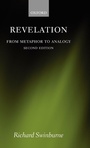
Book
07/2007
2nd Edition
Oxford University Press
€96.70
Shipment within 15-20 days
E-Book
07/2007
2nd Edition
OUP eBook
€41.99
Available for download
Previous edition
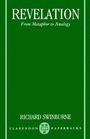
Book
12/1991
Clarendon Press
€23.55
Article exhausted; check for reprint
Person
Content
PART I: MEANING ; PART II: EVIDENCE OF A REVELATION ; PART III: THE CHRISTIAN REVELATION