

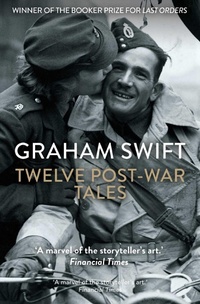
Twelve Post-War Tales
'A marvel of the storyteller's art', Financial Times
Published on 7. May 2026
Book
Paperback/Softback
304 pages
978-1-3985-3551-0 (ISBN)
Description
The remarkable new work of fiction from the Booker Prize-winning author of Last Orders, Waterland and Mothering Sunday
'His archly modulated, precise prose, reminiscent at times of his friend Kazuo Ishiguro's, has lost none of its power ... immensely readable late-career Swift from start to finish, Twelve Post-War Tales is a marvel of the storyteller's art.' Financial Times
'There can surely be no better contemporary writer to take on history's circularities that Graham Swift. ... "Growing up in the 1950s there was all the evidence of war." Swift has said. This beautiful cluster of stories shows how vital it remains in recollection.' Observer
'Skilful, generous and humane, these 12 tales suggest the complexity and heartbreak of being engaged on such an uncertain journey.' Guardian
'The characters in this collection share their thoughts and memories with the reader as though with a close friend, and the warmth of their confidences balances against their sadness. We feel we've been in the trenches with them, even when a story has gone no farther than the living room.' Wall Street Journal
'These stories, depth charges of love, anguish, resentment, each in their way relating to the effects of WW2, are so good. Swift at his best - and he's on top form here - has the humanity and wry humour of William Trevor', Patrick Gale
'Quite wonderful. Such grace and clarity - I'm filled with admiration', Philip Pullman
In the aftermath of the Second World War Private Joseph Caan, a young Jewish soldier stationed in Germany, seeks the truth about lost family members; in the 1960s a father focuses on his daughter's wedding even as the Cuban Missile Crisis brings the world to the brink of disaster; in 2001, while planes fly into the Twin Towers, a maid working for US Embassy staff in London wonders if her birth on the day of the Kennedy assassination shaped her life; and at the height of a pandemic lockdown, Dr. Cole, a retired specialist in respiratory disease, returns to work and recalls a formative childhood encounter with illness and much more. These are just a few of the challenged characters we meet in Graham Swift's Twelve Post-war Tales.
Tender, humane, funny and moving, Swift's latest work of fiction displays his quietly commanding ability to set the personal and the ordinary against the harsh sweep of history. It is an outstanding achievement, confirming his status as one of the great and subtlest voices of our age.
'His archly modulated, precise prose, reminiscent at times of his friend Kazuo Ishiguro's, has lost none of its power ... immensely readable late-career Swift from start to finish, Twelve Post-War Tales is a marvel of the storyteller's art.' Financial Times
'There can surely be no better contemporary writer to take on history's circularities that Graham Swift. ... "Growing up in the 1950s there was all the evidence of war." Swift has said. This beautiful cluster of stories shows how vital it remains in recollection.' Observer
'Skilful, generous and humane, these 12 tales suggest the complexity and heartbreak of being engaged on such an uncertain journey.' Guardian
'The characters in this collection share their thoughts and memories with the reader as though with a close friend, and the warmth of their confidences balances against their sadness. We feel we've been in the trenches with them, even when a story has gone no farther than the living room.' Wall Street Journal
'These stories, depth charges of love, anguish, resentment, each in their way relating to the effects of WW2, are so good. Swift at his best - and he's on top form here - has the humanity and wry humour of William Trevor', Patrick Gale
'Quite wonderful. Such grace and clarity - I'm filled with admiration', Philip Pullman
In the aftermath of the Second World War Private Joseph Caan, a young Jewish soldier stationed in Germany, seeks the truth about lost family members; in the 1960s a father focuses on his daughter's wedding even as the Cuban Missile Crisis brings the world to the brink of disaster; in 2001, while planes fly into the Twin Towers, a maid working for US Embassy staff in London wonders if her birth on the day of the Kennedy assassination shaped her life; and at the height of a pandemic lockdown, Dr. Cole, a retired specialist in respiratory disease, returns to work and recalls a formative childhood encounter with illness and much more. These are just a few of the challenged characters we meet in Graham Swift's Twelve Post-war Tales.
Tender, humane, funny and moving, Swift's latest work of fiction displays his quietly commanding ability to set the personal and the ordinary against the harsh sweep of history. It is an outstanding achievement, confirming his status as one of the great and subtlest voices of our age.
More details
Language
English
Place of publication
London
United Kingdom
Publishing group
Simon & Schuster Ltd
Product notice
Paperback (UK-B)
Dimensions
Height: 196 mm
Width: 126 mm
Thickness: 24 mm
Weight
272 gr
ISBN-13
978-1-3985-3551-0 (9781398535510)
Copyright in bibliographic data and cover images is held by Nielsen Book Services Limited or by the publishers or by their respective licensors: all rights reserved.
Schweitzer Classification
Other editions
Additional editions
E-Book
05/2025
Simon + Schuster LLC
€6.44
Available for download
Book
05/2025
Scribner UK
€24.50
Available immediately
Person
Graham Swift was born in 1949. He is the author of eleven novels, most recently Here We Are; three collections of short stories, including the highly praised England and Other Stories; and Making an Elephant, a book of essays, portraits, poetry and reflections on his life in writing. With Waterland he won the Guardian Fiction Prize and with Last Orders the Booker Prize. Mothering Sunday became a worldwide bestseller and won the Hawthornden Prize for best work of imaginative literature. All three novels were made into films. His books have appeared in over thirty-five languages.