

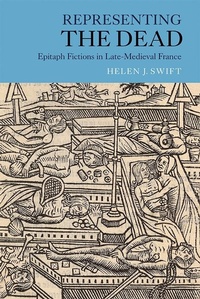
Representing the Dead
Epitaph Fictions in Late-Medieval France
Published on 20. October 2016
Book
Hardback
354 pages
978-1-84384-436-5 (ISBN)
Description
An examination of how the dead were memorialised in late medieval French literature.
Awarded a commendation in the Society for French Studies R. Gapper Book Prize for the best book published in 2016 by a scholar working in French studies in Britain or Ireland.
Who am I when I am dead? Several late-medieval French writers used literary representation of the dead as a springboard for exploring the nature of human being. Death is a critical moment for identity definition: one is remembered, forgotten or, worse, misremembered. Works in prose and verse by authors from Alain Chartier to Jean Bouchet record characters' deaths, but what distinguishes them as epitaph fictions is not their commemoration of the deceased, so much as their interrogation of how, by whom, and to what purpose posthumous identity is constituted. Far from rigidly memorialising the dead, they exhibit a productive messiness in the processes by which identity is composed in the moment of its decomposition as a complex interplay between body, voice and text. The cemeteries, hospitals, temples and testaments of fifteenth- and early-sixteenth-century literature, from the "Belle Dame sans mercy" querelle to Le Jugement poetic de l'honneur femenin, present a wealth of ambulant corpses, disembodied voices, animated effigies, martyrs for love and material echoes of the past which invite readers to approach epitaphic identity as a challenging question: here lies who, exactly? In its broadest context, this study casts fresh light on ideas of selfhood in medieval culture as well as on contemporary conceptions of the capacities and purposes of literary representation itself.
Helen Swift is Associate Professor of Medieval French at St Hilda's College, Oxford.
Awarded a commendation in the Society for French Studies R. Gapper Book Prize for the best book published in 2016 by a scholar working in French studies in Britain or Ireland.
Who am I when I am dead? Several late-medieval French writers used literary representation of the dead as a springboard for exploring the nature of human being. Death is a critical moment for identity definition: one is remembered, forgotten or, worse, misremembered. Works in prose and verse by authors from Alain Chartier to Jean Bouchet record characters' deaths, but what distinguishes them as epitaph fictions is not their commemoration of the deceased, so much as their interrogation of how, by whom, and to what purpose posthumous identity is constituted. Far from rigidly memorialising the dead, they exhibit a productive messiness in the processes by which identity is composed in the moment of its decomposition as a complex interplay between body, voice and text. The cemeteries, hospitals, temples and testaments of fifteenth- and early-sixteenth-century literature, from the "Belle Dame sans mercy" querelle to Le Jugement poetic de l'honneur femenin, present a wealth of ambulant corpses, disembodied voices, animated effigies, martyrs for love and material echoes of the past which invite readers to approach epitaphic identity as a challenging question: here lies who, exactly? In its broadest context, this study casts fresh light on ideas of selfhood in medieval culture as well as on contemporary conceptions of the capacities and purposes of literary representation itself.
Helen Swift is Associate Professor of Medieval French at St Hilda's College, Oxford.
Reviews / Votes
[The author's] findings, which take into account recent scholarship and critical theory, are of great use for all scholars interested in the relationship between identity (name, renown, reputation) and death. PARERGONOffers...fertile ground for readers of medieval French literature, who will be challenged by this book to rethink the question of what fiction is being performed when the epitaph speaks. * SPECULUM * The concept of 'epitaph fictions' announced in this study's subtitle thus introduces not simply a subgenre of metafiction, it also proposes a fresh and productive way of approaching the medieval literary treatment of death. * RENAISSANCE QUARTERLY * A lively and dazzling book, full to bursting with clever analyses, probing questions, vivid illustrations.and suggestive connections. * MODERN LANGUAGE REVIEW *More details
Series
Language
English
Place of publication
Cambridge
United Kingdom
Publishing group
Boydell & Brewer Ltd
Target group
College/higher education
Product notice
Cloth over boards
Illustrations
21 s/w Abbildungen, 5 farbige Abbildungen
5 colour, 21 b/w illus.
Dimensions
Height: 236 mm
Width: 152 mm
Thickness: 28 mm
Weight
930 gr
ISBN-13
978-1-84384-436-5 (9781843844365)
Copyright in bibliographic data and cover images is held by Nielsen Book Services Limited or by the publishers or by their respective licensors: all rights reserved.
Schweitzer Classification
Person
Helen J. Swift
Content
Introduction: Representing the Dead
Framing Identity: 'je suis' and 'cy gist'
Identity and/as Echo: the 'Belle Dame' querelle and Le Jardin de plaisance
Dying to be told: storytelling and exemplarity 'selon le stile Jehan Bocace'
Placing the Dead: Cemeteries, Hospitals and Temples
Afterword: Illustrating the dead
Coda: re-member me
Appendix: Early Editions of the Jardin de plaisance et fleur de rethorique
Bibliography
Framing Identity: 'je suis' and 'cy gist'
Identity and/as Echo: the 'Belle Dame' querelle and Le Jardin de plaisance
Dying to be told: storytelling and exemplarity 'selon le stile Jehan Bocace'
Placing the Dead: Cemeteries, Hospitals and Temples
Afterword: Illustrating the dead
Coda: re-member me
Appendix: Early Editions of the Jardin de plaisance et fleur de rethorique
Bibliography