

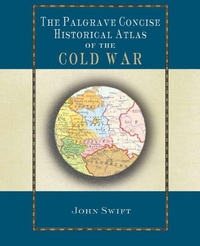
The Palgrave Concise Historical Atlas of the Cold War
Published on 30. October 2003
Book
Hardback
VII, 120 pages
978-0-333-99403-0 (ISBN)
Description
A historical atlas must depict complex issues in a manner immediately accessible to the reader. The Cold War has long needed such an atlas. With easily understood maps and text, this atlas meets this demand. Not only are the obvious issues addressed, such as Cuba, Berlin and so on, but the author also presents themes such as cultural issues and détente to the reader, presenting the Cold War in all its complexities in a form which is useful and understandable.
Reviews / Votes
Praise for books in the Palgrave Concise Historical Atlas Series:
"a useful text and library reference...can serve as a supplemental volume or stand alone as a short text" - Nationalities Papers
". . . a valuable tool for the classroom and the general public."-Multicultural Review
More details
Edition
2003 edition
Language
English
Place of publication
London
United Kingdom
Target group
Professional and scholarly
Product notice
sewn/stitched
Cloth over boards
With dust jacket
Illustrations
VII, 120 p.
Dimensions
Height: 243 mm
Width: 197 mm
Thickness: 14 mm
Weight
438 gr
ISBN-13
978-0-333-99403-0 (9780333994030)
DOI
10.1057/9780230001183
Schweitzer Classification
Other editions
Additional editions
Book
10/2003
Palgrave Macmillan
€58.84
Shipment within 15-20 days
Person
DR. JOHN SWIFT is a lecturer at St. Martin's College, Lancaster, and also an honorary research fellow at Lancaster University History Department. He is the author of
Labour in Crisis: Clement Attlee and the Labour Party in Opposition, 1931-34
and
Peter the Great
.
Content
Preface PART 1: THE ORIGINS OF THE COLD WAR The Russian Revolution and the World The Comintern and the Red Scare in the West in the 1920s Chaos and Communism in China, 1918-1939 Foreign Policy under Stalin The Grand Alliance in World War II The Zonal Division of Germany The End of the War Against Japan Eastern Europe 1944-1949 PART 2: THE HEIGHT OF THE COLD WAR The Truman Doctrine Marshall Aid The Berlin Blockade The Chinese Communist Victory NATO and the Warsaw Pact Other Regional Security Pacts The Malayan Emergency Korea: Partition and War Korea: The UN Intervenes Budapest, 1956 Eisenhower and Central America The Two Chinas The Cultural Revolution Cuba: Castro's Revolution and the Bay of Pigs The Cuban Missile Crisis The Sino-Soviet Split The Berlin Wall Culture and the Cold War Capitalism v. Communism in the 1960s The Peace Corps Southeast Asia: Partition and War Southeast Asia; American Intervention Southeast Asia: The Fall of the South The Non-Aligned Movement The Prague Spring Intelligence Gathering The Middle East Wars and the Threat to World Peace Détente in the 1970s The Arms Race Arms Sales and Military Assistance Nuclear Proliferation Capitalism v. Communism in the 1980s Nicaragua and the Sadanistas The Cold War in Africa The Soviet Invasion of Afghanistan The Early Reagan Years - Renewed Cold War PART 3: THE END OF THE COLD WAR AND AFTER Gorbachev's Reforms The Fall of Communism in Eastern Europe The Break-up of the USSR The Legacy of the Cold War: Yugoslavia The Legacy of the Cold War: Russia The Surviving Communist World Select Bibliography