

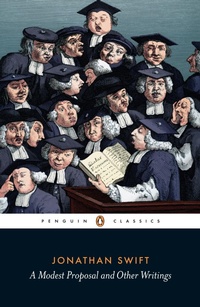
A Modest Proposal and Other Writings
Published on 24. September 2009
Book
Paperback/Softback
464 pages
978-0-14-043642-6 (ISBN)
Description
The Penguin Classics edition of Jonathan Swift's savagely satirical A Modest Proposal and Other Writings is edited with an introduction and notes by Carol Fabricant.
To ease poverty in Ireland by eating the children of the poor was the satirical 'solution' suggested by Jonathan Swift in his essay 'A Modest Proposal' (1729). Here Swift unleashes the full power of his ironic armoury and corrosive wit, finding his targets - the British ruling class and avaricious landlords, and the brutalized Irish, complicit in their own oppression - with deadly precision. His masterly essay is accompanied by a generous selection of prose works, among them pamphlets attacking British rule in his native Ireland, periodical essays critiquing the new capitalist and military classes, a journal detailing his political activities in London, a loving tribute to his beloved 'Stella' after her death and pieces on such diverse subjects as the absurdities of astrology, the joys of punning and comical rules for servants. Ingenious and unconventional, Swift is revealed here as one of the greatest satirists in the English language.
In her introduction to this new edition, Carol Fabricant discusses Swift's life and turbulent times, his political views and his powers as a writer of complex irony and intricate word play. This volume also includes a chronology, further reading, a glossary, notes and a biographical dictionary.
Jonathan Swift (1667-1745) was born in Dublin. Sent to Kilkenny Grammar School when he was six, Swift later attended Trinity College, Dublin, where he received his BA degree in 1686. He is considered the foremost prose satirist in the English language, which stemmed from his criticism of Britain's repressive colonial policies in Ireland. Among Swift's best known works are his ironic masterpiece, 'A Modest Proposal' (1729), and his novel, Gulliver's Travels (1726).
If you enjoyed A Modest Proposal, you might like Alexander Pope's The Rape of the Lock and Other Major Writings, also available in Penguin Classics.
To ease poverty in Ireland by eating the children of the poor was the satirical 'solution' suggested by Jonathan Swift in his essay 'A Modest Proposal' (1729). Here Swift unleashes the full power of his ironic armoury and corrosive wit, finding his targets - the British ruling class and avaricious landlords, and the brutalized Irish, complicit in their own oppression - with deadly precision. His masterly essay is accompanied by a generous selection of prose works, among them pamphlets attacking British rule in his native Ireland, periodical essays critiquing the new capitalist and military classes, a journal detailing his political activities in London, a loving tribute to his beloved 'Stella' after her death and pieces on such diverse subjects as the absurdities of astrology, the joys of punning and comical rules for servants. Ingenious and unconventional, Swift is revealed here as one of the greatest satirists in the English language.
In her introduction to this new edition, Carol Fabricant discusses Swift's life and turbulent times, his political views and his powers as a writer of complex irony and intricate word play. This volume also includes a chronology, further reading, a glossary, notes and a biographical dictionary.
Jonathan Swift (1667-1745) was born in Dublin. Sent to Kilkenny Grammar School when he was six, Swift later attended Trinity College, Dublin, where he received his BA degree in 1686. He is considered the foremost prose satirist in the English language, which stemmed from his criticism of Britain's repressive colonial policies in Ireland. Among Swift's best known works are his ironic masterpiece, 'A Modest Proposal' (1729), and his novel, Gulliver's Travels (1726).
If you enjoyed A Modest Proposal, you might like Alexander Pope's The Rape of the Lock and Other Major Writings, also available in Penguin Classics.
More details
Language
English
Place of publication
London
United Kingdom
Publishing group
Penguin Books Ltd
Product notice
Paperback (UK-B)
Dimensions
Height: 196 mm
Width: 130 mm
Thickness: 23 mm
Weight
329 gr
ISBN-13
978-0-14-043642-6 (9780140436426)
Copyright in bibliographic data and cover images is held by Nielsen Book Services Limited or by the publishers or by their respective licensors: all rights reserved.
Schweitzer Classification
Other editions
Additional editions

Jonathan Swift | Carole Fabricant
A Modest Proposal and Other Writings
E-Book
09/2009
1st Edition
Penguin Books Ltd
€9.49
Available for download
Persons
Jonathan Swift was born in Dublin on 30 November 1667, some months after his father's death. He was sent to Kilkenny Grammar School when he was six and later attended Trinity College, Dublin, where he received his BA degree in 1686. He is considered the foremost prose satirist in the English language, which stemmed from his criticism of Britain's repressive colonial policies in Ireland. Among Swift's best known works is his ironic masterpiece, 'A Modest Proposal' (1729), and his novel, Gulliver's Travels (1726). Swift died on 19 October 1745.
Carole Fabricant is Professor of English at the University of California, Riverside. She is the author of Swift's Landscape and has published widely on a number of eighteenth-century writers, including Alexander Pope, Edmund Burke and Bishop Berkeley, as well as on topics such as landscape gardening, travel, tourism and questions of colonialism and race in the eighteenth-centruy, especially as they relate to British-Irish relations during the period.
Carole Fabricant is Professor of English at the University of California, Riverside. She is the author of Swift's Landscape and has published widely on a number of eighteenth-century writers, including Alexander Pope, Edmund Burke and Bishop Berkeley, as well as on topics such as landscape gardening, travel, tourism and questions of colonialism and race in the eighteenth-centruy, especially as they relate to British-Irish relations during the period.