

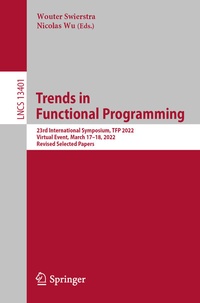
Trends in Functional Programming
23rd International Symposium, TFP 2022, Virtual Event, March 17-18, 2022, Revised Selected Papers
Published on 2. January 2023
Book
Paperback/Softback
VII, 193 pages
978-3-031-21313-7 (ISBN)
Description
This book constitutes revised selected papers from the 23rd International Symposium on Trends in Functional Programming, TFP 2022, which was held virtually in March 2022.
The 9 full papers presented in this volume were carefully reviewed and selected from 17 submissions. They deal with all aspects of functional programming, taking a broad view of current and future trends in the area.
The 9 full papers presented in this volume were carefully reviewed and selected from 17 submissions. They deal with all aspects of functional programming, taking a broad view of current and future trends in the area.
More details
Series
Edition
1st ed. 2022
Language
English
Place of publication
Cham
Switzerland
Publishing group
Springer International Publishing
Target group
Professional and scholarly
Illustrations
686 s/w Abbildungen, 11 farbige Abbildungen
VII, 193 p. 697 illus., 11 illus. in color.
Dimensions
Height: 235 mm
Width: 155 mm
Thickness: 12 mm
Weight
318 gr
ISBN-13
978-3-031-21313-7 (9783031213137)
DOI
10.1007/978-3-031-21314-4
Schweitzer Classification
Other editions
Additional editions
Wouter Swierstra | Nicolas Wu
Trends in Functional Programming
23rd International Symposium, TFP 2022, Virtual Event, March 17-18, 2022, Revised Selected Papers
E-Book
01/2023
Springer
€48.14
Available for download
Content
Embedding generic monadic transformer into Scala (Project Paper).- Towards a Language for Defining Reusable Programming Language Components (Project Paper).- Deep Embedding with Class.- Understanding Algebraic Effect Handlers via Delimited Control Operators.- Reducing the Power Consumption of IoT with Task-Oriented Programming.- Semantic equivalence of task-oriented programs in TopHat.- Algorithm Design with the Selection Monad.- Sound and Complete Type Inference for Closed Effect Rows.- Towards Efficient Adjustment of Effect Rows.