

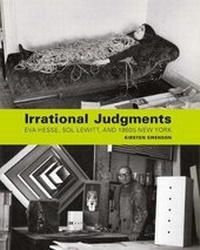
Irrational Judgments
Eva Hesse, Sol LeWitt, and 1960s New York
Published on 26. November 2015
Book
Hardback
200 pages
978-0-300-21156-6 (ISBN)
Description
An intimate study of the friendship and creative dialogue between two artists, offering an in-depth understanding of their work and the upheavals of 1960s New York
Irrational Judgments examines the close friendship and significant exchange of ideas between Eva Hesse (1936-1970) and Sol LeWitt (1928-2007) in New York City during the 1960s. Taking its title from LeWitt's statement "Irrational judgments lead to new experience," this book examines the breakthroughs of the artists' intertwined careers, offering a new understanding of minimal, post-minimal, and conceptual art amid the era's political and social upheavals.
Kirsten Swenson offers the first in-depth discussion of the early critical developments of each artist: LeWitt's turn from commercial design to fine art, and Hesse's move from expressionist painting to reliefs and sculpture. Bringing together a wealth of documents, interviews, and images-many published here for the first time-this handsome publication presents an insightful account of the artists' influence on and support for each other's pursuit of an experimental practice. Swenson's analysis expands our understanding of the artists' ideas, the importance of their work, and, more broadly, the relationship of the 1960s New York art world to gender politics, the Vietnam War, and the city itself.
Irrational Judgments examines the close friendship and significant exchange of ideas between Eva Hesse (1936-1970) and Sol LeWitt (1928-2007) in New York City during the 1960s. Taking its title from LeWitt's statement "Irrational judgments lead to new experience," this book examines the breakthroughs of the artists' intertwined careers, offering a new understanding of minimal, post-minimal, and conceptual art amid the era's political and social upheavals.
Kirsten Swenson offers the first in-depth discussion of the early critical developments of each artist: LeWitt's turn from commercial design to fine art, and Hesse's move from expressionist painting to reliefs and sculpture. Bringing together a wealth of documents, interviews, and images-many published here for the first time-this handsome publication presents an insightful account of the artists' influence on and support for each other's pursuit of an experimental practice. Swenson's analysis expands our understanding of the artists' ideas, the importance of their work, and, more broadly, the relationship of the 1960s New York art world to gender politics, the Vietnam War, and the city itself.
Reviews / Votes
"Kirsten Swenson presents a nuanced argument of the period and the artists, and she places the relationship between LeWitt and Hesse at the center of it."-Elisabeth Sussman, Whitney Museum of American Art "Kirsten Swenson presents a nuanced argument of the period and the artists, and she places the relationship between LeWitt and Hesse at the center of it."-Elisabeth Sussman, Whitney Museum of American Art -- Elisabeth Sussman, Whitney Museum of American Art "This stellar account of Hesse and LeWitt's friendship, as well as their exhibitions and installations, will deepen readers' understanding of these groundbreaking artists."-Publishers Weekly * Publishers Weekly *More details
Language
English
Place of publication
United States
Target group
Professional and scholarly
Product notice
Cloth over boards
Illustrations
33 color + 46 b-w illus.
Dimensions
Height: 229 mm
Width: 178 mm
Weight
816 gr
ISBN-13
978-0-300-21156-6 (9780300211566)
Copyright in bibliographic data and cover images is held by Nielsen Book Services Limited or by the publishers or by their respective licensors: all rights reserved.
Schweitzer Classification
Other editions
Additional editions
E-Book
11/2015
1st Edition
De Gruyter
€43.20
Available for download
Person
Kirsten Swenson is assistant professor of art history, University of Massachusetts, Lowell.