

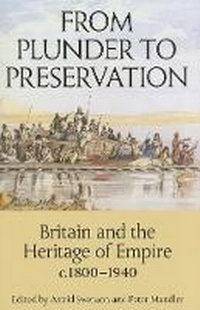
From Plunder to Preservation
Britain and the Heritage of Empire, c.1800-1940
Published on 30. May 2013
Book
Hardback
400 pages
978-0-19-726541-3 (ISBN)
Description
What was the effect of the British Empire on the cultures and civilisations of the peoples over whom it ruled? This book takes a novel approach to this important and controversial subject by considering the impact of empire on the idea of 'heritage'. It reveals a dazzling variety of attitudes on the part of the imperialists - from frank 'plunder' of American, Asian, African and Pacific peoples' cultural artefacts and monuments to a growing appreciation of the need for 'preservation' of the world's heritage in the places it originated. But it goes beyond the empire-centred view to consider how far colonised peoples themselves were able to embed indigenous understandings of their heritage in the empire, and how indeed the empire was very often dependent on indigenous knowledge for its own functioning. This book will therefore appeal to those interested in the history of the British Empire in all parts of the world, and also to the burgeoning audience for writing on 'world heritage' - the movement pioneered by UNESCO to move beyond a Eurocentric idea of heritage and to identify cultural value in all of the historical productions of the world's peoples. Its case studies and unusual illustrations range from an extraordinary Anglo-African cathedral in the Sudan to palm leaf manuscripts in Sri Lanka, from Mayan and Indian temples to Shakespeare's Birthplace and Hadrian's Wall. Together they provide a vivid story of how our current understanding of the diverse heritages of world history was forged in the crucible of the British Empire. What was the effect of the British Empire on the cultures and civilizations of the peoples over whom it ruled? This book takes a novel approach to this important and controversial subject by considering the impact of empire on the idea of 'heritage'. It reveals a dazzling variety of attitudes on the part of the imperialists - from frank 'plunder' of American, Asian, African and Pacific peoples' cultural artefacts and monuments to a growing appreciation of the need for 'preservation' of the world's heritage in the places it originated. But it goes beyond the empire-centred view to consider how far colonized peoples themselves were able to embed indigenous understandings of their heritage in the empire, and how indeed the empire was very often dependent on indigenous knowledge for its own functioning. This book will therefore appeal to those interested in the history of the British Empire in all parts of the world, and also to the burgeoning audience for writing on 'world heritage' - the movement pioneered by UNESCO to move beyond a Eurocentric idea of heritage and to identify cultural value in all of the historical productions of the world's peoples. Its case studies and unusual illustrations range from an extraordinary Anglo-African cathedral in the Sudan to palm leaf manuscripts in Sri Lanka, from Mayan and Indian temples to Shakespeare's Birthplace and Hadrian's Wall. Together they provide a vivid story of how our current understanding of the diverse heritages of world history was forged in the crucible of the British Empire.
Reviews / Votes
... lively, handsomely produced and beautifully illustrated collections of essays ... * Times Literary Supplement *More details
Series
Language
English
Place of publication
Oxford
United Kingdom
Target group
College/higher education
Professional and scholarly
Illustrations
c. 50 b&w halftones
Dimensions
Height: 243 mm
Width: 168 mm
Thickness: 24 mm
Weight
750 gr
ISBN-13
978-0-19-726541-3 (9780197265413)
Copyright in bibliographic data and cover images is held by Nielsen Book Services Limited or by the publishers or by their respective licensors: all rights reserved.
Schweitzer Classification
Persons
Astrid Swenson is a Lecturer in European History at Brunel University London. She received her Ph.D from St. John's College Cambridge and was a Research Fellow at the University of Cambridge in the Cambridge Victorian Studies Group and a Fellow of Darwin College. Her book The Rise of Heritage: Preserving the past in France, Germany and Britain, 1789-1914 is forthcoming with Cambridge University Press.
Peter Mandler is Professor of Modern Cultural History at the University of Cambridge and Bailey College Lecturer in History at Gonville and Caius College. His book Return from the natives: How Margaret Mead won the Second World War and lost the Cold War is forthcoming with Yale University Press. From November 2012 he will be President of the Royal Historical Society.
Peter Mandler is Professor of Modern Cultural History at the University of Cambridge and Bailey College Lecturer in History at Gonville and Caius College. His book Return from the natives: How Margaret Mead won the Second World War and lost the Cold War is forthcoming with Yale University Press. From November 2012 he will be President of the Royal Historical Society.
Content
Part I: Introduction
1: Astrid Swanson: The Heritage of Empire'
Part II: The Classical World
2: Edmund Richardson: Of Doubtful Antiquity
3: Mary Beard: Officers and Gentlemen? Roman Britain and the British Empire
4: Robin Cormack: Unity out of Diversity? The Making of a Modern Christian Monument in Anglo-Egyptian Sudan
Part III: The Biblical World
5: David Gange: Unholy Water: Archaeology, the Bible, and the First Aswan Dam
6: Simon Goldhill: The Cotswolds in Jerusalem: Restoration and Empire
Part IV: Empires and Civilisations
7: Sujit Sivasundaram: Remaking the Native in the South Pacific, South-East Asia and Southern Africa
8: Indra Sengupta: Monument Preservation and the Vexing Question of Religious Structures in Colonial India
9: Donald Malcolm Reid: Representing Ancient Egypt at Imperial High Noon (1882-1922): Egyptological Careers and Artistic Allegories of Civilization'
Part V: The New World
10: Donna Yates: Publication as Preservation at a Remote Maya Site in the Early Twentieth Century
11: Melanie Hall: Plunder or Preservation? Negotiating an Anglo-American Heritage in the Later Nineteenth Century in the Old World and the New: Shakespeare's Birthplace, Niagara Fall and Carlyle's House
12: Sadiah Qureshi: Dying Americans: Race, Extinction and Conservation in the New World
1: Astrid Swanson: The Heritage of Empire'
Part II: The Classical World
2: Edmund Richardson: Of Doubtful Antiquity
3: Mary Beard: Officers and Gentlemen? Roman Britain and the British Empire
4: Robin Cormack: Unity out of Diversity? The Making of a Modern Christian Monument in Anglo-Egyptian Sudan
Part III: The Biblical World
5: David Gange: Unholy Water: Archaeology, the Bible, and the First Aswan Dam
6: Simon Goldhill: The Cotswolds in Jerusalem: Restoration and Empire
Part IV: Empires and Civilisations
7: Sujit Sivasundaram: Remaking the Native in the South Pacific, South-East Asia and Southern Africa
8: Indra Sengupta: Monument Preservation and the Vexing Question of Religious Structures in Colonial India
9: Donald Malcolm Reid: Representing Ancient Egypt at Imperial High Noon (1882-1922): Egyptological Careers and Artistic Allegories of Civilization'
Part V: The New World
10: Donna Yates: Publication as Preservation at a Remote Maya Site in the Early Twentieth Century
11: Melanie Hall: Plunder or Preservation? Negotiating an Anglo-American Heritage in the Later Nineteenth Century in the Old World and the New: Shakespeare's Birthplace, Niagara Fall and Carlyle's House
12: Sadiah Qureshi: Dying Americans: Race, Extinction and Conservation in the New World