

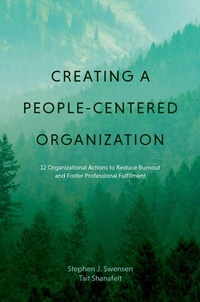
Creating a People-Centered Organization
12 Organizational Actions to Reduce Burnout and Foster Professional Fulfillment
2nd Edition
Will be published approx. on 1. August 2026
Book
Paperback/Softback
384 pages
978-0-19-782527-3 (ISBN)
Description
Creating a People-Centered Organization offers a structured framework for improving workplace culture in clinical settings. Grounded in research and executive leadership experience, the authors present twelve organizational actions that reduce burnout and promote professional fulfilment among healthcare professionals.
Rather than focusing on occupational distress, burnout, moral injury, and cognitive dissonance distress, this practical guide presents a hopeful narrative on well-being, camaraderie, values alignment, and meaning. It introduces ten ideal work elements such as trust, mentorship, flexibility, and community supporting intrinsic motivation and sustainable engagement. The book also provides strategies for building reliable systems that foster clinician and staff well-being as a vehicle to optimize patient care and integrates insights from organizational development, occupational well-being, and operations management to guide cultural transformation.
Designed for clinicians, healthcare managers, and operational leaders, this title is essential for organizations and programs focused on health systems leadership, organizational behavior, and clinical management, and for institutions seeking to foster resilient, values-driven healthcare organizations.
Rather than focusing on occupational distress, burnout, moral injury, and cognitive dissonance distress, this practical guide presents a hopeful narrative on well-being, camaraderie, values alignment, and meaning. It introduces ten ideal work elements such as trust, mentorship, flexibility, and community supporting intrinsic motivation and sustainable engagement. The book also provides strategies for building reliable systems that foster clinician and staff well-being as a vehicle to optimize patient care and integrates insights from organizational development, occupational well-being, and operations management to guide cultural transformation.
Designed for clinicians, healthcare managers, and operational leaders, this title is essential for organizations and programs focused on health systems leadership, organizational behavior, and clinical management, and for institutions seeking to foster resilient, values-driven healthcare organizations.
More details
Persons
Dr. Stephen J. Swensen is a recognized expert, speaker, and inter-disciplinary researcher in wellbeing, leadership, and organizational development. For 35 years he served patients at Mayo Clinic as a clinician, scientist, educator, and executive leader. He is active as a Senior Fellow of the Institute for Healthcare Improvement and a Transformational Fellow at The NARBHA Institute. Stephen has been married for 48 years, has two children, and has completed 39 running and cross-country skate ski marathons.
Dr. Tait Shanafelt Dr. Tait Shanafelt is an international thought leader and researcher in the field of clinician well-being and its implications for quality of care. His pioneering studies in this area over 25 years ago are credited with helping launch the entire field of organizational efforts to promote clinician well-being. He has published over 600 peer reviewed manuscripts and has served in executive leadership positions at both Stanford Medicine and Mayo Clinic as well as served
on the National Academy Clinician Well-being Steering Committee on Clinician Well-being. Tait has been married for 23 years and has four children.
Dr. Tait Shanafelt Dr. Tait Shanafelt is an international thought leader and researcher in the field of clinician well-being and its implications for quality of care. His pioneering studies in this area over 25 years ago are credited with helping launch the entire field of organizational efforts to promote clinician well-being. He has published over 600 peer reviewed manuscripts and has served in executive leadership positions at both Stanford Medicine and Mayo Clinic as well as served
on the National Academy Clinician Well-being Steering Committee on Clinician Well-being. Tait has been married for 23 years and has four children.
Content
- Section I. Foundation
- Chapter 1: Introduction
- Chapter 2: Consequences of Occupational Distress
- Chapter 3: Drivers of Occupational Distress
- Chapter 4: The Business Case
- Chapter 5: Quality Shortfalls from Health Care Waste: A Unifying Root Cause of Occupational Distress
- Section II. Strategy
- Chapter 6: The Blueprint for Creating a People-Centered Organization
- Chapter 7: Ideal Work Elements
- Chapter 8: Getting Senior Leadership on Board
- Chapter 9: Assessment
- Section III. Execution
- Chapter 10: The Three Action Sets of the Intervention Triad: Evidence-based Strategies for Reducing Occupational Distress and Establishing a People-Centered Organization
- Chapter 11: Introduction to the Agency Action Set
- Chapter 12: Agency Ideal Work Element: Partnership
- Chapter 13: Agency Ideal Work Element: Trust and Respect
- Chapter 14: Agency Ideal Work Element: Work-Life Integration, Control, and Flexibility
- Chapter 15: Agency Action: Measuring Leader Behaviors
- Chapter 16: Agency Action: Removing Pebbles
- Chapter 17: Agency Action: Work-Life Integration, Control, and Flexibility
- Chapter 18: Agency Action: Creating a Values Alignment Compact
- Chapter 19: Introduction to the Coherence Action Set
- Chapter 20: Coherence Ideal Work Element: Professional Development and Mentorship
- Chapter 21: Coherence Ideal Work Element: Fairness and Equity
- Chapter 22: Coherence Ideal Work Element: Safety
- Chapter 23: Coherence Action: Selecting and Developing Leaders
- Chapter 24: Coherence Action: Improving Practice Efficiency
- Chapter 25: Coherence Action: Establishing Fair and Just Accountability
- Chapter 26: Coherence Action: Forming Safe Havens
- Chapter 27: Introduction to the Camaraderie Action Set
- Chapter 28: Camaraderie Ideal Work Element: Belonging, Camaraderie, and Community at Work
- Chapter 29: Camaraderie Ideal Work Element: Intrinsic Motivation and Rewards
- Chapter 30: Camaraderie Action: Cultivating Community and Commensality
- Chapter 31: Camaraderie Action: Optimizing Rewards, Recognition, and Appreciation
- Chapter 32: Camaraderie Action: Fostering Boundarylessness
- Chapter 33: Applying the Action Sets to Address the Unique Needs of Medical Students, Residents, and Fellows
- Chapter 34: The Health Care Chief Wellness Officer
- Chapter 35: Promotion of Self-Care
- Section IV. The Journey
- Chapter 36: Summary
- Chapter 37: Conclusion