

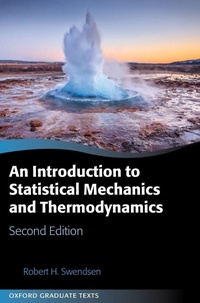
An Introduction to Statistical Mechanics and Thermodynamics
Second Edition
2nd Edition
Published on 10. December 2019
Book
Hardback
496 pages
978-0-19-885323-7 (ISBN)
Description
This text presents the two complementary aspects of thermal physics as an integrated theory of the properties of matter. Conceptual understanding is promoted by thorough development of basic concepts. In contrast to many texts, statistical mechanics, including discussion of the required probability theory, is presented first. This provides a statistical foundation for the concept of entropy, which is central to thermal physics. A unique feature of the book is the development of entropy based on Boltzmann's 1877 definition; this avoids contradictions or ad hoc corrections found in other texts. Detailed fundamentals provide a natural grounding for advanced topics, such as black-body radiation and quantum gases. An extensive set of problems (solutions are available for lecturers through the OUP website), many including explicit computations, advance the core content by probing essential concepts. The text is designed for a two-semester undergraduate course but can be adapted for one-semester courses emphasizing either aspect of thermal physics. It is also suitable for graduate study.
Reviews / Votes
Review from previous edition In his innovative new text, Carnegie Mellon University physics professor Robert Swendsen presents the foundations of statistical mechanics with, as he puts it, a detour through thermodynamics. That's a desirable strategy because the statistical approach is more fundamental than the classical thermodynamics approach and has many applications to current research problems. [] The mathematical notation is carefully introduced and useful; the selected mathematical techniques are clearly explained in a conversational style that both graduate and advanced undergraduate students will find easy to follow. The author's subject organization and conceptual viewpoint address some of the shortcomings of conventional developments of thermal physics and will be helpful to students and researchers seeking a deep appreciation of statistical physics. * Physics Today, August 2013 * Bob Swendsen's book is very well thought out, educationally sound, and more original than other texts. * Jan Tobochnik, Kalamazoo College, USA * Robert Swendsen is a well-respected researcher who has developed many novel algorithms that illustrate his deep understanding of statistical mechanics. His textbook reflects his deep understanding and will likely have a major impact on the way statistical mechanics and thermodynamics is taught. Particularly noteworthy is Swendsen's treatment of entropy, following Boltzmann's original definition in terms of probability, and his comprehensive discussion of the fundamental principles and applications of statistical mechanics and thermodynamics. Students and instructors will enjoy reading the book as much as Swendsen obviously enjoyed writing it. * Harvey Gould, Clark University, USA * In this reader-friendly, excellent text, the author provides a unique combination of the best of two worlds: traditional thermodynamics (following Callen's footsteps) and modern statistical mechanics (including VPython codes for simulations). * Royce Zia, Virginia Polytechnic Institute and State University, USA * Swendsen is famous for developing Monte Carlo algorithms which dramatically speed up the simulation of many systems near a phase transition. The ideas for those algorithms required deep understanding of statistical mechanics, an understanding which is now fully applied to this excellent textbook. * Peter Young, University of California, USA *More details
Series
Edition
2nd Revised edition
Language
English
Place of publication
Oxford
United Kingdom
Target group
College/higher education
Edition type
Revised edition
Illustrations
28 b/w line illustrations
Dimensions
Height: 250 mm
Width: 175 mm
Thickness: 31 mm
Weight
1014 gr
ISBN-13
978-0-19-885323-7 (9780198853237)
Copyright in bibliographic data and cover images is held by Nielsen Book Services Limited or by the publishers or by their respective licensors: all rights reserved.
Schweitzer Classification
Other editions
Additional editions
Robert H. Swendsen
An Introduction to Statistical Mechanics and Thermodynamics
Book
08/2024
Oxford University Press
€50.00
Available immediately
Robert H. Swendsen
An Introduction to Statistical Mechanics and Thermodynamics
E-Book
12/2019
2nd Edition
OUP eBook
€73.99
Available for download
Person
Robert H. Swendsen is Professor of Physics at Carnegie Mellon University, where he works primarily in computational statistical mechanics. Professor Swendsen is a Fellow of both the American Physical Society and the American Association for the Advancement of Science. He was given an IBM Outstanding Achievement Award in 1981 and shared a Forefronts of Large-Scale Computational Problems Award with S. Kumar, J.M. Rosenberg, and P.A. Kollman in 1991.
Content
Preface
Introduction1:
Part 1 Entropy
2: The Classical Ideal Gas
3: Discrete Probability Theory
4: The Classical Ideal Gas: Configurational Entropy
5: Continuous Random Numbers
6: The Classical Ideal Gas: Energy-Dependence of Entropy
7: Classical Gasses: Ideal and Otherwise
8: Temperature Pressure, Chemical Potential, and All That
Part 2 Thermodynamics
9: The Postulates and Laws of Thermodynamics
10: Perturbations of Thermodynamic State Functions
11: Thermodynamics Processes
12: Thermodynamic Potentials
13: The Consequences of Extensivity
14: Thermodynamic Identities
15: Extremum Principles
16: Stability Conditions
17: Phase Transitions
18: The Nernst Postulate: the Third Law of Thermodynamics
Part 3 Classical Statistical Mechanics
19: Ensembles in Classical Statistical Mechanics
20: Classical Ensembles: Grand and Otherwise
21: Refining the Definition of Entropy
22: Irreversibility
Part 4 Quantum Statistical Mechanics
23: Quantum Ensembles
24: Quantum Canonical Ensemble
25: Black-Body Radiation
26: The Harmonic Solid
27: Ideal Quantum Gases
28: Bose-Einstein Statistics
29: Fermi-Dirac Statistics
30: Insulators and Semiconductors
31: Phase Transitions and the Ising Model
Appendix
Appendix: Computer Calculations and VPython
Index
Index
Free
1: Introduction
I
Part 1 Entropy
2: Classical Ideal Gas
3: Discrete probability theory
4: Configurational entropy
5: Continuous random numbers
6: Classical ideal gas: Energy
7: Ideal and "real" gases
8: T, P, ?, and all that
II
Part 2 Thermodynamics
9: Postulates and Laws of thermodynamics
10: Thermodynamic perturbations
11: Thermodynamic processes
12: Thermodynamic potentials
13: Extensivity
14: Thermodynamic identities
15: Extremum principles
16: Stability conditions
17: Phase transitions
18: Nernst postulate
III
Part 3 Classical statistical mechanics
19: Classical ensembles
20: Classical ensembles: grand and otherwise
21: Irreversibility
IV
Part 4 Quantum statistical mechanics
22: Quantum ensembles
23: Quantum canoncial ensemble
24: Black-body radiation
25: The harmonic solid
26: Ideal quantum gases
27: Bose-Einstein statistics
28: Fermi-Dirac statistics
29: Insulators and semiconductors
30: The Ising model
Introduction1:
Part 1 Entropy
2: The Classical Ideal Gas
3: Discrete Probability Theory
4: The Classical Ideal Gas: Configurational Entropy
5: Continuous Random Numbers
6: The Classical Ideal Gas: Energy-Dependence of Entropy
7: Classical Gasses: Ideal and Otherwise
8: Temperature Pressure, Chemical Potential, and All That
Part 2 Thermodynamics
9: The Postulates and Laws of Thermodynamics
10: Perturbations of Thermodynamic State Functions
11: Thermodynamics Processes
12: Thermodynamic Potentials
13: The Consequences of Extensivity
14: Thermodynamic Identities
15: Extremum Principles
16: Stability Conditions
17: Phase Transitions
18: The Nernst Postulate: the Third Law of Thermodynamics
Part 3 Classical Statistical Mechanics
19: Ensembles in Classical Statistical Mechanics
20: Classical Ensembles: Grand and Otherwise
21: Refining the Definition of Entropy
22: Irreversibility
Part 4 Quantum Statistical Mechanics
23: Quantum Ensembles
24: Quantum Canonical Ensemble
25: Black-Body Radiation
26: The Harmonic Solid
27: Ideal Quantum Gases
28: Bose-Einstein Statistics
29: Fermi-Dirac Statistics
30: Insulators and Semiconductors
31: Phase Transitions and the Ising Model
Appendix
Appendix: Computer Calculations and VPython
Index
Index
Free
1: Introduction
I
Part 1 Entropy
2: Classical Ideal Gas
3: Discrete probability theory
4: Configurational entropy
5: Continuous random numbers
6: Classical ideal gas: Energy
7: Ideal and "real" gases
8: T, P, ?, and all that
II
Part 2 Thermodynamics
9: Postulates and Laws of thermodynamics
10: Thermodynamic perturbations
11: Thermodynamic processes
12: Thermodynamic potentials
13: Extensivity
14: Thermodynamic identities
15: Extremum principles
16: Stability conditions
17: Phase transitions
18: Nernst postulate
III
Part 3 Classical statistical mechanics
19: Classical ensembles
20: Classical ensembles: grand and otherwise
21: Irreversibility
IV
Part 4 Quantum statistical mechanics
22: Quantum ensembles
23: Quantum canoncial ensemble
24: Black-body radiation
25: The harmonic solid
26: Ideal quantum gases
27: Bose-Einstein statistics
28: Fermi-Dirac statistics
29: Insulators and semiconductors
30: The Ising model