

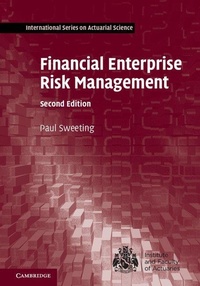
Financial Enterprise Risk Management
2nd Edition
Published on 7. August 2017
Book
Hardback
614 pages
978-1-107-18461-9 (ISBN)
Description
This comprehensive, yet accessible, guide to enterprise risk management for financial institutions contains all the tools needed to build and maintain an ERM framework. It discusses the internal and external contexts with which risk management must be carried out, and it covers a range of qualitative and quantitative techniques that can be used to identify, model and measure risks. This new edition has been thoroughly updated to reflect new legislation and the creation of the Financial Conduct Authority and the Prudential Regulation Authority. It includes new content on Bayesian networks, expanded coverage of Basel III, a revised treatment of operational risk and a fully revised index. Over 100 diagrams are used to illustrate the range of approaches available, and risk management issues are highlighted with numerous case studies. This book also forms part of the core reading for the UK actuarial profession's specialist technical examination in enterprise risk management, ST9.
Reviews / Votes
Review of previous edition: 'Provides all the tools required to build and maintain a comprehensive ERM framework, covering a range of qualitative and quantitative techniques and their uses in identifying, assessing, modelling and measuring risk.' Actuary Magazine 'In total, this book provides not only a very comprehensive and accessible introduction to financial enterprise risk management, but also covers advanced topics such as Bayesian networks and current regulatory developments such as Basel III. It clearly demonstrates the importance of risk management for financial institutions and outlines detailed steps and procedures that can be taken to obtain a firm understanding of risk. The book discusses the specific advantages and limitations of current risk management tools and frameworks and provides rich guidance on how to implement ERM on a comprehensive level.' Matthias M. M. Buehlmaier, zbMATHMore details
Series
Edition
2nd Revised edition
Language
English
Place of publication
Cambridge
United Kingdom
Target group
Professional and scholarly
Edition type
Revised edition
Illustrations
Worked examples or Exercises; 25 Tables, black and white; 5 Halftones, black and white; 115 Line drawings, black and white
Dimensions
Height: 250 mm
Width: 175 mm
Thickness: 37 mm
Weight
1223 gr
ISBN-13
978-1-107-18461-9 (9781107184619)
Copyright in bibliographic data and cover images is held by Nielsen Book Services Limited or by the publishers or by their respective licensors: all rights reserved.
Schweitzer Classification
Other editions
Additional editions
Paul Sweeting
Financial Enterprise Risk Management
E-Book
08/2017
Cambridge University Press
€87.49
Available for download
Paul Sweeting
Financial Enterprise Risk Management
E-Book
08/2017
2nd Edition
Cambridge University Press
€105.99
Available for download
Previous edition
Paul Sweeting
Financial Enterprise Risk Management
Book
08/2011
1st Edition
Cambridge University Press
€101.51
Article exhausted; check for reprint
Person
Paul Sweeting is Professor of Actuarial Science at the University of Kent, Canterbury where he teaches enterprise risk management. His research covers areas as diverse as longevity, pensions accounting, and investment strategy. Prior to joining the University of Kent, Professor Sweeting was Head of Research at Legal and General Investment Management and Managing Director at J. P. Morgan Asset Management. He is a Fellow of the Institute of Actuaries, the Royal Statistical Society, and the Chartered Institute for Securities and Investment. He is also a CFA Charterholder and a Chartered Enterprise Risk Actuary. He has written a number of articles on financial issues, and is a regular contributor to the written and broadcast media.
Content
1. An introduction to enterprise risk management; 2. Types of financial institution; 3. Stakeholders; 4. The internal environment; 5. The external environment; 6. Process overview; 7. Definitions of risk; 8. Risk identification; 9. Some useful statistics; 10. Statistical distributions; 11. Modelling techniques; 12. Extreme value theory; 13. Modelling time series; 14. Quantifying particular risks; 15. Risk assessment; 16. Responses to risk; 17. Continuous considerations; 18. Economic capital; 19. Risk frameworks; 20. Case studies; 21. Solutions to questions; References; Index.