

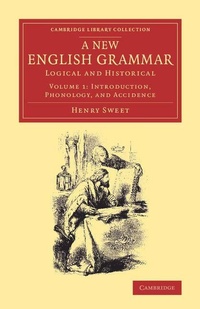
A New English Grammar
Logical and Historical
Published on 21. August 2014
Book
Paperback/Softback
528 pages
978-1-108-07525-1 (ISBN)
Description
The respected phonetician and philologist Henry Sweet (1845-1912) has had a lasting influence on the study and teaching of linguistics, particularly phonetics and Old English. Sweet is also known for being, in part, the inspiration for Henry Higgins in Shaw's Pygmalion. This two-volume work, first published in 1892-8, marks the start of a new tradition in the study of English, although it received little attention in Britain upon its publication. Building on developments in European linguistics, this was the first grammar of English to adopt a scientific approach to the description of language, in particular of phonology. Volume 1 (1892) contains one of the first studies of English phonology, which applies the same rigorous analysis to the spoken language as to the written, as well as detailed descriptions of the parts of speech, accidence, and the history of English.
More details
Series
Language
English
Place of publication
Cambridge
United Kingdom
Target group
Professional and scholarly
Product notice
Paperback (trade)
Illustrations
Worked examples or Exercises
Dimensions
Height: 216 mm
Width: 140 mm
Thickness: 31 mm
Weight
737 gr
ISBN-13
978-1-108-07525-1 (9781108075251)
Copyright in bibliographic data and cover images is held by Nielsen Book Services Limited or by the publishers or by their respective licensors: all rights reserved.
Schweitzer Classification
Other editions
Complete work / Part of the work
Book
08/2014
Cambridge University Press
€96.74
No shipping information available
Content
Preface; Part I. Introduction: Grammar and language; Parts of speech in detail; Word-groups; History of language; Divisions and methods of grammar; History of English; Part II. Phonology: Phonetics; Laws of sound-change; Old English sounds; Middle English sounds; Modern English sound-changes; Present English; Part III. Accidence: Nouns; Adjectives; Pronouns; Numerals; Verbs; Particles; Composition; Derivation.