

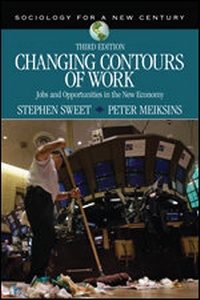
Changing Contours of Work
Jobs and Opportunities in the New Economy
3rd Edition
Published on 29. February 2016
Book
Paperback/Softback
328 pages
978-1-4833-5825-3 (ISBN)
Description
Proud sponsor of the 2019 SAGE Keith Roberts Teaching Innovations Award-enabling graduate students and early career faculty to attend the annual ASA pre-conference teaching and learning workshop.
In the Third Edition of Changing Contours of Work: Jobs and Opportunities in the New Economy, Sweet and Meiksins once again provide a rich analysis of the American workplace in the larger context of an integrated global economy. Through engaging vignettes and rich data, this text frames the development of jobs and employment opportunities in an international comparative perspective, revealing the historical transformations of work (the "old economy" and the "new economy") and identifying the profound effects that these changes have had on lives, jobs, and life chances. The text examines the many complexities of race, class, and gender inequalities in the modern-day workplace, and details the consequences of job insecurity and work schedules mismatched to family needs. Throughout the text, strategic recommendations are offered to improve the new economy.
In the Third Edition of Changing Contours of Work: Jobs and Opportunities in the New Economy, Sweet and Meiksins once again provide a rich analysis of the American workplace in the larger context of an integrated global economy. Through engaging vignettes and rich data, this text frames the development of jobs and employment opportunities in an international comparative perspective, revealing the historical transformations of work (the "old economy" and the "new economy") and identifying the profound effects that these changes have had on lives, jobs, and life chances. The text examines the many complexities of race, class, and gender inequalities in the modern-day workplace, and details the consequences of job insecurity and work schedules mismatched to family needs. Throughout the text, strategic recommendations are offered to improve the new economy.
Reviews / Votes
"Changing Contours of Work: Jobs and Opportunities in the New Economy provides numerous insights into the new world of work and is a prolific source of material for class discussion, further research, and written assignments." -- Teaching Sociology "Changing Contours of Work is an engaging text that is of significant value in courses on the sociology of work." -- Journal of Family Theory & Review "With a captivating dose of realism and critical inquiry, the authors have done an excellent job of introducing some of the most troubling labour market issues of our time. It is an excellent source for upper level undergraduate students and those trying to make sense of recent transformations in the world of work and beyond." -- Work, Employment and Society "Changing Contours of Work inspires students to acquire a sociological imagination in the way they view the labor force, understanding the way that personal troubles with income or employment are linked to public issues.Changing Contours of Work provides a thorough overview of the structure of the new economy and the way opportunities and rewards are unequally divided across the lines of class, gender, and race.Perhaps one of the greatest attributes of the book,however, is the ease by which Sweet and Meiksins integrate classical sociology with contemporary studies of stratification in a way that is extremely accessible to undergraduate students." -- William J. Scarborough * American Sociological Association *
More details
Series
Edition
3rd Revised edition
Language
English
Place of publication
Thousand Oaks
United States
Target group
College/higher education
Edition type
Revised edition
Dimensions
Height: 229 mm
Width: 152 mm
Weight
435 gr
ISBN-13
978-1-4833-5825-3 (9781483358253)
Copyright in bibliographic data and cover images is held by Nielsen Book Services Limited or by the publishers or by their respective licensors: all rights reserved.
Schweitzer Classification
Other editions
New editions
Stephen A. Sweet | Peter F. Meiksins
Changing Contours of Work
Jobs and Opportunities in the New Economy
Book
04/2025
4th Edition
SAGE Publications Inc
€124.79
Shipment within 15-20 days
Previous edition
Stephen A. Sweet | Peter F. Meiksins
Changing Contours of Work
Jobs and Opportunities in the New Economy
Book
05/2012
2nd Edition
SAGE Publications Inc
€53.41
Article exhausted; check for reprint
Persons
Stephen Sweet is Associate Professor and Chair of Sociology at Ithaca College and formerly the associate director of the Cornell Careers Institute, a Sloan Center for the Study of Working Families. He has written a number of articles on the challenges confronting working families, focusing on the issues of concern to dual career couples across the life course. His studies have appeared in a variety of publications, including the New Directions in Life Course Research, Journal of Vocational Behavior, Journal of Marriage and the Family, Innovative Higher Education, The International Journal of Mass Emergencies and Disasters, Journal of College Student Development, and Community, Work, and Family. Stephen's other book with SAGE is The Work-Family Interface. He has also published The Handbook of Work and Family with co-authors Marcie Pitt-Catsouphes and Ellen Ernst Kossek; Managing Careers in the New Risk Economy, with co-investigator Phyllis Moen; College and Society: An Introduction to the Sociological Imagination, and Data Analysis with SPSS: A First Course in Applied Statistics. Stephen has been the recipient of a Sloan Officers Grant to study the effects of corporate downsizing on dual earner couples.
Peter Meiksins is a Professor of Sociology at Cleveland State University. He is the author of many articles on the sociology of work, including studies of the work experiences of engineers and part-time work in professional technical occupations and essays on labor process theory, professional work in comparative perspective, and contemporary labor relations. His work has appeared in a variety of journals, including Work and Occupations, Theory and Society, Economic and Industrial Democracy, Work, Employment and Society, and Sociological Quarterly. He is the author of Putting Work in Its Place: A Quiet Revolution (with Peter Whalley) and of Engineering Labour: Technical Workers in Comparative Perspective (with Chris Smith). Peter's other books are Rethinking the Labor Process (with Mark Wardell and Tom Steiger) and Rising From the Ashes: Labor in the Age of Global Capitalism (with Ellen Wood and Michael Yates). He and co-investigator Peter Whalley received a major grant from the Sloan Foundation to study "Flexible Work for Technical Professionals." Peter's current research concerns the sociology of design work (a study of the work of graphic designers, industrial designers and interior designers). This research has been supported by a Fund for the Advancement of the Discipline grant from the American Sociological Foundation.
Peter Meiksins is a Professor of Sociology at Cleveland State University. He is the author of many articles on the sociology of work, including studies of the work experiences of engineers and part-time work in professional technical occupations and essays on labor process theory, professional work in comparative perspective, and contemporary labor relations. His work has appeared in a variety of journals, including Work and Occupations, Theory and Society, Economic and Industrial Democracy, Work, Employment and Society, and Sociological Quarterly. He is the author of Putting Work in Its Place: A Quiet Revolution (with Peter Whalley) and of Engineering Labour: Technical Workers in Comparative Perspective (with Chris Smith). Peter's other books are Rethinking the Labor Process (with Mark Wardell and Tom Steiger) and Rising From the Ashes: Labor in the Age of Global Capitalism (with Ellen Wood and Michael Yates). He and co-investigator Peter Whalley received a major grant from the Sloan Foundation to study "Flexible Work for Technical Professionals." Peter's current research concerns the sociology of design work (a study of the work of graphic designers, industrial designers and interior designers). This research has been supported by a Fund for the Advancement of the Discipline grant from the American Sociological Foundation.
Content
List of Exhibits
About the Authors
Preface
Acknowledgments
Chapter 1: Mapping the Contours of Work
Scenes From the New Economy
Culture and Work
Structure and Work
Agency and Careers
Chapter 2: New Products, New Ways of Working, and the New Economy
A Postindustrial Society?
The End of Mass Production?
New Skills?
New Cultures of Control?
The End of Organized Labor?
A New Global Economy?
Chapter 3: Economic Inequality, Social Mobility, and the New Economy
Are Economic Divides Narrowing or Widening in the United States?
Are Career Pathways Opening or Closing?
Is the Global Economy Becoming More Flat or Bumpy?
Chapter 4: Whose Jobs Are Secure
Risk and Work: Historical and Comparative Views
How Insecure Are Workers in the New Economy?
The Costs of Job Loss and Insecurity
Responding to Insecurity: Old and New Careers
Chapter 5: A Fair Day's Work? The Intensity and Scheduling of Jobs in the New Economy
Time, Intensity, and Work
How Much Should We Work? Comparative Frameworks
Why Are Americans Working So Much?
Nonstandard Schedules: Jobs in a 24/7 Economy
How Americans Deal With Overwork
Chapter 6: Gender Chasms in the New Economy
When Did Home Work Become Nonwork?
Women's Participation in the Paid Labor Force in America
Gender Inequalities in Compensation
Socialization, Career Selection, and Career Paths
Interpersonal Discrimination in the Workplace
Structural Dimensions of Gender Discrimination
Strategies to Bridge the Care Gaps: International
Chapter 7: Race, Ethnicity, and Work: Legacies of the Past, Problems in the Present
Histories of Race, Ethnicity, and Work
Magnitude of Racial Inequality in the New Economy
Intergenerational Transmission of Resources
Geographic Distribution of Race and Work Opportunity
Racial Prejudice and Discrimination
Racialized Jobs
Race, Ethnicity, and Work: Social Policy
Chapter 8: Reshaping the Contours of the New Economy
Opportunity Chasms
Agents of Change
Appendix: Legislative and Regulatory Time Line of Worker Rights and Protections in the United States
References
Index
About the Authors
Preface
Acknowledgments
Chapter 1: Mapping the Contours of Work
Scenes From the New Economy
Culture and Work
Structure and Work
Agency and Careers
Chapter 2: New Products, New Ways of Working, and the New Economy
A Postindustrial Society?
The End of Mass Production?
New Skills?
New Cultures of Control?
The End of Organized Labor?
A New Global Economy?
Chapter 3: Economic Inequality, Social Mobility, and the New Economy
Are Economic Divides Narrowing or Widening in the United States?
Are Career Pathways Opening or Closing?
Is the Global Economy Becoming More Flat or Bumpy?
Chapter 4: Whose Jobs Are Secure
Risk and Work: Historical and Comparative Views
How Insecure Are Workers in the New Economy?
The Costs of Job Loss and Insecurity
Responding to Insecurity: Old and New Careers
Chapter 5: A Fair Day's Work? The Intensity and Scheduling of Jobs in the New Economy
Time, Intensity, and Work
How Much Should We Work? Comparative Frameworks
Why Are Americans Working So Much?
Nonstandard Schedules: Jobs in a 24/7 Economy
How Americans Deal With Overwork
Chapter 6: Gender Chasms in the New Economy
When Did Home Work Become Nonwork?
Women's Participation in the Paid Labor Force in America
Gender Inequalities in Compensation
Socialization, Career Selection, and Career Paths
Interpersonal Discrimination in the Workplace
Structural Dimensions of Gender Discrimination
Strategies to Bridge the Care Gaps: International
Chapter 7: Race, Ethnicity, and Work: Legacies of the Past, Problems in the Present
Histories of Race, Ethnicity, and Work
Magnitude of Racial Inequality in the New Economy
Intergenerational Transmission of Resources
Geographic Distribution of Race and Work Opportunity
Racial Prejudice and Discrimination
Racialized Jobs
Race, Ethnicity, and Work: Social Policy
Chapter 8: Reshaping the Contours of the New Economy
Opportunity Chasms
Agents of Change
Appendix: Legislative and Regulatory Time Line of Worker Rights and Protections in the United States
References
Index