

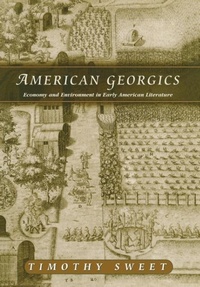
American Georgics
Economy and Environment in Early American Literature
Published on 16. January 2002
Book
Hardback
232 pages
978-0-8122-3637-8 (ISBN)
Description
In classical terms the georgic celebrates the working landscape, cultivated to become fruitful and prosperous, in contrast to the idealized or fanciful landscapes of the pastoral. Arguing that economic considerations must become central to any understanding of the human community's engagement with the natural environment, Timothy Sweet identifies a distinct literary mode he calls the American georgic.
Offering a fresh approach to ecocritical and environmentally-oriented literary studies, Sweet traces the history of the American georgic from its origins in late sixteenth-century English literature promoting the colonization of the Americas through the mid-nineteenth century, ending with George Perkins Marsh's Man and Nature (1864), the foundational text in the conservationist movement.
Offering a fresh approach to ecocritical and environmentally-oriented literary studies, Sweet traces the history of the American georgic from its origins in late sixteenth-century English literature promoting the colonization of the Americas through the mid-nineteenth century, ending with George Perkins Marsh's Man and Nature (1864), the foundational text in the conservationist movement.
Reviews / Votes
"Sweet offers a wide-ranging examination of the agricultural work of North American men and women as seen through the lens of literature. . . . Sweet's greatest achievement is his ability to integrate hundreds of years of discourse about the North American continent into a cohesive narrative of evolving perceptions of environment and humankind's role in shaping it." (American Literature) "Thoughtful, critically intelligent, and well-informed." (Lawrence Buell, Harvard University)More details
Language
English
Place of publication
Pennsylvania
United States
Target group
College/higher education
US School Grade: College Graduate Student
Product notice
Paper over boards
Dimensions
Height: 237 mm
Width: 159 mm
Thickness: 22 mm
Weight
531 gr
ISBN-13
978-0-8122-3637-8 (9780812236378)
Copyright in bibliographic data and cover images is held by Nielsen Book Services Limited or by the publishers or by their respective licensors: all rights reserved.
Schweitzer Classification
Other editions
Additional editions
E-Book
04/2013
1st Edition
University of Pennsylvania Press
€78.49
Available for download
Person
Timothy Sweet is Professor of English at West Virginia University. He is the author also of Traces of War: Poetry, Photography, and the Crisis of the Union.
Content
Introduction
1. Economy and Environment in Sixteenth-Century Promotional Literature
2. "God Sells Us All Things for Our Labour": John Smith's Generall Historie
3. "Wonder-Working Providence" of the Market
4. "Admirable Oeconomy": Robert Beverley's Calculus of Compensation
5. Ideologies of Farming: Crevecoeur, Jefferson, Rush, and Brown
6. Cherokee "Improvements" and the Removal Debate
7. "Co-Workers with Nature": Cooper, Thoreau, and Marsh
Notes
Woks Cited
Index
Acknowledgments
1. Economy and Environment in Sixteenth-Century Promotional Literature
2. "God Sells Us All Things for Our Labour": John Smith's Generall Historie
3. "Wonder-Working Providence" of the Market
4. "Admirable Oeconomy": Robert Beverley's Calculus of Compensation
5. Ideologies of Farming: Crevecoeur, Jefferson, Rush, and Brown
6. Cherokee "Improvements" and the Removal Debate
7. "Co-Workers with Nature": Cooper, Thoreau, and Marsh
Notes
Woks Cited
Index
Acknowledgments