

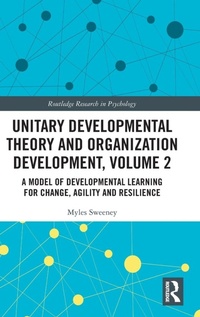
Unitary Developmental Theory and Organization Development, Volume 2
A Model of Developmental Learning for Change, Agility and Resilience
1st Edition
Published on 30. November 2022
Book
Hardback
274 pages
978-1-032-36659-3 (ISBN)
Description
This book introduces Unitary Developmental Theory (UDT) to the field of organization development. The second of two volumes, it introduces the UDT model and examines its application to organization development and change management.
The book presents UDT comprising seven developmental levels, showing how using its methodical progression can help to avoid issues such as unsustainable growth and change failure while examining how the model improves collaboration, digital transformation, change management and team development. It shows how the model clinically transforms concepts such as culture which is often cited as the cause of failure for change, re-defining it as habituated maturation stage and simplifying culture change accordingly. This book is designed to accompany Volume 1 which details the psychology of the model and its equal applicability to mental-health recovery.
Showing how UDT can be used as an overarching model to optimize organization development, this book will be of great interest to researchers, scholars and postgraduate students from the fields of organizational psychology, organization development and change management.
The book presents UDT comprising seven developmental levels, showing how using its methodical progression can help to avoid issues such as unsustainable growth and change failure while examining how the model improves collaboration, digital transformation, change management and team development. It shows how the model clinically transforms concepts such as culture which is often cited as the cause of failure for change, re-defining it as habituated maturation stage and simplifying culture change accordingly. This book is designed to accompany Volume 1 which details the psychology of the model and its equal applicability to mental-health recovery.
Showing how UDT can be used as an overarching model to optimize organization development, this book will be of great interest to researchers, scholars and postgraduate students from the fields of organizational psychology, organization development and change management.
Reviews / Votes
"This model is the best insight into bad Organisations since Prof. Clive Boddy's Corporate Psychopathy, but has the benefit of offering normative process to get things right again"- Christine Louis de Canonville, MIACP, Ireland.
More details
Series
Language
English
Place of publication
London
United Kingdom
Publishing group
Taylor & Francis Ltd
Target group
College/higher education
Postgraduate
Illustrations
15 s/w Zeichnungen, 15 s/w Abbildungen, 17 s/w Tabellen
17 Tables, black and white; 15 Line drawings, black and white; 15 Illustrations, black and white
Dimensions
Height: 240 mm
Width: 161 mm
Thickness: 21 mm
Weight
631 gr
ISBN-13
978-1-032-36659-3 (9781032366593)
Copyright in bibliographic data and cover images is held by Nielsen Book Services Limited or by the publishers or by their respective licensors: all rights reserved.
Schweitzer Classification
Other editions
Additional editions
Myles Sweeney
Unitary Developmental Theory and Organization Development, Volume 2
A Model of Developmental Learning for Change, Agility and Resilience
Book
05/2024
1st Edition
Routledge
€63.80
Shipment within 10-20 days
Myles Sweeney
Unitary Developmental Theory and Organization Development, Volume 2
A Model of Developmental Learning for Change, Agility and Resilience
E-Book
11/2022
1st Edition
Routledge
€55.49
Available for download
Myles Sweeney
Unitary Developmental Theory and Organization Development, Volume 2
A Model of Developmental Learning for Change, Agility and Resilience
E-Book
11/2022
1st Edition
Routledge
€55.49
Available for download
Person
Content
1.Organization Development/Change Management and the Problems that UDT Addresses: An Introduction 2. UDT: An Introduction to the Psychology behind the Model 3. The UDT Modeling of Organization Development 4. Culture Analysis and Development: A Sample UDT Breakthrough 5. Some Points on Applying the Model 6. Construct Validation through Correspondence with Prevailing Models of OD and Maturity, Historical Case Studies, etc. 7. UDT Bolstering OD/CM Theory and Practice 8. Disconnecting from the Old Paradigm and Leading the Way: UDT and Agile 9. Ultimate UDT Maturity with Agility and Resilience: The Regenerative Eco-System. Conclusion. Glossary. References