

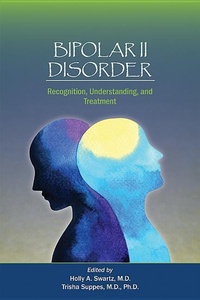
Bipolar II Disorder
Recognition, Understanding, and Treatment
Will be published approx. on 16. July 2019
Book
Paperback/Softback
322 pages
978-1-61537-178-5 (ISBN)
Description
Unlike its cousin, bipolar I disorder, which has been
extensively studied and depicted in popular literature and on screen,
bipolar II disorder is poorly understood, underdiagnosed, and insufficiently
treated. Bipolar II Disorder: Recognition, Understanding, and
Treatment is the only text on the market that examines every aspect
of the disorder in an up-to-date, rigorous, and clinically oriented manner.
The editors, experts on the diagnosis and treatment of this neglected
illness, have gathered a group of contributors who together advance the
reader's knowledge of the disease in a systematic, accessible way,
identifying and addressing the challenges of diagnosis and treatment and
exploring current thinking on the biological determinants of the disorder.
Acknowledging potential pitfalls of differential diagnosis, the book
examines psychiatric comorbidities that most typically co-occur with bipolar
II, such as anxiety disorders, impulse-control disorders, and borderline
personality disorder. Next, the book focuses on the growing body of evidence
that suggests that the underlying biology of bipolar II is distinct from
that of other mood disorders and discusses the increasingly important role
that neuroimaging plays in the diagnosis and understanding of bipolar II
disorder as research progresses. Finally, the text explores how to manage
bipolar II disorder, providing an up-to-date review of medication options
and psychosocial treatments.
The book's strengths are many and compelling:
* Individual chapters are written by experts in the fields of
phenomenology, genetics, neuroimaging, psychopharmacology, psychotherapy,
child psychiatry, and reproductive mental health who review what is
currently known about bipolar II disorder and its management.
* A
special chapter on suicide describes a framework for understanding risk and
a clinical model for conducting suicide risk assessment specific to
individuals with bipolar II disorder. The chapter underscores factors
associated with increased risk in bipolar II disorder and identifies
strategies to mitigate that risk.
* Written for a professional audience,
the book may also be of interest to patients who want to learn more about
their own diagnosis and to those who wish to support them.
* Fascinating
case vignettes and concise key points are provided throughout the text,
helping readers to understand and contextualize the most important
information in each chapter for easy reference and review.
* Although
advances have been made in understanding bipolar II disorder since the
diagnosis was first codified in 1994, many gaps remain in the evidence base,
particularly related to optimal treatments and neurobiology, and the book
examines future directions for inquiry.
For years, clinicians had
little guidance for diagnosing and treating bipolar II disorder, relying on
treatment options for bipolar I disorder, which were inadequate and of
limited efficacy. Bipolar II Disorder: Recognition, Understanding, and
Treatment responds to these frustrations with evidence-based,
substantive, and up-to-the-minute information, demystifying the disorder and
equipping the reader to provide the highest standard of care.
extensively studied and depicted in popular literature and on screen,
bipolar II disorder is poorly understood, underdiagnosed, and insufficiently
treated. Bipolar II Disorder: Recognition, Understanding, and
Treatment is the only text on the market that examines every aspect
of the disorder in an up-to-date, rigorous, and clinically oriented manner.
The editors, experts on the diagnosis and treatment of this neglected
illness, have gathered a group of contributors who together advance the
reader's knowledge of the disease in a systematic, accessible way,
identifying and addressing the challenges of diagnosis and treatment and
exploring current thinking on the biological determinants of the disorder.
Acknowledging potential pitfalls of differential diagnosis, the book
examines psychiatric comorbidities that most typically co-occur with bipolar
II, such as anxiety disorders, impulse-control disorders, and borderline
personality disorder. Next, the book focuses on the growing body of evidence
that suggests that the underlying biology of bipolar II is distinct from
that of other mood disorders and discusses the increasingly important role
that neuroimaging plays in the diagnosis and understanding of bipolar II
disorder as research progresses. Finally, the text explores how to manage
bipolar II disorder, providing an up-to-date review of medication options
and psychosocial treatments.
The book's strengths are many and compelling:
* Individual chapters are written by experts in the fields of
phenomenology, genetics, neuroimaging, psychopharmacology, psychotherapy,
child psychiatry, and reproductive mental health who review what is
currently known about bipolar II disorder and its management.
* A
special chapter on suicide describes a framework for understanding risk and
a clinical model for conducting suicide risk assessment specific to
individuals with bipolar II disorder. The chapter underscores factors
associated with increased risk in bipolar II disorder and identifies
strategies to mitigate that risk.
* Written for a professional audience,
the book may also be of interest to patients who want to learn more about
their own diagnosis and to those who wish to support them.
* Fascinating
case vignettes and concise key points are provided throughout the text,
helping readers to understand and contextualize the most important
information in each chapter for easy reference and review.
* Although
advances have been made in understanding bipolar II disorder since the
diagnosis was first codified in 1994, many gaps remain in the evidence base,
particularly related to optimal treatments and neurobiology, and the book
examines future directions for inquiry.
For years, clinicians had
little guidance for diagnosing and treating bipolar II disorder, relying on
treatment options for bipolar I disorder, which were inadequate and of
limited efficacy. Bipolar II Disorder: Recognition, Understanding, and
Treatment responds to these frustrations with evidence-based,
substantive, and up-to-the-minute information, demystifying the disorder and
equipping the reader to provide the highest standard of care.
Reviews / Votes
The overall quality of this book is high. It is dividedinto short topics with relevant subtitles and has unique key points
summaries at the end of each chapter, enhancing retention of critical
learning points. The treatment section is up to date with appropriate
evidence when available, and boldly addresses controversial topics of
treatment with antidepressants. -- Daniel M. Tuinstra, M.D. * Doody's Book Review * This volume presents a comprehensive review of current
knowledge about bipolar II disorder by noted authors in the various subject
areas that are covered. -- David L. Dunner, M.D., FACPsych * Journal of Psychiatric Practice *
More details
Language
English
Place of publication
VA
United States
Target group
Professional and scholarly
US School Grade: College Graduate Student and over
Product notice
Paperback (trade)
Illustrations
6 Plates, black and white; 9 Figures; 17 Tables, unspecified
Dimensions
Height: 233 mm
Width: 156 mm
Thickness: 17 mm
Weight
537 gr
ISBN-13
978-1-61537-178-5 (9781615371785)
Copyright in bibliographic data and cover images is held by Nielsen Book Services Limited or by the publishers or by their respective licensors: all rights reserved.
Schweitzer Classification
Other editions
Additional editions
E-Book
05/2019
American Psychiatric Association Publishing
€46.99
Available for download
Persons
Holly A. Swartz, M.D., is Professor in the
Department of Psychiatry at the University of Pittsburgh School of Medicine
in Pittsburgh, Pennsylvania.
Trisha Suppes, M.D., Ph.D., is
Professor in the Department of Psychiatry & Behavioral Sciences at
Stanford University School of Medicine in Palo Alto, California and on staff
at the Palo Alto Health Care System, Palo Alto, California.
Department of Psychiatry at the University of Pittsburgh School of Medicine
in Pittsburgh, Pennsylvania.
Trisha Suppes, M.D., Ph.D., is
Professor in the Department of Psychiatry & Behavioral Sciences at
Stanford University School of Medicine in Palo Alto, California and on staff
at the Palo Alto Health Care System, Palo Alto, California.
Content
Preface
Chapter 1. A Neglected Condition
Part I:
Recognition
Chapter 2. Diagnosing Bipolar II Disorder
Chapter 3.
Interface Between Borderline Personality Disorder and Bipolar II
Disorder
Chapter 4. Psychiatric and Medical Comorbidities
Chapter
5. Suicide and Bipolar II Disorder
Part II: Understanding
Chapter
6. Genetics of Bipolar II Disorder
Chapter 7. Functional Brain Imaging
and Neural Determinants of Bipolar II Disorder
Part III:
Treatment
Chapter 8. Mood Stabilizers and Antipsychotic Medications in
Bipolar II Disorder
Chapter 9. Antidepressant Medications: Special
Considerations in Bipolar II Disorder
Chapter 10. Psychosocial
Interventions in Bipolar II Disorder
Part IV: Special
Populations
Chapter 11. Bipolar II Disorder in Childhood and
Adolescence
Chapter 12. Reproductive-Age Women With Bipolar II
Disorder
Chapter 1. A Neglected Condition
Part I:
Recognition
Chapter 2. Diagnosing Bipolar II Disorder
Chapter 3.
Interface Between Borderline Personality Disorder and Bipolar II
Disorder
Chapter 4. Psychiatric and Medical Comorbidities
Chapter
5. Suicide and Bipolar II Disorder
Part II: Understanding
Chapter
6. Genetics of Bipolar II Disorder
Chapter 7. Functional Brain Imaging
and Neural Determinants of Bipolar II Disorder
Part III:
Treatment
Chapter 8. Mood Stabilizers and Antipsychotic Medications in
Bipolar II Disorder
Chapter 9. Antidepressant Medications: Special
Considerations in Bipolar II Disorder
Chapter 10. Psychosocial
Interventions in Bipolar II Disorder
Part IV: Special
Populations
Chapter 11. Bipolar II Disorder in Childhood and
Adolescence
Chapter 12. Reproductive-Age Women With Bipolar II
Disorder