

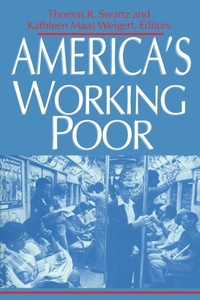
America's Working Poor
Published on 15. January 1996
Book
Paperback/Softback
210 pages
978-0-268-00649-5 (ISBN)
Description
With the erosion of the economic boundaries that once defined the American middle class, the United States seems nearer to becoming an economically dichotomous society of rich and poor. While this alarming economic trend has spurred much discussion in the political and economic arenas, the working poor-individuals whose incomes are insufficient to support either themselves or their families-have been overlooked in the current debates about poverty in America. As their numbers continue to swell, however, America's working poor can no longer be ignored. In this wide-ranging volume five economists, three sociologists, an ethicist, and an urban ethnographer examine the changing size, composition, and location of the working poor in the United States. Kathleen Maas Weigert sets the stage by providing a definitional context and overview of the problem. Elijah Anderson then puts a human face on some hard statistics by analyzing the shifting role of the heroic grandmother in the African-American community. Employing a unique data source based on the 1980 and 1990 censuses, John D. Kasarda answers the questions of who and where the working poor are and how their numbers have changed since 1980. Rebecca M. Blank and Rebecca A. London take an in-depth look at the working poor population as it has evolved over the past 15 years and offer a comprehensive examination of the policy options designed to address its shifting needs. Sheldon Danziger and Peter Gottschalk effectively debunk the myth that "anyone who works hard can get ahead in America" by arguing that uneven tides in the economic mainstream leave an increasing number of willing workers behind. Sandra L. Hofferth raises the important issue of child care for the working poor. James P. Sterba argues that the working poor have a right to welfare assistance, and finally, Thomas R. Swartz brings the topic into the current political arena by speculating about the consequences of the various welfare reform proposals that are currently making their way through Congress.
Reviews / Votes
"This volume is probably the most current and concise source of information on the employment aspects of poverty in the United States as they pertain to public assistance programs and policies extant and proposed to address the continuing problems of the working poor. Hence scholars with a bent toward policy analysis will surely find the volume exciting and useful. Additionally, because the essence of the concern for low-wage workers is that they must work long hours to achieve even a minimal income, family economists and extension family life specialists may find this book useful for examples of the reality of severe time constraints that affect family life, management skills, and consumption patterns." -The Journal of Consumer AffairsMore details
Language
English
Place of publication
Notre Dame IN
United States
Target group
College/higher education
Professional and scholarly
Illustrations
50 tables and charts - 32 Tables, black and white - 18 Charts
Dimensions
Height: 229 mm
Width: 152 mm
Thickness: 13 mm
Weight
349 gr
ISBN-13
978-0-268-00649-5 (9780268006495)
Copyright in bibliographic data and cover images is held by Nielsen Book Services Limited or by the publishers or by their respective licensors: all rights reserved.
Schweitzer Classification
Persons
Thomas R. Swartz is Professor Emeritus of Economics at the University of Notre Dame and a Fellow of the Urban Institute for Community and Educational Initiatives. He is the coeditor of Taking Sides and Urban Finance Under Siege.
Kathleen Maas Weigert is a Professor in the Department of Sociology at Loyola University, Chicago. She also served the Center for Social Concerns and the Joan B. Kroc Institute for International Peace Studies at Notre Dame.
Kathleen Maas Weigert is a Professor in the Department of Sociology at Loyola University, Chicago. She also served the Center for Social Concerns and the Joan B. Kroc Institute for International Peace Studies at Notre Dame.