

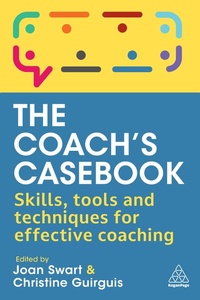
The Coach's Casebook
Skills, Tools and Techniques for Effective Coaching
1st Edition
Published on 3. July 2023
Book
Paperback/Softback
432 pages
978-1-3986-1047-7 (ISBN)
Description
What skills do I need to craft clear and effective coaching questions? How do I set goals for my clients? What do I need to be aware of when coaching with different personalities and facing mental health conditions?
The Coach's Casebook answers these questions and provides coaches with a thorough grounding in the knowledge, competencies, tools and techniques they need to coach employees to reach their full potential. This book also explains how these coaching tools and techniques apply in practice to boost personal development, performance and wellbeing.
There is extensive coverage of how to apply coaching interventions to manage work-life balance and prevent burnout at work and at home, and how to combine coaching and mindfulness as well as how to encourage clients to develop a growth mindset and reframe imposter syndrome. Specific guidance on active listening, coaching high-performers and those with high-potential, leadership coaching, coaching minorities and underrepresented groups and how to coach challenging personalities is also given. This practical guide, is supported by case studies and scenarios throughout taking from real-life coaching, is for those new to coaching and those in the intermediate stages of their career.
The Coach's Casebook contains everything needed to allow clients to flourish.
Reviews / Votes
"This book is a comprehensive toolkit for coaches looking to deepen their skills and help their clients achieve meaningful transformation. It covers the importance of self-awareness, self-management, supervision and wellbeing; along with neuroscience, enabling energy shifts, building strong habits, and working with clients' systems to create lasting change - would highly recommend!"More details
Other editions
Additional editions
Joan Swart | Christine Guirguis
The Coach's Casebook
Skills, Tools and Techniques for Effective Coaching
Book
07/2023
1st Edition
Kogan Page Ltd
€187.60
Shipment within 10-20 days
Joan Swart | Christine Guirguis
The Coach's Casebook
Skills, Tools and Techniques for Effective Coaching
E-Book
07/2023
1st Edition
Kogan Page Ltd
€40.49
Available for download
Persons
Editor
Joan Swart, PSYD forensic psychology and MBA, is a coaching psychologist, researcher and author. She has developed several individual, organizational and leadership curricula, including at the Jay Shetty Certification School, and is an accredited supervisor at the Association of Coaching. She is based in Cape Town, South Africa.
Christine Guirguis is an Association For Coaching Certified Productivity and Performance Coach. With a passion to discover and unlock the secret of living life to one's full potential she created the Human Potential Diagram and the 7 Keys of Discovery. She's also the community leader of Connecting with Christine, which unites like minded people to level up their lives through sought out challenges and workshops. She has also founded Advaya Project which provides people with the tools they need to reach their true potential. She is based in Cairo, Egypt.
Content
-
- Chapter - 01: Introduction and misconceptions of coaching;
- Section - ONE: Models and frameworks;
-
- Chapter - 02: The three Cs of coaching and professional practice;
- Chapter - 03: Awareness and accountability in coaching;
- Chapter - 04: Building habits;
- Section - TWO: Competencies;
-
- Chapter - 05: Coach supervision - who needs it?;
- Chapter - 06: Coaching presence;
- Chapter - 07: The importance of self-management for a coach;
- Chapter - 08: Are you listening to listening ? The art of listening;
- Chapter - 09: The power of non-directive questioning;
- Chapter - 10: Clarity from heart-brain connection to self-discovery;
- Chapter - 11: Seeking transformation versus focusing on solutions;
- Section - THREE: Approaches;
-
- Chapter - 12: Holistic transformation;
- Chapter - 13: Neuroscience-based coaching;
- Chapter - 14: Masculine/feminine energy aspects in coaching;
- Chapter - 15: Mindfulness and psychological flexibility in emotion-based coaching;
- Section - FOUR: Techniques and tools;
-
- Chapter - 16: Embodiment;
- Chapter - 17: Identifying and challenging blind spots in coaching;
- Chapter - 18: Coaching tools and techniques;
- Chapter - 19: The eyes watch but the brain sees - Visualization as a coaching tool for shifting the client's present view;
- Chapter - 20: The Wheel of Life;
- Section - FIVE: Transforming theory into practice - Application and implementation;
-
- Chapter - 21: Transitioning from theory to practice;
- Chapter - 22: Imposter syndrome;
- Chapter - 23: Ikigai;
- Chapter - 24: Preventing burnout by attaining a healthy work and personal life balance;
- Chapter - 25: Combining coaching and mindfulness;
- Chapter - 26: Establishing an effective coaching dialogue;
- Chapter - 27: Expanding modes of mind - From doing to being and becoming;
- Chapter - 28: The power of intention - Life coaching and the gap between intention and action;
- Chapter - 29: Overcoming fear: Stepping out of your comfort zone;
- Section - SIX: Transforming theory into practice - Execution;
-
- Chapter - 30: Goal setting - be SMARTER!;
- Chapter - 31: Sustaining and committing to action;
- Chapter - 32: The discovery call;
- Chapter - 33: Coaching ethics - don't be a plastic coach!;
- Chapter - 34: Structuring the session (or not);
- Chapter - 35: Questioning techniques;
- Section - SEVEN: Special niches and target groups;
-
- Chapter - 36: Leadership and executive coaching;
- Chapter - 37: Coaching and mental health;
- Chapter - 38: Coaching 'difficult' personality types;
- Chapter - 39: Empowering women to overcome cultural barriers;
- Chapter - 40: Conclusion;