

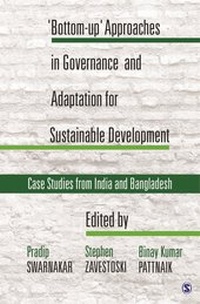
'Bottom-up' Approaches in Governance and Adaptation for Sustainable Development
Case Studies from India and Bangladesh
1st Edition
Published on 7. July 2017
Book
Hardback
368 pages
978-93-86446-04-6 (ISBN)
Description
This book analyzes how governance and climate change adaptation - both integral to sustainable development - operate outside the bureaucratic apparatus of the state. It examines 'top-down' and 'bottom-up' approaches to sustainable development and looks at a possible 'middle-out' approach to resolving the challenges to sustainable development.
The book also includes case studies from India and Bangladesh, which show that community-level factors such as social and cultural capital are key to the success of sustainable development efforts.
The book also includes case studies from India and Bangladesh, which show that community-level factors such as social and cultural capital are key to the success of sustainable development efforts.
Reviews / Votes
This important volume is a welcome addition to Western-dominated literature pushing top-down approaches to sustainable development. It gives voice to scholars and practitioners in countries like India and Bangladesh who report on promising bottom-up approaches that are suited to a diverse range of local settings. -- Riley E Dunlap, * Regents Professor of Sociology, Oklahoma State University, USA * This fine collection of work by insightful scholars adds greatly to our understanding of the challenges of sustainable development. The theme of shifting from top-down strategies to bottom-up runs through the chapters, providing a well-integrated book from a diversity of contributors -- Richard York, * Director and Professor of Environmental Studies, University of Oregon, USA *More details
Edition
First Edition
Language
English
Place of publication
New Delhi
India
Target group
College/higher education
Professional and scholarly
Dimensions
Height: 216 mm
Width: 140 mm
Weight
532 gr
ISBN-13
978-93-86446-04-6 (9789386446046)
Copyright in bibliographic data and cover images is held by Nielsen Book Services Limited or by the publishers or by their respective licensors: all rights reserved.
Schweitzer Classification
Other editions
Additional editions
Pradip Swarnakar | Stephen Zavestoski | Binay Kumar Pattnaik
'Bottom-up' Approaches in Governance and Adaptation for Sustainable Development
Case Studies from India and Bangladesh
Book
02/2020
1st Edition
SAGE Publications Pvt. Ltd
€69.60
Article exhausted; check different version
Persons
Pradip Swarnakar is Associate Professor of Sociology at the ABV-Indian Institute of Information Technology and Management Gwalior, India. Dr Swarnakar's research areas include environmental sociology, climate change, social networks, and sustainability transition. He has completed projects funded by the Indian Council of Social Science Research and the National Science Foundation. He was a visiting scholar at the Department of Sociology, the University of San Francisco, USA; the Department of Social Research, the University of Helsinki, Finland; and the Department of Urban and Environmental Sociology, the Helmholtz Centre for Environmental Research GmbH-UFZ, Germany. He was a recipient of the Fulbright-Nehru Academic & Professional Excellence Award, the Kone Foundation Senior Researcher grant, and the Deutsche Forschungsgemeinschaft (German Research Foundation) grant. His work on climate change has been published in the British Journal of Sociology Stephen Zavestoski is Professor of Sociology and Environmental Studies at the University of San Francisco, USA. Dr Zavestoski's research areas include environmental sociology, social movements, sociology of health and illness, and urban sustainability. He is co-editor of Social Movements in Health (2005) and Contested Illnesses: Citizens, Science, and Health Social Movements (2012). Dr Zavestoski's current work explores strategies to address both sustainability and public health through urban and transportation planning. This work has culminated in Incomplete Streets: Processes, Practices and Possibilities (2014), co-edited with Julian Agyeman. Dr Zavestoski is co-editor of the book series Equity, Justice, and the Sustainable City. Binay Kumar Pattnaik is Professor of Sociology at the Indian Institute of Technology Kanpur, India, and former Director of the Institute for Social and Economic Change, Bangalore, India. He has contributed handsomely to the areas of sociology of science and technology, social movements, and development studies. More particularly, he has contributed to the studies on technology transfer and R&D in the Indian industry, scientific productivity, effects of globalization and liberalization on science and technology regimes in developing countries, science technology and social stratification, etc. His recent contributions include papers in People's Science Movement in India, Appropriate Technology Movement in India (journal titled Sociology of Science and Technology), and ICT Revolution in India (Polish Sociological Review). His latest contribution pertaining to sustainable technologies from the developing societies based on grassroots-level innovations featured in the Technology in Society (2014). In addition to a good number of papers/articles, he has contributed nine books (both written and edited, including guestedited volumes of international journals) of which the latest one is entitled Sociology of Science and Technology in India (2013, SAGE).
Content
Preface and Acknowledgments
Introduction: Governance for Sustainable Development in the Anthropocene - Stephen Zavestoski and Pradip Swarnakar
Section 1: Governance I: Questioning the Top-down Approach of Sustainable Development
Forest, Adivasis, and the Forest Rights Act (2006): Interrogating Top-down Environmental Governance - Jyotiprasad Chatterjee
Science and Politics of Wildlife Enumeration: Questioning the 'Tiger Count' in India - Jayanthi A Pushkaran
Urban Land Governance Reforms and Sustainable Development: A Study of Urban Property Ownership Records (UPOR) in Karnataka - Kanekanti Chandrashekar Smitha and Manasi Seshaiah
Challenges of Sustainable Biodiversity Management: National Chambal Sanctuary in Uttar Pradesh - Nidhi Yadav and Naresh Chandra Sahu
Freshwater Wetlands in Bangladesh: The Need for Alternative Governance - Mohammad Abu Taiyeb Chowdhury
Section 2: Governance II: Experiments with 'Bottom-up' Approaches
Dynamics and Pay-offs in Community-based Water Resource Management: A Case Study from Indian Sunderbans - Satabdi Datta
Local Solutions to Local Disasters: Governance in Flood Management in Assam - Arpita Das and Partha Jyoti Das
The Role of Rural Local Bodies in Sustainable Development - James Rajanayagam
Deployment of Solar Home Lighting Systems in Rural India - Kartikeya Singh
From Participation to Empowerment: Community-based Ecotourism in Goa - Rohini Fadte
Section 3: Climate Change Adaptation: A 'Bottom-up' Challenge to 'Top-down' Sustainable Development
Downscaling Climate Change: Perceptions and Adaptive Behaviors of Rural Farmers in West Bengal - Farhat Naz, Marie-Charlotte Buisson, and Archisman Mitra
Adaptive Capacity of Marginalized Urban Women to Climate Change: National Capital Territory of Delhi - Sakshi Saini and Savita Aggarwal
Community-based Climate Change Adaptation in Coastal India: A 'Bottom-up' Approach Using 3P Model - Rachna Arora, Ashish Chaturvedi, Manjeet Saluja, Nikita Mundra, and Arushi Sen
Local Knowledge, Social Capital, and Governance of Climate Change Adaptation in Bangladesh - Md. Masud-All-Kamal
Section 4: Synergizing 'Top-down' and 'Bottom-up
Neither 'Top-down' nor 'Bottom-up': A 'Middle-out' Alternative to Sustainable Development - Stephen Zavestoski and Pradip Swarnakar
Index
Introduction: Governance for Sustainable Development in the Anthropocene - Stephen Zavestoski and Pradip Swarnakar
Section 1: Governance I: Questioning the Top-down Approach of Sustainable Development
Forest, Adivasis, and the Forest Rights Act (2006): Interrogating Top-down Environmental Governance - Jyotiprasad Chatterjee
Science and Politics of Wildlife Enumeration: Questioning the 'Tiger Count' in India - Jayanthi A Pushkaran
Urban Land Governance Reforms and Sustainable Development: A Study of Urban Property Ownership Records (UPOR) in Karnataka - Kanekanti Chandrashekar Smitha and Manasi Seshaiah
Challenges of Sustainable Biodiversity Management: National Chambal Sanctuary in Uttar Pradesh - Nidhi Yadav and Naresh Chandra Sahu
Freshwater Wetlands in Bangladesh: The Need for Alternative Governance - Mohammad Abu Taiyeb Chowdhury
Section 2: Governance II: Experiments with 'Bottom-up' Approaches
Dynamics and Pay-offs in Community-based Water Resource Management: A Case Study from Indian Sunderbans - Satabdi Datta
Local Solutions to Local Disasters: Governance in Flood Management in Assam - Arpita Das and Partha Jyoti Das
The Role of Rural Local Bodies in Sustainable Development - James Rajanayagam
Deployment of Solar Home Lighting Systems in Rural India - Kartikeya Singh
From Participation to Empowerment: Community-based Ecotourism in Goa - Rohini Fadte
Section 3: Climate Change Adaptation: A 'Bottom-up' Challenge to 'Top-down' Sustainable Development
Downscaling Climate Change: Perceptions and Adaptive Behaviors of Rural Farmers in West Bengal - Farhat Naz, Marie-Charlotte Buisson, and Archisman Mitra
Adaptive Capacity of Marginalized Urban Women to Climate Change: National Capital Territory of Delhi - Sakshi Saini and Savita Aggarwal
Community-based Climate Change Adaptation in Coastal India: A 'Bottom-up' Approach Using 3P Model - Rachna Arora, Ashish Chaturvedi, Manjeet Saluja, Nikita Mundra, and Arushi Sen
Local Knowledge, Social Capital, and Governance of Climate Change Adaptation in Bangladesh - Md. Masud-All-Kamal
Section 4: Synergizing 'Top-down' and 'Bottom-up
Neither 'Top-down' nor 'Bottom-up': A 'Middle-out' Alternative to Sustainable Development - Stephen Zavestoski and Pradip Swarnakar
Index