

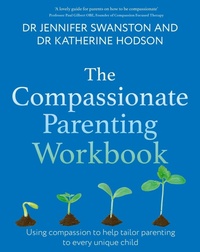
The Compassionate Parenting Workbook
Using compassion to help tailor parenting to every unique child
Published on 1. May 2025
Book
Paperback/Softback
240 pages
978-1-4721-4974-9 (ISBN)
Description
Parenting is hard. We live in a world that is rife with criticism and, unfortunately, this has a vast impact upon our wellbeing, with self-criticism leading to anxiety, guilt, sadness, shame and hopelessness. This naturally makes parenting feel even harder.
On the other hand, applying self-compassion can make you more emotionally resilient, have lower stress levels and healthier relationships. Being more compassionate gives you a greater sense of perceived personal control within your life, and these skills are proven to be passed on to children too - with better life outcomes for those who are brought up to receive compassion and be compassionate.
This book will introduce compassion to your life as a person, a parent, and in your approach to your child. Hopefully in the future, this will mean your child will adopt this way of relating to themselves and to others too.
USING THIS WORKBOOK, READERS WILL LEARN ABOUT:
- Managing the systems that drive us, cause us to react to threats, or soothe us.
- Developing a compassionate mind for yourself, and encouraging that in your children.
- Putting compassionate skills in action for specific problems like eating, sleeping and behaviour.
Filled with interactive exercises and practical skills, The Compassionate Parenting Workbook will guide you in your journey to be a more compassionate parent.
THE COMPASSIONATE MIND APPROACH
The self-help books in this series are based on compassion focused therapy (CFT, developed by series editor Paul Gilbert). This brings together an understanding of how our mind can cause us difficulties but also provides us with a powerful solution in the shape of mindfulness and compassion. It teaches ways to stimulate the part of the brain connected with kindness, warmth, compassion and safeness, and to calm the part that makes us feel, anxious, angry, sad or depressed.
On the other hand, applying self-compassion can make you more emotionally resilient, have lower stress levels and healthier relationships. Being more compassionate gives you a greater sense of perceived personal control within your life, and these skills are proven to be passed on to children too - with better life outcomes for those who are brought up to receive compassion and be compassionate.
This book will introduce compassion to your life as a person, a parent, and in your approach to your child. Hopefully in the future, this will mean your child will adopt this way of relating to themselves and to others too.
USING THIS WORKBOOK, READERS WILL LEARN ABOUT:
- Managing the systems that drive us, cause us to react to threats, or soothe us.
- Developing a compassionate mind for yourself, and encouraging that in your children.
- Putting compassionate skills in action for specific problems like eating, sleeping and behaviour.
Filled with interactive exercises and practical skills, The Compassionate Parenting Workbook will guide you in your journey to be a more compassionate parent.
THE COMPASSIONATE MIND APPROACH
The self-help books in this series are based on compassion focused therapy (CFT, developed by series editor Paul Gilbert). This brings together an understanding of how our mind can cause us difficulties but also provides us with a powerful solution in the shape of mindfulness and compassion. It teaches ways to stimulate the part of the brain connected with kindness, warmth, compassion and safeness, and to calm the part that makes us feel, anxious, angry, sad or depressed.
Reviews / Votes
A thoughtful, well-conceived resource that bridges psychological theory and the pragmatics of family life and parenting. For parents seeking to lead with kindness, curiosity, and emotional resilience, this book is a must-have. It is a step-by-step toolkit for cultivating more connected, compassionate relationships between parents and their children -- Dr Jane Gilmour * The Psychologist *More details
Series
Language
English
Place of publication
London
United Kingdom
Publishing group
Little, Brown Book Group
Product notice
Paperback (UK-trade)
Dimensions
Height: 204 mm
Width: 256 mm
Thickness: 20 mm
Weight
536 gr
ISBN-13
978-1-4721-4974-9 (9781472149749)
Copyright in bibliographic data and cover images is held by Nielsen Book Services Limited or by the publishers or by their respective licensors: all rights reserved.
Schweitzer Classification
Other editions
Additional editions
Jennifer Swanston | Katherine Hodson
The Compassionate Parenting Workbook
Using compassion to help tailor parenting to every unique child
E-Book
05/2025
Robinson
€3.99
Available for download
Persons
Dr Jen Swanston is a clinical psychologist specialising in working with young people and young people with a variety of difficulties. Since qualifying over 12 years ago, Jen has worked both within the NHS and in private practice. She specialises in supporting young people on the autism spectrum (diagnosis and intervention) and also young people with a variety of mental health difficulties. She also provides parenting support, using a variety of evidence-based approaches. Jen is also highly trained in many therapeutic models including CFT, CBT, ACT and DBT.
Dr Katherine Hodson qualified as a child & adolescent clinical psychologist in 2005. She has undertaken general and advanced training in compassion focused therapy, and regularly utilises this therapeutic model in her clinical practice, alongside CBT, ACT, systemic approaches and NVR. She was additionally trained in the MTFC programme in Oregan, USA. She has a special interest in working with the mental health needs of children and teenagers, plus working with those with an Autism Spectrum Disorder.
Together, they are the co-authors of: Brighter Futures: A Parent's Guide to Raising Happy, Confident Children in the Primary School Years.
Dr Katherine Hodson qualified as a child & adolescent clinical psychologist in 2005. She has undertaken general and advanced training in compassion focused therapy, and regularly utilises this therapeutic model in her clinical practice, alongside CBT, ACT, systemic approaches and NVR. She was additionally trained in the MTFC programme in Oregan, USA. She has a special interest in working with the mental health needs of children and teenagers, plus working with those with an Autism Spectrum Disorder.
Together, they are the co-authors of: Brighter Futures: A Parent's Guide to Raising Happy, Confident Children in the Primary School Years.