

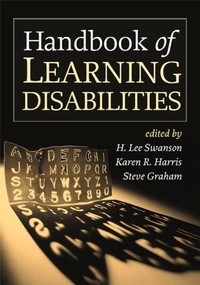
Handbook of Learning Disabilities
1st Edition
Published on 2. March 2006
Book
Paperback/Softback
587 pages
978-1-59385-303-7 (ISBN)
Description
This comprehensive Handbook reviews the major theoretical, methodological, and instructional advances that have occurred in the field of learning disabilities over the last 20 years. With contributions from leading researchers, the volume synthesizes a vast body of knowledge on the nature of learning disabilities, their relationship to basic psychological and brain processes, and how students with these difficulties can best be identified and treated. Findings are reviewed on ways to support student performance in specific skill areas - including language arts, math, science, and social studies - as well as general principles of effective instruction that cut across academic domains.
Reviews / Votes
'[This] is an excellent reference for any practitioner's library since it provides such a thorough overview of the LD field, and it would also serve well as a text for an introductory course in LD in teacher training programs.' - Educational Review'Swanson, Harris, and Graham have brought together the best researchers and thinkers in the field, who 'deliver the goods' on the full range of historical, conceptual, methodological, psychological, neurological, sociocultural, and instructional issues associated with the complex and elusive construct known as learning disabilities. A masterpiece.' - Edward J. Kame'enui, PhD, Institute for the Development of Educational Achievement, College of Education, University of Oregon, USA '[This] is an excellent reference for any practitioner's library since it provides such a thorough overview of the LD field, and it would also serve well as a text for an introductory course in LD in teacher training programs.' - Educational Review
'Swanson, Harris, and Graham have brought together the best researchers and thinkers in the field, who 'deliver the goods' on the full range of historical, conceptual, methodological, psychological, neurological, sociocultural, and instructional issues associated with the complex and elusive construct known as learning disabilities. A masterpiece.' - Edward J. Kame'enui, PhD, Institute for the Development of Educational Achievement, College of Education, University of Oregon, USA
'An invaluable book summarizing many key research programs related to LD.' - Contemporary Psychology
'There are several handbook-type volumes on learning disabilities on the market, but none matches this volume for comprehensiveness. The contributors represent an all-star cast of investigators who have built the field in the last two decades, and they address a wide range of problem areas, methodologies, and areas of scholarly and professional focus. The volume's coverage of instructional issues makes it an incredibly useful text for practitioner-oriented courses.' - Keith E. Stanovich, PhD, Department of Human Development and Applied Psychology, Ontario Institute for Studies in Education, University of Toronto, Canada
'The chapters in this volume offer an authoritative summary and analysis of core issues related to theory and practice in the LD field. The book should be required reading for all advanced students in the field. It is an indispensable graduate text and resource for scholars.' - C. Addison Stone, PhD, School of Education, University of Michigan, USA
More details
Language
English
Place of publication
New York
United States
Target group
College/higher education
Professional and scholarly
Dimensions
Height: 254 mm
Width: 178 mm
Weight
1056 gr
ISBN-13
978-1-59385-303-7 (9781593853037)
Copyright in bibliographic data and cover images is held by Nielsen Book Services Limited or by the publishers or by their respective licensors: all rights reserved.
Schweitzer Classification
Other editions
Additional editions
H. Lee Swanson | Karen R. Harris | Steve Graham
Handbook of Learning Disabilities
Book
07/2003
1st Edition
Guilford Publications
€94.27
Article exhausted; check different version
Persons
H. Lee Swanson, PhD, Graduate School of Education, University of California, Riverside
Karen R. Harris, EdD, Department of Special Education, Vanderbilt University;
Steve Graham, EdD, Department of Special Education, Vanderbilt University
Karen R. Harris, EdD, Department of Special Education, Vanderbilt University;
Steve Graham, EdD, Department of Special Education, Vanderbilt University
Content
Part I: Foundations and Current Perspectives. Swanson, Harris, Graham, Overview of Foundations, Causes, Instruction, and Methodology in the Field of Learning Disabilities. Hallahan, Mock, A Brief History of the Field of Learning Disabilities. Fletcher, Morris, Lyon, Classification and Definition of Learning Disabilities: An Integrative Perspective. Herr, Bateman, Learning Disabilities and the Law. Kavale, Forness, Learning Disability as a Discipline. Gersten, Baker, English-Language Learners with Learning Disabilities. Zigmond, Searching for the Most Effective Service Delivery Model for Students with Learning Disabilities. Part II: Causes and Behavioral Manifestations. Cutting, Denckla, Attention: Relationships Between Attention-Deficit/Hyperactivity Disorder and Learning Disabilities. Bowers, Ishaik, RAN's Contribution to Understanding Reading Disabilities. Siegel, Basic Cognitive Processes and Reading Disabilities. Swanson, Saez, Memory Difficulties in Children and Adults with Learning Disabilities. Geary, Learning Disabilities in Arithmetic: Problem-solving Differences and Cognitive Deficits. Mann, Language Processes: Keys to Reading Disability. Elbaum, Vaughn, Self-concept and Students with Learning Disabilities. Miller, Sanchez, Hynd, Neurological Correlates of Reading Disabilities. Thomson, Raskind, Genetic Influences on Reading and Writing Disabilities. Part III: Effective Instruction. Lovett, Barron, Benson, Effective Remediation of Word Identification and Decoding Difficulties in School-age Children with Reading Disabilities. Williams, Teaching Text Structure to Improve Reading Comprehension. L.S. Fuchs, D.S. Fuchs, Enhancing the Mathematical Problem Solving of Students with Mathematics Disabilities. Graham, Harris, Students with Learning Disabilities and the Process of Writing: A Meta-analysis of SRSD Studies. Berninger, Amtmann, Preventing Written Expression Disabilities through Early and Continuing Assessment and Intervention for Handwriting and/or Spelling Problems: Research into Practice. Scruggs, Mastropieri, Science and Social Studies. Part IV: Formation of Instructional Models. Wong, Harris, Graham, Butler, Cognitive Strategies Instruction Research in Learning Disabilities. Adams, Carnine, Direct Instruction. Jenkins, O'Connor, Cooperative Learning for Students with Learning Disabilities: Evidence from Experiments, Observations, and Interviews. D. S.Fuchs, L.S. Fuchs, McMaster, Otaiba, Identifying Children at Risk for Reading Failure: Curriculum-based Measurement and the Dual-discrepancy Approach. Englert, Mariage, The Sociocultural Model in Special Education Interventions: Apprenticing Students in Higher-order Thinking. Part V: Methodology. Abbott, Amtmann, Munson, Exploratory and Confirmatory Methods in Learning Disabilities Research. Schumaker, Deshler, Designs for Applied Educational Research. Speece, The Methods of Cluster Analysis and the Study of Learning Disabilities. S.E.Shaywitz, B.A. Shaywitz, Neurobiological Indices of Dyslexia. MacArthur, What Have We Learned about Learning Disabilities from Qualitative Research?: A Review of Studies.