

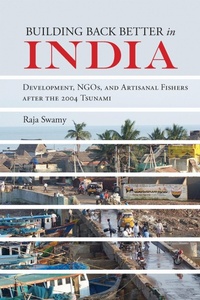
Building Back Better in India
Development, NGOs, and Artisanal Fishers After the 2004 Tsunami
Published on 30. July 2021
Book
Hardback
232 pages
978-0-8173-2097-3 (ISBN)
Description
Critically examines the role of humanitarian aid and disaster reconstruction
Building Back Better in India: Development, NGOs, and Artisanal Fishers after the 2004 Tsunami addresses the ways in which natural disasters impact the strategies and priorities of neoliberalizing states in the contemporary era. In the light of growing scholarly and public concern over 'disaster capitalism' and the tendency of states and powerful international financial institutions to view disasters as 'opportunities' to 'build back better,' Raja Swamy offers an ethnographically rich account of post-disaster reconstruction, its contested aims, and the mixed outcomes of state policy, humanitarian aid, and local resistance. Using the 2004 Indian Ocean tsunami as a case study, Swamy investigates the planning and implementation of a reconstruction process that sought to radically transform the geography of a coastal district in the Indian state of Tamil Nadu.
Drawing on an ethnographic study conducted in Tamil Nadu's Nagapattinam District, Swamy shows how and why the state-led, multilaterally financed, and NGO-mediated reconstruction prioritized the displacement of coastal fisher populations. Exploring the substantive differences shaping NGO action, specifically in response to core political questions affecting the well-being of their ostensible beneficiaries, this account also centers the political agency of disaster survivors and their allies among NGOs in contesting the meanings of recovery while navigating the process of reconstruction.
If humanitarian aid brought together NGOs and fishers as givers and recipients of aid, it also revealed in its workings competing and sometimes contradictory assumptions, goals, interests, and strategies driving the fraught historical relationship between artisanal fishers and the state. Importantly, this research foregrounds the ambiguous role of NGOs involved in the distribution of aid, as well as the agency and strategic actions of the primary recipients of aid-the fishers of Nagapattinam-as they struggled with a reconstruction process that made receipt of the humanitarian gift of housing conditional on the formal abandonment of all claims to the coast. Building Back Better in India thus bridges scholarly concerns with disasters, humanitarianism, and economic development with those focused on power, agency, and resistance.
Building Back Better in India: Development, NGOs, and Artisanal Fishers after the 2004 Tsunami addresses the ways in which natural disasters impact the strategies and priorities of neoliberalizing states in the contemporary era. In the light of growing scholarly and public concern over 'disaster capitalism' and the tendency of states and powerful international financial institutions to view disasters as 'opportunities' to 'build back better,' Raja Swamy offers an ethnographically rich account of post-disaster reconstruction, its contested aims, and the mixed outcomes of state policy, humanitarian aid, and local resistance. Using the 2004 Indian Ocean tsunami as a case study, Swamy investigates the planning and implementation of a reconstruction process that sought to radically transform the geography of a coastal district in the Indian state of Tamil Nadu.
Drawing on an ethnographic study conducted in Tamil Nadu's Nagapattinam District, Swamy shows how and why the state-led, multilaterally financed, and NGO-mediated reconstruction prioritized the displacement of coastal fisher populations. Exploring the substantive differences shaping NGO action, specifically in response to core political questions affecting the well-being of their ostensible beneficiaries, this account also centers the political agency of disaster survivors and their allies among NGOs in contesting the meanings of recovery while navigating the process of reconstruction.
If humanitarian aid brought together NGOs and fishers as givers and recipients of aid, it also revealed in its workings competing and sometimes contradictory assumptions, goals, interests, and strategies driving the fraught historical relationship between artisanal fishers and the state. Importantly, this research foregrounds the ambiguous role of NGOs involved in the distribution of aid, as well as the agency and strategic actions of the primary recipients of aid-the fishers of Nagapattinam-as they struggled with a reconstruction process that made receipt of the humanitarian gift of housing conditional on the formal abandonment of all claims to the coast. Building Back Better in India thus bridges scholarly concerns with disasters, humanitarianism, and economic development with those focused on power, agency, and resistance.
Reviews / Votes
After the 2004 tsunami in South India, reconstruction efforts leveraged the humanitarian gift of inland housing to relocate the artisanal fishing population and privatize the coastal commons. But the task of securing a spatial fix for capital accumulation failed. With keen ethnographic insight, Swamy shows how fishers sustained their claim to coastal life and livelihood while transforming humanitarian gifts into assets. Challenging assumptions about its depoliticizing and disciplining effects, he argues for humanitarianism as a contested process that can reset the contours of economy and politics." - Ajantha Subramanian, author of The Caste of Merit: Engineering Education in India"This rich, multi-level ethnography brings together a rich ethnography of a fishing community in India, with the largely separate literatures of humanitarianism, disaster studies and development studies, and offers new ways to help poor communities to remain political agents in the face of the forces of neo-liberalism." - Arjun Appadurai, author of India's World: The Politics of Creativity in a Globalized Society
More details
Series
Language
English
Place of publication
Alabama
United States
Target group
Professional and scholarly
Product notice
Cloth over boards
Illustrations
9 black & white figures, 1 map
Dimensions
Height: 231 mm
Width: 147 mm
Thickness: 28 mm
Weight
476 gr
ISBN-13
978-0-8173-2097-3 (9780817320973)
Copyright in bibliographic data and cover images is held by Nielsen Book Services Limited or by the publishers or by their respective licensors: all rights reserved.
Schweitzer Classification
Other editions
Additional editions

Raja Swamy
Building Back Better in India
Development, NGOs, and Artisanal Fishers after the 2004 Tsunami
E-Book
06/2021
1st Edition
University of Alabama Press
€140.99
Available for download
Person
Raja Swamy is assistant professor in the Department of Anthropology at the University of Tennessee, Knoxville.
Content
List of Figures
Preface
Acknowledgments
Abbreviations
Introduction: "Building Back Better"
Part I. Nagapattinam
Chapter 1. The Tsunami of 2004 and Its Aftermath
Chapter 2. Artisanal Fishers, the State, and an NGO
Part II. The Politics of Humanitarianism
Chapter 3. NGO Antipolitics and Politics
Chapter 4. The Humanitarian Gift Economy
Part III. Economic Development and Humanitarian Aid
Chapter 5. Unbridging the Future: Connectivity and Distance
Chapter 6. Memory, Space, and Power
Conclusion
Glossary
Notes
Bibliography
Index
Preface
Acknowledgments
Abbreviations
Introduction: "Building Back Better"
Part I. Nagapattinam
Chapter 1. The Tsunami of 2004 and Its Aftermath
Chapter 2. Artisanal Fishers, the State, and an NGO
Part II. The Politics of Humanitarianism
Chapter 3. NGO Antipolitics and Politics
Chapter 4. The Humanitarian Gift Economy
Part III. Economic Development and Humanitarian Aid
Chapter 5. Unbridging the Future: Connectivity and Distance
Chapter 6. Memory, Space, and Power
Conclusion
Glossary
Notes
Bibliography
Index