

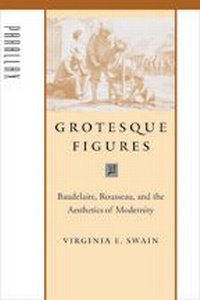
Grotesque Figures
Baudelaire, Rousseau, and the Aesthetics of Modernity
Published on 3. December 2004
Book
Hardback
288 pages
978-0-8018-7945-6 (ISBN)
Description
Charles Baudelaire is usually read as a paradigmatically modern poet, whose work ushered in a new era of French literature. But the common emphasis on his use of new forms and styles overlooks the complex role of the past in his work. In Grotesque Figures, Virginia E. Swain explores how the specter of the eighteenth century made itself felt in Baudelaire's modern poetry in the pervasive textual and figural presence of Jean-Jacques Rousseau. Not only do Rousseau's ideas inform Baudelaire's theory of the grotesque, but Rousseau makes numerous appearances in Baudelaire's poetry as a caricature or type representing the hold of the Enlightenment and the French Revolution over Baudelaire and his contemporaries. As a character in "Le Poeme du hashisch" and the Petits Poemes en prose, "Rousseau" gives the grotesque a human form. Swain's literary, cultural, and historical analysis deepens our understanding of Baudelaire and of nineteenth-century aesthetics by relating Baudelaire's poetic theory and practice to Enlightenment debates about allegory and the grotesque in the arts.
Offering a novel reading of Baudelaire's ambivalent engagement with the eighteenth-century, Grotesque Figures examines nineteenth-century ideological debates over French identity, Rousseau's political and artistic legacy, the aesthetic and political significance of the rococo, and the presence of the grotesque in the modern.
Offering a novel reading of Baudelaire's ambivalent engagement with the eighteenth-century, Grotesque Figures examines nineteenth-century ideological debates over French identity, Rousseau's political and artistic legacy, the aesthetic and political significance of the rococo, and the presence of the grotesque in the modern.
Reviews / Votes
Grotesque Figures is an important work that rethinks the boundary between eighteenth and nineteenth century studies, offering nuanced interpretations of Rousseau, Baudelaire, and the modernity they represent. French Forum 2005 This well argued text on pantomime offers a fascinating investigation of a subgenre of British theater. -- Elisabeth Heard Scriblerian 2006 A fresh context for looking at Baudelaire. -- Patricia A. Ward L'Esprit Createur 2006 Swain's wonderful explication of 'La Corde' alone is worth the price of the book. -- Johnson Kent Wright Journal of Modern History 2006 Her comparative analysis of Rousseau's writings and Baudelaire's prose poems are often breathtakingly original, themselves extraordinary hybrids of the social, the historical, the political, and the poetic. -- Tammy Berberi Journal of the Midwest Modern Language Association 2007 Swain's reading of Baudelaire's reception of Rousseau is provocative and stimulating. -- Thomas Cooksey South Atlantic Review 2008More details
Series
Language
English
Place of publication
Baltimore, MD
United States
Target group
Professional and scholarly
College/higher education
Product notice
sewn/stitched
Cloth over boards
Illustrations
7 s/w Photographien bzw. Rasterbilder, 3 s/w Zeichnungen
3 Line drawings, black and white; 7 Halftones, black and white
Dimensions
Height: 236 mm
Width: 160 mm
Thickness: 22 mm
Weight
522 gr
ISBN-13
978-0-8018-7945-6 (9780801879456)
DOI
10.1353/book.60319
Copyright in bibliographic data and cover images is held by Nielsen Book Services Limited or by the publishers or by their respective licensors: all rights reserved.
Schweitzer Classification
Other editions
Additional editions
E-Book
04/2020
Johns Hopkins University Press
€52.49
Available for download
Person
Virginia E. Swain is professor of French at Dartmouth College.
Content
List of Illustrations
Acknowledgments
List of Abbreviations
Introduction
1. The Grotesque: Definitions and Figures
2. Rococo Rhetoric: Figures of the Past in "Le Poeme du hachisch"
3. Identity Politics: "Rousseau" and "France" in the Mid-Nineteenth Century
4. Baudelaire's Physiologie: Rousseau as Caricature and Type in the Prose Poems
5. Machines, Monsters, and Men: Realism and the Modern Grotesque
6. The Sociopolitical Implications of the Grotesque: "Opera" and "Les Yeux des pauvres"
7. Rousseau, Trauma, and Fetishism: "Le Vieux Saltimbanque"
Conclusion
Notes
Selected Bibliography
Index
Acknowledgments
List of Abbreviations
Introduction
1. The Grotesque: Definitions and Figures
2. Rococo Rhetoric: Figures of the Past in "Le Poeme du hachisch"
3. Identity Politics: "Rousseau" and "France" in the Mid-Nineteenth Century
4. Baudelaire's Physiologie: Rousseau as Caricature and Type in the Prose Poems
5. Machines, Monsters, and Men: Realism and the Modern Grotesque
6. The Sociopolitical Implications of the Grotesque: "Opera" and "Les Yeux des pauvres"
7. Rousseau, Trauma, and Fetishism: "Le Vieux Saltimbanque"
Conclusion
Notes
Selected Bibliography
Index