

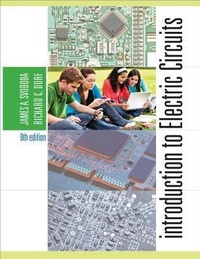
Introduction to Electric Circuits
9th Edition
Published on 11. March 2013
Book
Hardback
928 pages
978-1-118-47750-2 (ISBN)
Description
Known for its clear problem-solving methodology and it emphasis on design, as well as the quality and quantity of its problem sets, Introduction to Electric Circuits, Ninth Edition by Dorf and Svoboda will help readers to think like engineers. Abundant design examples, design problems, and the How Can We Check feature illustrate the texts focus on design. The 9th edition continues the expanded use of problem-solving software such as PSpice and MATLAB.
More details
Edition
9th Revised edition
Language
English
Place of publication
New York
United States
Target group
Professional and scholarly
Edition type
Revised edition
Product notice
sewn/stitched
Cloth over boards
Dimensions
Height: 251 mm
Width: 211 mm
Thickness: 36 mm
Weight
1724 gr
ISBN-13
978-1-118-47750-2 (9781118477502)
Copyright in bibliographic data and cover images is held by Nielsen Book Services Limited or by the publishers or by their respective licensors: all rights reserved.
Schweitzer Classification
Other editions
Previous edition
Richard C. Dorf | James A. Svoboda
Introduction to Electric Circuits
Book
01/2010
8th Edition
Wiley
€169.60
Shipment within 10-20 days
Persons
James A. Svoboda is an associate professor of electrical and computer engineering at Clarkson University where he teaches courses on topics such as circuits electronics, and computer programming. He earned a Ph.D. in electrical engineering from the University of Wisconsin, Madison, and M.S. from the University of Colorado, and a B. S. from General Motors Institute.
Sophomore Circuits is one of Professor Svoboda's favorite courses. He has taught this course to 2500 undergraduates at Clarkson University over the past 21 years. In 1996, he received Clarkson University's Distinguished Teaching Award.
Professor Svoboda has written several research papers describing the advantages of using nullors to model electric circuits for computer analysis. He is interested in the way technology affects engineering education and has developed several software packages for use in Sophomore Circuits.
Richard C. Dorf professor of electrical and computer engineering at the University of California, Davis, teaches graduate and undergraduate courses in electrical engineering in the fields of circuits and control systems. He earned a Ph.D. in electrical engineering from the U.S. Naval Postgraduate School, an M.S. from the University of Colorado and a B.S. from Clarkson University. Highly concerned with the discipline of electrical engineering and its wide value to social and economic needs, he has written and lectured internationally on the contributions and advances in electrical engineering.
Professor Dorf has extensive experience with education and industry and its professionally active in the fields of robotics, automation, electric circuits, and communications. He has served as a visiting professor at the University of Edinburgh, Scotland; The Massachusetts Institute of Technology; Stanford University; of California, Berkeley.
A Fellow of the Institute of Electrical and Electronic Engineers, Dr. Dorf is widely known to the profession for his Modern Control Systems, Eighth Edition (Addison-Wesley, 1998) and The International Encyclopedia of Robotics (Wiley 1988). Dr. Dorf is also the coauthor of Circuits, Devices and Systems (with Ralph Smith), Fifth Edition (Wiley, 1992). Dr. Dorf edited the widely used Electrical Engineering Handbook, Second Edition (CRC Press and IEEE Press) published in 1997.
Sophomore Circuits is one of Professor Svoboda's favorite courses. He has taught this course to 2500 undergraduates at Clarkson University over the past 21 years. In 1996, he received Clarkson University's Distinguished Teaching Award.
Professor Svoboda has written several research papers describing the advantages of using nullors to model electric circuits for computer analysis. He is interested in the way technology affects engineering education and has developed several software packages for use in Sophomore Circuits.
Richard C. Dorf professor of electrical and computer engineering at the University of California, Davis, teaches graduate and undergraduate courses in electrical engineering in the fields of circuits and control systems. He earned a Ph.D. in electrical engineering from the U.S. Naval Postgraduate School, an M.S. from the University of Colorado and a B.S. from Clarkson University. Highly concerned with the discipline of electrical engineering and its wide value to social and economic needs, he has written and lectured internationally on the contributions and advances in electrical engineering.
Professor Dorf has extensive experience with education and industry and its professionally active in the fields of robotics, automation, electric circuits, and communications. He has served as a visiting professor at the University of Edinburgh, Scotland; The Massachusetts Institute of Technology; Stanford University; of California, Berkeley.
A Fellow of the Institute of Electrical and Electronic Engineers, Dr. Dorf is widely known to the profession for his Modern Control Systems, Eighth Edition (Addison-Wesley, 1998) and The International Encyclopedia of Robotics (Wiley 1988). Dr. Dorf is also the coauthor of Circuits, Devices and Systems (with Ralph Smith), Fifth Edition (Wiley, 1992). Dr. Dorf edited the widely used Electrical Engineering Handbook, Second Edition (CRC Press and IEEE Press) published in 1997.
Content
Chapter 1: Electric Circuit Variables Chapter 2: Circuit Elements Chapter 3: Resistive Circuits Chapter 4: Methods of Analysis of Resistive Circuits Chapter 5: Circuit Theorems Chapter 6: The Operational Amplifier Chapter 7: Energy Storage Elements Chapter 8: The Complete Response of RL and RC Circuits Chapter 9: The Complete Response of Circuits with Two Energy Storage Elements Chapter 10: Sinusoidal Steady-State Analysis Chapter 11: AC Steady-State Power Chapter 12: Three-Phase Circuits Chapter 13: Frequency Response Chapter 14: The Laplace Transform Chapter 15: Fourier Series and Fourier Transform Chapter 16: Filter Circuits Chapter 17: Two-Port and Three-Port Networks