

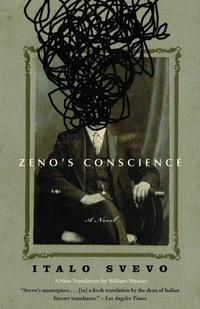
Zeno's Conscience
A Novel
Published on 4. February 2003
Book
Paperback/Softback
464 pages
978-0-375-72776-4 (ISBN)
Description
Long hailed as a seminal work of modernism in the tradition of Joyce and Kafka, and now available in a supple new English translation, Italo Svevo’s charming and splendidly idiosyncratic novel conducts readers deep into one hilariously hyperactive and endlessly self-deluding mind. The mind in question belongs to Zeno Cosini, a neurotic Italian businessman who is writing his confessions at the behest of his psychiatrist. Here are Zeno’s interminable attempts to quit smoking, his courtship of the beautiful yet unresponsive Ada, his unexpected–and unexpectedly happy–marriage to Ada’s homely sister Augusta, and his affair with a shrill-voiced aspiring singer. Relating these misadventures with wry wit and a perspicacity at once unblinking and compassionate, Zeno’s Conscience is a miracle of psychological realism.
More details
Series
Language
English
Place of publication
New York
United States
Product notice
Paperback (trade)
Illustrations
1 MAP
Dimensions
Height: 203 mm
Width: 131 mm
Thickness: 25 mm
Weight
322 gr
ISBN-13
978-0-375-72776-4 (9780375727764)
Copyright in bibliographic data and cover images is held by Nielsen Book Services Limited or by the publishers or by their respective licensors: all rights reserved.
Schweitzer Classification
Other editions
Additional editions
Persons
Italo Svevo, whose real name was Ettore Schmitz, was born in Trieste in 1861. He was educated in Trieste and in a commercial school in Germany and returned to his birthplace to begin a business career that he pursued successfully until his death. He published three novels (at his own expense): Una vita (1892; English translation: A Life), Senilità (1898; English translation: Emilio’s Carnival; also translated under the title As a Man Grows Older), and La coscienza di Zeno (1923; English translation: Zeno’s Conscience; also translated under the title Confessions of Zeno). After his first two novels were ignored, Svevo considered giving up writing and devoting himself full-time to business. Aiming to improve his English, he fell under the tutelage of James Joyce, twenty years his junior. Svevo read early portions of Dubliners, and Joyce read Svevo’s two novels and encouraged him to take up writing again. When Svevo completed Zeno’s Conscience, Joyce arranged to have it published in France, where Svevo was dubbed “the Italian Proust.” He soon emerged from obscurity in Italy, and his rank as a major writer was already established when he died in a car accident in 1928.