

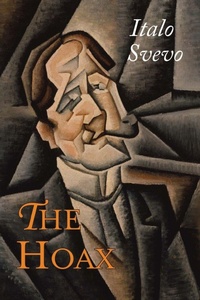
The Hoax
[A Perfect Hoax]
Published on 11. August 2017
Book
Paperback/Softback
168 pages
978-1-68422-138-7 (ISBN)
Description
2017 Reprint of 1930 Edition. Full facsimile of the original edition, not reproduced with Optical Recognition software. Influenced by the rise of the science of psychology and the turmoil of the early 20th century, The Hoax [also translated as A Perfect Hoax] is an ironic and affectionate story of illusion, self-deception, and impracticality in a practical world. Mario Samigli is in his seventies; he has all but given up his cherished aspirations as a writer and smiles at the world through his one remaining literary outlet—fables. When a travelling salesman with a taste for practical jokes persuades him that a Viennese publishing company wants to translate his early failed novel, Mario is caught in a fantasy of success and fame, and neglects his beloved invalid brother. The Hoax follows the elaborate prank as it escalates, forcing Mario blindly down a road that can only lead to disappointment.
More details
Language
English
Product notice
Paperback (trade)
Unsewn / adhesive bound
Dimensions
Height: 234 mm
Width: 156 mm
Thickness: 10 mm
Weight
266 gr
ISBN-13
978-1-68422-138-7 (9781684221387)
Copyright in bibliographic data and cover images is held by Nielsen Book Services Limited or by the publishers or by their respective licensors: all rights reserved.
Schweitzer Classification
Persons
The father of modern Italian novel, Italo Svevo (pseudonym of Ettore Schmitz) was an Italian novelist, playwright, short story writer, essayist, critic and business man.Svevo (whose pseudonym means "Italian Swabian") was the son of a German-Jewish glassware merchant and an Italian mother. At 12 he was sent to a boarding school near Würzburg, Germany. He later returned to a commercial school in Trieste, but his father's business difficulties forced him to leave school and become a bank clerk. He continued to read on his own and began to write.Svevo's first novel, A Life (1892), was revolutionary in its analytic, introspective treatment of the agonies of an ineffectual hero (a pattern Svevo repeated in subsequent works). A powerful but rambling work, the book was ignored upon its publication. So was its successor, As a Man Grows Older (1898), featuring another bewildered hero. Svevo had been teaching at a commercial school, and, with As a Man's failure, he formally gave up writing and became engrossed in his father-in-law's business.Ironically, business frequently required Svevo to visit England in the years that followed, and a decisive step in his life was to engage a young man, James Joyce, in 1907 as his English tutor in Trieste. They became close friends, and Joyce let the middle-aged businessman read portions of his unpublished Dubliners, after which Svevo timidly produced his own two novels. Joyce's tremendous admiration for them, along with other factors, encouraged Svevo to return to writing. He wrote what became his most famous novel, Confessions of Zeno (1923), a brilliant work in the form of a patient's statement for his psychiatrist. Published at Svevo's own expense, as were his other works, this novel was also a failure, until a few years later, when Joyce gave Svevo's work to two French critics, Valéry Larbaud and Benjamin Cremieux, who publicised him and made him famous.While working on a sequel to Zeno, Svevo was killed in an automobile accident. Svevo has been recognised as one of the most important figures in modern Italian literary history and his three novels, A Life, As a Man Grows Older and Confessions of Zeno, are all recognised as masterpieces of Italian literature.