

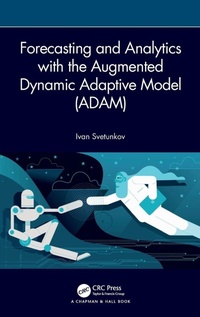
Forecasting and Analytics with the Augmented Dynamic Adaptive Model (ADAM)
1st Edition
Published on 17. November 2023
Book
Hardback
466 pages
978-1-032-59037-0 (ISBN)
Description
Forecasting and Analytics with the Augmented Dynamic Adaptive Model (ADAM) focuses on a time series model in Single Source of Error state space form, called "ADAM" (Augmented Dynamic Adaptive Model). The book demonstrates a holistic view to forecasting and time series analysis using dynamic models, explaining how a variety of instruments can be used to solve real life problems. At the moment, there is no other tool in R or Python that would be able to model both intermittent and regular demand, would support both ETS and ARIMA, work with explanatory variables, be able to deal with multiple seasonalities (e.g. for hourly demand data) and have a support for automatic selection of orders, components and variables and provide tools for diagnostics and further improvement of the estimated model. ADAM can do all of that in one and the same framework. Given the rising interest in forecasting, ADAM, being able to do all those things, is a useful tool for data scientists, business analysts and machine learning experts who work with time series, as well as any researchers working in the area of dynamic models.
Key Features:
* It covers basics of forecasting,
* It discusses ETS and ARIMA models,
* It has chapters on extensions of ETS and ARIMA, including how to use explanatory variables and how to capture multiple frequencies,
* It discusses intermittent demand and scale models for ETS, ARIMA and regression,
* It covers diagnostics tools for ADAM and how to produce forecasts with it,
* It does all of that with examples in R.
Key Features:
* It covers basics of forecasting,
* It discusses ETS and ARIMA models,
* It has chapters on extensions of ETS and ARIMA, including how to use explanatory variables and how to capture multiple frequencies,
* It discusses intermittent demand and scale models for ETS, ARIMA and regression,
* It covers diagnostics tools for ADAM and how to produce forecasts with it,
* It does all of that with examples in R.
More details
Language
English
Place of publication
United Kingdom
Publishing group
Taylor & Francis Ltd
Target group
Professional and scholarly
Academic
Illustrations
54 s/w Abbildungen, 111 farbige Abbildungen, 6 s/w Tabellen, 109 farbige Zeichnungen, 54 s/w Zeichnungen, 2 Farbfotos bzw. farbige Rasterbilder
6 Tables, black and white; 109 Line drawings, color; 54 Line drawings, black and white; 2 Halftones, color; 111 Illustrations, color; 54 Illustrations, black and white
Dimensions
Height: 240 mm
Width: 161 mm
Thickness: 31 mm
Weight
901 gr
ISBN-13
978-1-032-59037-0 (9781032590370)
Copyright in bibliographic data and cover images is held by Nielsen Book Services Limited or by the publishers or by their respective licensors: all rights reserved.
Schweitzer Classification
Other editions
Additional editions
E-Book
11/2023
1st Edition
Chapman & Hall/CRC
€73.99
Available for download
E-Book
11/2023
1st Edition
Chapman & Hall/CRC
€73.99
Available for download
Person
Ivan Svetunkov is a Lecturer of Marketing Analytics at Lancaster University, UK and a Marketing Director of Centre for Marketing Analytics and Forecasting. He has PhD in Management Science from Lancaster University and a candidate degree in economics from Saint Petersburg State University of Economics and Finance, Russia. His areas of interests includes statistical methods of analytics and forecasting, focusing on demand forecasting in healthcare, supply chain and retail. He is a creator and a maintainer of several forecasting and analytics-related R packages, such as greybox, smooth and legion.
Content
1. Introduction 2. Forecasts evaluation 3. Time series components and simple forecasting methods 4. Introduction to ETS 5. Pure additive ADAM ETS 6. Pure multiplicative ADAM ETS 7. General ADAM ETS model 8. Introduction to ARIMA 9. ADAM ARIMA 10. Explanatory variables in ADAM 11. Estimation of ADAM 12. Multiple frequencies in ADAM 13. Intermittent State Space Model 14. Model diagnostics 15. Model selection and combinations in ADAM 16. Handling uncertainty in ADAM 17. Scale model for ADAM 18. Forecasting with ADAM 19. Forecasting functions of the smooth package 20. What's next?