

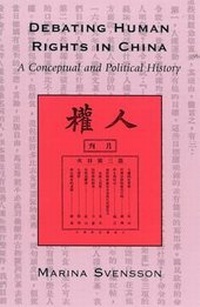
Debating Human Rights in China
A Conceptual and Political History
Published on 14. May 2002
Book
Hardback
400 pages
978-0-7425-1696-0 (ISBN)
Description
Tracing the concept of human rights in Chinese political discourse since the late Qing dynasty, this comprehensive history convincingly demonstrates that-contrary to conventional wisdom-there has been a vibrant debate on human rights throughout the twentieth century. Drawing on little-known sources, Marina Svensson argues that the concept of human rights was invoked by the Chinese people well before the adoption of the Universal Declaration of Human Rights in 1948, and that it has continued to have strong appeal after 1949, both in Taiwan and on the mainland. These largely forgotten debates provide important perspectives on and contrasts to the official PRC line. The author gives particular attention to the issues of power and agency in describing the widely divergent views of official spokespersons, establishment intellectuals, and dissidents. Until quite recently the PRC dismissed human rights as a bourgeois slogan. Yet the globalization of human rights and the growing importance of the issue in bilateral and multilateral relations have forced the regime to embrace, or rather appropriate, the language of human rights, an appropriation that continues to be vigorously challenged by dissidents at home and abroad. By exploring the relationship between domestic and international human rights discourses, this study offers new insights not only into the Chinese but also into the Western human rights debate. Students and scholars of China and of human rights will find this work an important tool for understanding one of the great issues of our time.
Reviews / Votes
This study demonstrates the diversity of perspectives on the existence and scope of human rights in China from the end of the Qing dynasty to the present....Highly recommended . * CHOICE * Well-written. Svensson is thoroughly steeped in the Chinese-language literature on the subject and has found an astonishing amount of material. The book is so comprehensive that it will doubtless stand as the definitive work until conditions in China change. * The China Journal * [Provides] engaging and provocative materials for anyone interested in human rights and in social, political, and cultural transformations in China....[A] rich and contested discourse woven together sensibly and intelligently....[A] friendly textbook for instructors and students of Chinese political culture. * China Quarterly * Marina Svensson has written a sophisticated, nuanced, complex history of human rights discource in China in the twentieth century. As she has argued and proven with her in-depth research, human rights discourse is not alien to China. * Journal of Asian Studies * The book is rich in details, comprehensive in scope and careful in its exposition. It also has a superb bibliography of the writings of Chinese intellectuals since the early twentieth century. The book is a very good guide for anyone who wants to understand Chinese rights thinking in the past century. * Political Studies Review * Marina Svensson takes a topic about which much has been written and turns it inside out in fascinating and unexpected ways through careful readings of a range of important yet often overlooked Chinese documents. The end result is a sophisticated study that illuminates the complex process by which visions of freedom and cultural traditions can clash, intersect, and reshape one another. -- Jeffrey N. Wasserstrom, University of California, Irvine; author of China's Brave New World-And Other Tales for Global Times Svensson is the ideal person to write this history. Although she is an excellent scholar, she is more than that. As she puts it, 'In my case, human rights activism came first and academic work only later' (p. xii). As a result, her book is imbued with passion, while at the same time characterized by a meticulous regard for the evidence. * Pacific Affairs * Marina Svensson has crafted an analytical history tracing the political and conceptual journey of the idea of human rights. * China Rights Forum *More details
Language
English
Place of publication
United States
Publishing group
Bloomsbury Publishing Plc
Dimensions
Height: 234 mm
Width: 149 mm
Thickness: 29 mm
Weight
644 gr
ISBN-13
978-0-7425-1696-0 (9780742516960)
Copyright in bibliographic data and cover images is held by Nielsen Book Services Limited or by the publishers or by their respective licensors: all rights reserved.
Schweitzer Classification
Other editions
Additional editions
E-Book
05/2002
1st Edition
Rowman & Littlefield Publishers
€55.99
Available for download
Person
Marina Svensson is assistant professor in the Department of East Asian Languages, Lund University. She is the coeditor of The Chinese Human Rights Reader.
Content
Chapter 1 Debating Human Rights in China: Introductory Perspectives Chapter 2 The Conception of Human Rights in the West: Historical Origin and Contemporary Controversies Chapter 3 Culture and Human Rights: Between Universalism and Relativism Chapter 4 China and the Introduction of Western Thought Chapter 5 Ideas of Human Rights in the Early Twentieth Century: The Quest for National Salvation Chapter 6 The New Culture Movement and Beyond: Human Rights and the Liberation of the Individual Chapter 7 The Nanking Decade, 1927-1937: Liberal and Radical Voices on Human Rights Chapter 8 Human Rights Debate in Wartime China: Between Individual Freedom and National Salvation Chapter 9 The 1950s: Human Rights Debates on Two Sides of the Taiwan Strait Chapter 10 The Domestic Challenge Over Human Rights: The Democracy Wall Activists and the Official Reaction, 1978-1982 Chapter 11 A Contested and Evolving Discourse: Human Rights Debates since the Late 1980s Chapter 12 The Chinese Human Rights Debate: Conclusion and Prospects Chapter 13 Glossary