

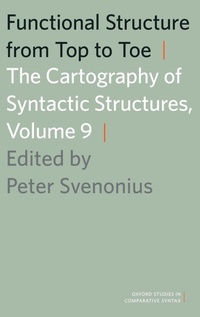
Functional Structure from Top to Toe
The Cartography of Syntactic Structures, Volume 9
Published on 30. October 2014
Book
Hardback
336 pages
978-0-19-974039-0 (ISBN)
Description
This volume consists of nine original chapters on central issues in theoretical syntax, all written by distinguished authors who have made major contributions to generative syntax, plus an introductory chapter by the editor. Dedicated to Tarald Taraldsen, the collection reflects the diverse energies that have pushed the cartographic program forward over the last decade.
The first three papers deal with subject extraction, the que/qui alternation, and relative clause formation. Luigi Rizzi presents arguments that subjects are 'criterial' and that subject extraction is highly restricted. Hilda Koopman and Dominique Sportiche concur, suggesting that what appears to be subject extraction in French has been misanalyzed, and involves a relative structure. Adriana Belletti shows that children avoid using object relatives, preferring subject relatives, even when it requires passivization.
The fourth paper, by Ian Roberts, analyzes the loss of pro-drop in the history of French and Brazilian Portuguese. The papers by M. Rita Manzini and Richard S. Kayne both present novel analyses of complementizers, suggesting that they are essentially nominal, rather than verbal.
The final three papers address the relationship of morphology to syntax. The first two argue for a syntactic approach to word formation, Guglielmo Cinque's in a typological context and Anders Holmberg's within an analysis of Finnish focus constructions. The final paper, by Edwin Williams, presents an argument for the limitations of the syntactic approach to word formation.
The first three papers deal with subject extraction, the que/qui alternation, and relative clause formation. Luigi Rizzi presents arguments that subjects are 'criterial' and that subject extraction is highly restricted. Hilda Koopman and Dominique Sportiche concur, suggesting that what appears to be subject extraction in French has been misanalyzed, and involves a relative structure. Adriana Belletti shows that children avoid using object relatives, preferring subject relatives, even when it requires passivization.
The fourth paper, by Ian Roberts, analyzes the loss of pro-drop in the history of French and Brazilian Portuguese. The papers by M. Rita Manzini and Richard S. Kayne both present novel analyses of complementizers, suggesting that they are essentially nominal, rather than verbal.
The final three papers address the relationship of morphology to syntax. The first two argue for a syntactic approach to word formation, Guglielmo Cinque's in a typological context and Anders Holmberg's within an analysis of Finnish focus constructions. The final paper, by Edwin Williams, presents an argument for the limitations of the syntactic approach to word formation.
More details
Series
Language
English
Place of publication
New York
United States
Target group
College/higher education
Dimensions
Height: 240 mm
Width: 161 mm
Thickness: 23 mm
Weight
672 gr
ISBN-13
978-0-19-974039-0 (9780199740390)
Copyright in bibliographic data and cover images is held by Nielsen Book Services Limited or by the publishers or by their respective licensors: all rights reserved.
Schweitzer Classification
Other editions
Additional editions
Peter Svenonius
Functional Structure from Top to Toe
The Cartography of Syntactic Structures, Volume 9
Book
10/2014
Oxford University Press Inc
€66.60
Shipment within 15-20 days
Peter Svenonius
Functional Structure from Top to Toe
The Cartography of Syntactic Structures, Volume 9
E-Book
09/2014
1st Edition
OUP eBook
€29.49
Available for download
Person
Peter Svenonius is a Professor in the Department of Linguistics at the University of Tromso -The Arctic University of Norway, and is the Director of CASTL, the Center for Advanced Study in Theoretical Linguistics. He has published on a range of subjects in theoretical linguistics.
Content
Preface ; 1. Introduction ; Peter Svenonius ; 2. Again on Tense, Aspect, Mood Morpheme Order and the "Mirror Principle" ; Guglielmo Cinque ; 3. The Syntax of the Finnish Question Particle ; Anders Holmberg ; 4. Derivational Prefixes are Projective, not Realizational ; Edwin Williams ; 5. The Romance k- complementizers ; M. Rita Manzini ; 6. "Why Isn't This a Complementizer?" ; Richard S. Kayne ; 7. Taraldsen's Generalisation and Language Change: Two Ways to Lose Null Subjects ; Ian Roberts ; 8. Notes on Passive Object Relatives ; Adriana Belletti ; 9. Some Consequences of Criterial Freezing: Asymmetries, Anti-adjacency and Extraction from Cleft Sentences ; Luigi Rizzi ; 10. The que/qui Alternation: New Analytical Directions ; Hilda Koopman and Dominique Sportiche