

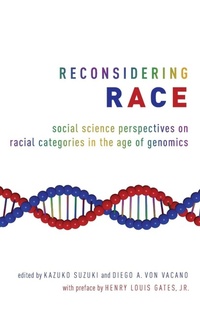
Reconsidering Race
Social Science Perspectives on Racial Categories in the Age of Genomics
Published on 7. June 2018
Book
Hardback
324 pages
978-0-19-046528-5 (ISBN)
Description
Race is one of the most elusive phenomena of social life. While we generally know it when we see it, it's not an easy concept to define. Social science literature has argued that race is a Western, socio-political concept that emerged with the birth of modern imperialism, whether in the sixteenth century (the Age of Discovery) or the eighteenth century (the Age of Enlightenment). The editors of this book point out that there is a disjuncture between the way race is conceptualized in the social science and medical literature: some of the modern sciences employ racial and ethnic categories, but they do so to analyze, diagnose, and treat particular conditions such as organ transplants for mixed-race children, heart disease, cancer, osteoporosis, skin disorders, obesity, and gastrointestinal diseases. As such, race has a physical, as opposed to a purely social, dimension.
In order to more fully understand what we mean by "race", social scientists need to engage genetics, medicine, and health. To be sure, the long shadow of eugenics and the Nazi use of scientific racism have cast a pall over the effort to understand this complicated relationship between social science and race. But while the contributors of this volume reject pseudoscience and hierarchical ways of looking at race, they make the claim that it is time to reassess the Western-based, "social construction" paradigm. The chapters in this book consider three fundamental tensions in thinking about race: one between theories that see race as fixed or malleable; a second between the idea that race is a universal but modern Western concept and the idea that it has a deeper and more complicated cultural history; and a third between socio-political and biological/bio-medical concepts of race. Arguing that race is not merely socially constructed, the contributors, including Henry Louis Gates, Jr., Ann Morning, Jennifer Hochschild, Rogers Brubaker, Michael Keevak, Carolyn Rouse, and Sandra Soo-Jin Lee, offer a provocative collection of views on the way that social scientists must reconsider the idea of race in the age of genomics.
In order to more fully understand what we mean by "race", social scientists need to engage genetics, medicine, and health. To be sure, the long shadow of eugenics and the Nazi use of scientific racism have cast a pall over the effort to understand this complicated relationship between social science and race. But while the contributors of this volume reject pseudoscience and hierarchical ways of looking at race, they make the claim that it is time to reassess the Western-based, "social construction" paradigm. The chapters in this book consider three fundamental tensions in thinking about race: one between theories that see race as fixed or malleable; a second between the idea that race is a universal but modern Western concept and the idea that it has a deeper and more complicated cultural history; and a third between socio-political and biological/bio-medical concepts of race. Arguing that race is not merely socially constructed, the contributors, including Henry Louis Gates, Jr., Ann Morning, Jennifer Hochschild, Rogers Brubaker, Michael Keevak, Carolyn Rouse, and Sandra Soo-Jin Lee, offer a provocative collection of views on the way that social scientists must reconsider the idea of race in the age of genomics.
Reviews / Votes
"What becomes clear from reading the chapters in this volume is just how important it is to employ a social constructivist lens to view the new narratives surrounding genomic science. So while the editors of Reconsidering Race maintain that the social sciences would do better to adapt their frameworks to encompass knowledge learned from genomics, the many rich contributions to this volume actually show that the hard sciences could stand to learn something from the social sciences." - Perspectives on Politics "[This] volume delivers quite effectively on its promise to broaden the conversation about race and science beyond Euro-American bordersaa true strength of the collection." - American Journal of Human Biology "When social scientists and humanists fail to engage the discourses of the sciences, both scientists and the general public are left without the broader context of meaning that we all need in order to understand the stakes of urgent medical questions or of revelations about the human genome and what these might portend for our personal and shared futures. This collection of essays represents the promise of meaningful colloquy across the disciplines, bringing together some of our most gifted scholars to think about new ways to place science and the humanities in conversation, and to expand and complicate our understanding of race on both an historical and global scale."- Henry Louis Gates, Jr., Harvard University, from the preface "Reconsidering Race is a thoughtful and illuminating collection of essays that should be required reading for students and teachers alike. In this engaging volume, leading scholars in the social sciences, humanities, and biology address how genetics are reconfiguring our notions of relatedness and difference and reshaping the meaning of race. They show what's at stake are not only claims about who we are but also the paths we may take for addressing the continuing problems of racial or ethnic inequalities."-Catherine Lee, author of Fictive Kinship "This estimable volume productively interrupts some of our most dearly-held convictions about the relationship between race and genetics, taking the genomics turn as an opportunity to rigorously reexamine and adapt existing social science paradigms."-Alondra Nelson, author of The Social Life of DNA: Race, Reparations, and Reconciliation After the GenomeMore details
Language
English
Place of publication
New York
United States
Target group
Professional and scholarly
Dimensions
Height: 240 mm
Width: 161 mm
Thickness: 22 mm
Weight
652 gr
ISBN-13
978-0-19-046528-5 (9780190465285)
Copyright in bibliographic data and cover images is held by Nielsen Book Services Limited or by the publishers or by their respective licensors: all rights reserved.
Schweitzer Classification
Other editions
Additional editions
Kazuko Suzuki | Diego A. von Vacano
Reconsidering Race
Social Science Perspectives on Racial Categories in the Age of Genomics
E-Book
05/2018
1st Edition
OUP eBook
€39.49
Available for download
Kazuko Suzuki | Diego A. von Vacano
Reconsidering Race
Social Science Perspectives on Racial Categories in the Age of Genomics
E-Book
05/2018
1st Edition
OUP eBook
€51.49
Available for download
Persons
Kazuko Suzuki is Associate Professor of Sociology at Texas A&M University and the author of Divided Fates: The State, Race, and Korean Immigrants' Adaptation in Japan and the United States, winner of the 2017 Book Award on Asia/Transnational from the Asia and Asian American Section of the American Sociological Association.
Diego A. von Vacano is Associate Professor of Political Science at Texas A&M University and the author of The Color of Citizenship: Race, Modernity and Latin American/Hispanic Political Thought and The Art of Power: Machiavelli, Nietzsche and the Making of Aesthetic Political Theory.
Diego A. von Vacano is Associate Professor of Political Science at Texas A&M University and the author of The Color of Citizenship: Race, Modernity and Latin American/Hispanic Political Thought and The Art of Power: Machiavelli, Nietzsche and the Making of Aesthetic Political Theory.
Editor
Associate Professor of SociologyAssociate Professor of Sociology, Texas A&M University
Associate Professor of Political ScienceAssociate Professor of Political Science, Texas A&M University
Preface
Alphonse Fletcher University ProfessorAlphonse Fletcher University Professor, Harvard University
Content
Preface: Race is Socially Constructed but Mutations Are Real
-Henry Louis Gates, Jr.
Acknowledgments
A Critical Analysis of Racial Categories in the Age of Genomics: An Introduction
-Kazuko Suzuki and Diego A. von Vacano
Part One: The New Challenges to the Social Construction Approach to Race
Chapter 1: Biological Theories of Race beyond the Millennium
-Joseph L. Graves, Jr.
Chapter 2: Americans' Attitudes on Individual or Racially-Inflected Genetic Inheritance
-Jennifer Hochschild and Maya Sen
Chapter 3: The Constructivist Concept of Race
-Ann Morning
Chapter 4: The Return of Biology
-Rogers Brubaker
Part Two: Race, Genomics, and Health
Chapter 5: A Sociogenomic World
-Catherine Bliss
Chapter 6: Nature versus Nurture in the Explanations for Racial/Ethnic Health Disparities: Parsing Disparities in the Era of Genome-Wide Association Studies
-Jay S. Kaufman, Dinela Rushani, and Richard S. Cooper
Chapter 7: Genetic Ancestry Tests and Race: Who Takes Them, Why, and How Do They Affect Racial Identities?
-Wendy D. Roth and Katherine A. Lyon
Part Three: Global Perspectives on Race and Genomics Debates
Chapter 8: Recasting Race: Science, Politics, and Group-Making in the Postcolony
-Ruha Benjamin
Chapter 9: Evidence of What?: Recreating Race through Evidence-Based Approaches to Global Health
-Carolyn Rouse
Chapter 10: How Did East Asians Become Yellow?
-Michael Keevak
Chapter 11: Reconsiderations of Race: Commissioning Parents and Transnational Surrogacy in India
-Sharmila Rudrappa
Chapter 12: Academic Regionalism and the Study of Human Genetic Variation in a Transnational Context: Asianism and the Racialization of Ethnicity
-Shirley Sun
Conclusion: Thinking about Race in the Age of Genomics: Assessments and Prospects
-Kazuko Suzuki and Diego A. von Vacano
Bibliography
About the Contributors
Index
-Henry Louis Gates, Jr.
Acknowledgments
A Critical Analysis of Racial Categories in the Age of Genomics: An Introduction
-Kazuko Suzuki and Diego A. von Vacano
Part One: The New Challenges to the Social Construction Approach to Race
Chapter 1: Biological Theories of Race beyond the Millennium
-Joseph L. Graves, Jr.
Chapter 2: Americans' Attitudes on Individual or Racially-Inflected Genetic Inheritance
-Jennifer Hochschild and Maya Sen
Chapter 3: The Constructivist Concept of Race
-Ann Morning
Chapter 4: The Return of Biology
-Rogers Brubaker
Part Two: Race, Genomics, and Health
Chapter 5: A Sociogenomic World
-Catherine Bliss
Chapter 6: Nature versus Nurture in the Explanations for Racial/Ethnic Health Disparities: Parsing Disparities in the Era of Genome-Wide Association Studies
-Jay S. Kaufman, Dinela Rushani, and Richard S. Cooper
Chapter 7: Genetic Ancestry Tests and Race: Who Takes Them, Why, and How Do They Affect Racial Identities?
-Wendy D. Roth and Katherine A. Lyon
Part Three: Global Perspectives on Race and Genomics Debates
Chapter 8: Recasting Race: Science, Politics, and Group-Making in the Postcolony
-Ruha Benjamin
Chapter 9: Evidence of What?: Recreating Race through Evidence-Based Approaches to Global Health
-Carolyn Rouse
Chapter 10: How Did East Asians Become Yellow?
-Michael Keevak
Chapter 11: Reconsiderations of Race: Commissioning Parents and Transnational Surrogacy in India
-Sharmila Rudrappa
Chapter 12: Academic Regionalism and the Study of Human Genetic Variation in a Transnational Context: Asianism and the Racialization of Ethnicity
-Shirley Sun
Conclusion: Thinking about Race in the Age of Genomics: Assessments and Prospects
-Kazuko Suzuki and Diego A. von Vacano
Bibliography
About the Contributors
Index