

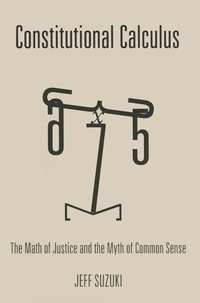
Constitutional Calculus
The Math of Justice and the Myth of Common Sense
Published on 26. April 2015
Book
Hardback
296 pages
978-1-4214-1595-6 (ISBN)
Description
How should we count the population of the United States? What would happen if we replaced the electoral college with a direct popular vote? What are the consequences of allowing unlimited partisan gerrymandering of congressional districts? Can six-person juries yield verdicts consistent with the needs of justice? Is it racist to stop and frisk minorities at a higher rate than non-minorities? These and other questions have long been the subject of legal and political debate and are routinely decided by lawyers, politicians, judges, and voters, mostly through an appeal to common sense and tradition. But mathematician Jeff Suzuki asserts that common sense is not so common, and traditions developed long ago in what was a mostly rural, mostly agricultural, mostly isolated nation of three million might not apply to a mostly urban, mostly industrial, mostly global nation of three hundred million. In Constitutional Calculus, Suzuki guides us through the U.S. Constitution and American history to show how mathematics reveals our flaws, finds the answers we need, and moves us closer to our ideals.
From the first presidential veto to the debate over mandatory drug testing, the National Security Agency's surveillance program, and the fate of death row inmates, Suzuki draws us into real-world debates and then reveals how math offers a superior compass for decision-making. Relying on iconic cases, including the convictions of the Scottsboro boys, League of United Latin American Citizens v. Perry, and Floyd v. City of New York, Suzuki shows that more math can lead to better justice, greater fairness, and a more stable democracy. Whether you are fascinated by history, math, social justice, or government, your interest will be piqued and satisfied by the convincing case Suzuki makes.
From the first presidential veto to the debate over mandatory drug testing, the National Security Agency's surveillance program, and the fate of death row inmates, Suzuki draws us into real-world debates and then reveals how math offers a superior compass for decision-making. Relying on iconic cases, including the convictions of the Scottsboro boys, League of United Latin American Citizens v. Perry, and Floyd v. City of New York, Suzuki shows that more math can lead to better justice, greater fairness, and a more stable democracy. Whether you are fascinated by history, math, social justice, or government, your interest will be piqued and satisfied by the convincing case Suzuki makes.
Reviews / Votes
A breath of fresh air. It was a reaffirmation that mathematics should be used more often to make general public policy. -- Charles Ashbacher MAA ReviewsMore details
Language
English
Place of publication
Baltimore, MD
United States
Product notice
sewn/stitched
Cloth over boards
Illustrations
7 s/w Zeichnungen, 1 Karte
1 Maps; 7 Line drawings, black and white
Dimensions
Height: 231 mm
Width: 178 mm
Thickness: 24 mm
Weight
608 gr
ISBN-13
978-1-4214-1595-6 (9781421415956)
DOI
10.1353/book.38782
Copyright in bibliographic data and cover images is held by Nielsen Book Services Limited or by the publishers or by their respective licensors: all rights reserved.
Schweitzer Classification
Other editions
Additional editions
E-Book
04/2015
Johns Hopkins University Press
€26.49
Available for download
Person
Jeff Suzuki is an associate professor of mathematics at Brooklyn College. He is the author of Mathematics in Historical Context and A History of Mathematics.
Content
Acknowledgments
Prologue
Part I
1.21. Stand Up and Be Estimated
1.22. (Nearly) Equal Representation
1.23. Weighting for a Fair Vote
1.24. The Impossibility of Democracy
1.4. Dragons and Dummymanders
2.1. The Worst Way to Elect a President, Except for All the Rest
Part II
A4.1. Stop and Frisk
A4.2. Reverend Thomas Bayes and the Law
A5. "The Man of Statistics"
A6.1. Despair over Disparity
A6.2. Once Is an Accident...
A6.3. 12 6 5 10 n-Angry Men
A8.1. The Peril and Promise of Social Network Analysis
A8.2. Three Strikes for Three Strikes
A8.3. The Price of Punishment
Epilogue
Select Topical Bibliography
Index
Prologue
Part I
1.21. Stand Up and Be Estimated
1.22. (Nearly) Equal Representation
1.23. Weighting for a Fair Vote
1.24. The Impossibility of Democracy
1.4. Dragons and Dummymanders
2.1. The Worst Way to Elect a President, Except for All the Rest
Part II
A4.1. Stop and Frisk
A4.2. Reverend Thomas Bayes and the Law
A5. "The Man of Statistics"
A6.1. Despair over Disparity
A6.2. Once Is an Accident...
A6.3. 12 6 5 10 n-Angry Men
A8.1. The Peril and Promise of Social Network Analysis
A8.2. Three Strikes for Three Strikes
A8.3. The Price of Punishment
Epilogue
Select Topical Bibliography
Index