

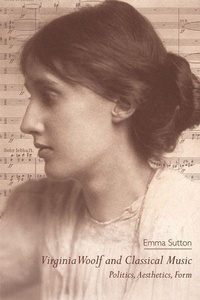
Virginia Woolf and Classical Music
Politics, Aesthetics, Form
Published on 16. September 2013
Book
Hardback
184 pages
978-0-7486-3787-4 (ISBN)
Description
This study is a groundbreaking investigation into the formative influence of music on Virginia Woolf's writing
In this unique study Emma Sutton discusses all of Woolf's novels as well as selected essays and short fiction, offering detailed commentaries on Woolf's numerous allusions to classical repertoire and to composers including Bach, Mozart, Beethoven and Wagner. Sutton explores Woolf's interest in the contested relationship between politics and music, placing her work in a matrix of ideas about music and national identity, class, anti-Semitism, pacifism, sexuality and gender. The study also considers the formal influence of music - from fugue to Romantic opera - on Woolf's prose and narrative techniques. The analysis of music's role in Woolf's aesthetics and fiction is contextualized in accounts of her musical education, activities as a listener, and friendships with musicians; and the study outlines the relationship between her 'musicalized' work and that of contemporaries including Joyce, Lawrence, Forster, Mansfield and Eliot.
Key Features:
Analysis of music, national identity and war in The Voyage Out, Jacob's Room and Mrs DallowayClose reading of Wagner's influence on the plot and narrative techniques of The Voyage OutAnalysis of music and philo- and anti-Semitism in The YearsInnovative reading of the 'fugal' structure of Mrs Dalloway
In this unique study Emma Sutton discusses all of Woolf's novels as well as selected essays and short fiction, offering detailed commentaries on Woolf's numerous allusions to classical repertoire and to composers including Bach, Mozart, Beethoven and Wagner. Sutton explores Woolf's interest in the contested relationship between politics and music, placing her work in a matrix of ideas about music and national identity, class, anti-Semitism, pacifism, sexuality and gender. The study also considers the formal influence of music - from fugue to Romantic opera - on Woolf's prose and narrative techniques. The analysis of music's role in Woolf's aesthetics and fiction is contextualized in accounts of her musical education, activities as a listener, and friendships with musicians; and the study outlines the relationship between her 'musicalized' work and that of contemporaries including Joyce, Lawrence, Forster, Mansfield and Eliot.
Key Features:
Analysis of music, national identity and war in The Voyage Out, Jacob's Room and Mrs DallowayClose reading of Wagner's influence on the plot and narrative techniques of The Voyage OutAnalysis of music and philo- and anti-Semitism in The YearsInnovative reading of the 'fugal' structure of Mrs Dalloway
Reviews / Votes
Persuasive and engrossing from the outset, this much needed, wide-ranging and authoritative work is a substantial contribution to Woolf studies. Invited to attend afresh to her writings, we close Sutton's book retuned to Woolf's complexities and reawakened to her meanings. * David Bradshaw, Oxford University * Sutton's readings of Woolf's writing are fresh and mature, full of new insights and precise contextualization, and capture the pitch of Woolf's writing just right. -- Andrea Zemgulys * English Literature in Transition, 1880-1920, Volume 58, Number 2 * This fascinating and learned study opens up quite new paths for exploring Virginia Woolf's writing. It also gives a vivid portrait of musical life in the earlier twentieth century and the arguments around nationalism and gender. Dr. Sutton demonstrates the presence of Wagner and of Beethoven in Woolf's formal experiments. * Gillian Beer, University of Cambridge * ...should be acquired as a matter of priority by any academic library wanting to keep its collection of Woolf scholarship up to date. -- JAMES ACHESON * Journal of Language, Literature and Culture, 62.2 * Sutton's listening is both attentive and inventive, and brings a new sophistication and subtlety to our understanding of musical-literary relations in modernism. -- Will May, University of Southampton * The Review of English Studies *More details
Language
English
Place of publication
Edinburgh
United Kingdom
Target group
College/higher education
Product notice
sewn/stitched
Paper over boards
Dimensions
Height: 236 mm
Width: 152 mm
Thickness: 18 mm
Weight
454 gr
ISBN-13
978-0-7486-3787-4 (9780748637874)
Copyright in bibliographic data and cover images is held by Nielsen Book Services Limited or by the publishers or by their respective licensors: all rights reserved.
Schweitzer Classification
Other editions
Additional editions
E-Book
09/2013
Edinburgh University Press
€24.49
Available for download

E-Book
09/2013
Edinburgh University Press
€0.00
Available for download
Person
Emma Sutton is Senior Lecturer in English at the University of St Andrews, Scotland. Her publications include Aubrey Beardsley and British Wagnerism in the 1890s (Oxford UP, 2002), and Opera and the Novel (co-edited with Michael Downes, 2012). She is a contributor to Cambridge UP's forthcoming Wagner Encyclopedia, is editing The Voyage Out for their scholarly edition of Woolf's work and has written widely and broadcast on music and literature.
Content
Acknowledgements; List of Abbreviations and Editions Used in the Text; Introduction; 1. On Not Writing Opera; 2. Killing the Pianist in the House; 3. Death in Effigy; 4. Fugues, Flights & Free Association; 5. What it Really Means to be English; 6. Only Suggest; Bibliography; Index.