

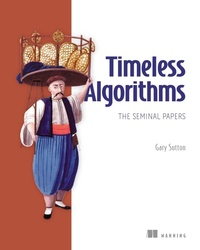
Timeless Algorithms: The Seminal Papers
Will be published approx. on 29. September 2026
Book
Paperback/Softback
375 pages
978-1-63343-446-2 (ISBN)
Description
Get a free eBook (PDF or ePub) from Manning as well as access to the online liveBook format (and its AI assistant that will answer your questions in any language) when you purchase the print book.
Understand the enduring algorithms behind modern AI and data science. Explore the breakthrough algorithms that power modern AI—including Bayes’ prior and posterior beliefs, Fisher’s estimation and likelihood, Shannon’s information gain, and Breiman’s algorithmic modeling. With clarity and rigor, statistics expert Gary Sutton unpacks each concept and explains its practical relevance.
This book explains both the how and the why of the most important data science algorithms. Along with the theory and practical application, you’ll get the fascinating stories behind the discoveries by Bayes, Fisher, Shannon, Bellman, and others. You’ll especially appreciate how author Gary Sutton makes the sometimes-complex seminal papers come to life in rich detail.
Timeless Algorithms: The Seminal Papers will help you to:
• Diagnose model failures by detecting bias, drift, and overfitting early
• Connect tools to theory by linking modern methods to their intellectual roots
• Interpret model behavior for both technical and non-technical stakeholders
• Balance accuracy and ethics by weighing performance against transparency and fairness
• Think probabilistically by applying Bayesian inference, entropy, and expected value
• Design trustworthy systems by making deliberate, well-founded choices about data, loss, and structure
• Recognize hidden assumptions by uncovering what every model quietly believes about the world
• Apply automation tools—such as generative AI and AutoML—while maintaining interpretability and human oversight
About the book
Timeless Algorithms: The Seminal Papers uses the insights of AI pioneers to help you diagnose failures, recognize hidden assumptions, and reason across the layers of your models and applications. Each chapter connects a common data tool to its seminal mathematics paper, revealing the “hidden stack”—a unique framework that maps the layers of modern intelligence from data to philosophy. With a focus on judgement and ethics, you’ll learn to design trustworthy systems, think probabilistically, and use automation wisely to build intelligent models that are not just effective, but principled.
About the reader
For data scientists, engineers, statisticians, business analysts, and decision-makers.
About the author
Gary Sutton is a business intelligence and analytics leader and the author of Statistics Slam Dunk: Statistical analysis with R on real NBA data, and Statistics Every Programmer Needs.
Understand the enduring algorithms behind modern AI and data science. Explore the breakthrough algorithms that power modern AI—including Bayes’ prior and posterior beliefs, Fisher’s estimation and likelihood, Shannon’s information gain, and Breiman’s algorithmic modeling. With clarity and rigor, statistics expert Gary Sutton unpacks each concept and explains its practical relevance.
This book explains both the how and the why of the most important data science algorithms. Along with the theory and practical application, you’ll get the fascinating stories behind the discoveries by Bayes, Fisher, Shannon, Bellman, and others. You’ll especially appreciate how author Gary Sutton makes the sometimes-complex seminal papers come to life in rich detail.
Timeless Algorithms: The Seminal Papers will help you to:
• Diagnose model failures by detecting bias, drift, and overfitting early
• Connect tools to theory by linking modern methods to their intellectual roots
• Interpret model behavior for both technical and non-technical stakeholders
• Balance accuracy and ethics by weighing performance against transparency and fairness
• Think probabilistically by applying Bayesian inference, entropy, and expected value
• Design trustworthy systems by making deliberate, well-founded choices about data, loss, and structure
• Recognize hidden assumptions by uncovering what every model quietly believes about the world
• Apply automation tools—such as generative AI and AutoML—while maintaining interpretability and human oversight
About the book
Timeless Algorithms: The Seminal Papers uses the insights of AI pioneers to help you diagnose failures, recognize hidden assumptions, and reason across the layers of your models and applications. Each chapter connects a common data tool to its seminal mathematics paper, revealing the “hidden stack”—a unique framework that maps the layers of modern intelligence from data to philosophy. With a focus on judgement and ethics, you’ll learn to design trustworthy systems, think probabilistically, and use automation wisely to build intelligent models that are not just effective, but principled.
About the reader
For data scientists, engineers, statisticians, business analysts, and decision-makers.
About the author
Gary Sutton is a business intelligence and analytics leader and the author of Statistics Slam Dunk: Statistical analysis with R on real NBA data, and Statistics Every Programmer Needs.
More details
Language
English
Product notice
Paperback (trade)
Unsewn / adhesive bound
Weight
449 gr
ISBN-13
978-1-63343-446-2 (9781633434462)
Copyright in bibliographic data and cover images is held by Nielsen Book Services Limited or by the publishers or by their respective licensors: all rights reserved.
Schweitzer Classification
Other editions
Additional editions
Gary Sutton
Timeless Algorithms: The Seminal Papers
E-Book
approx. 09/2026
Simon + Schuster LLC
€50.43
Not yet available
Person
Gary Sutton is a vice president for a leading financial services company. He has built and led high-performing business intelligence and analytics organizations across multiple verticals, where R was the preferred programming language for predictive modeling, statistical analyses, and other quantitative insights. Gary earned his undergraduate degree from the University of Southern California, a Masters from George Washington University, and a second Masters in Data Science, from Northwestern University.