

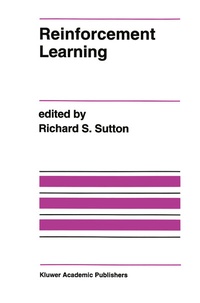
Reinforcement Learning
A Special Issue of Macnine Learning on Reinforcement Learning
Published on 31. May 1992
Book
Hardback
172 pages
978-0-7923-9234-7 (ISBN)
Description
Reinforcement learning is the learning of a mapping from situations to actions so as to maximize a scalar reward or reinforcement signal. The learner is not told which action to take, as in most forms of machine learning, but instead must discover which actions yield the highest reward by trying them. In the most interesting and challenging cases, actions may affect not only the immediate reward, but also the next situation, and through that all subsequent rewards. These two characteristics -- trial-and-error search and delayed reward -- are the most important distinguishing features of reinforcement learning.
Reinforcement learning is both a new and a very old topic in AI. The term appears to have been coined by Minsk (1961), and independently in control theory by Walz and Fu (1965). The earliest machine learning research now viewed as directly relevant was Samuel's (1959) checker player, which used temporal-difference learning to manage delayed reward much as it is used today. Of course learning and reinforcement have been studied in psychology for almost a century, and that work has had a very strong impact on the AI/engineering work. One could in fact consider all of reinforcement learning to be simply the reverse engineering of certain psychological learning processes (e.g. operant conditioning and secondary reinforcement).
Reinforcement Learning is an edited volume of original research, comprising seven invited contributions by leading researchers.
Reinforcement learning is both a new and a very old topic in AI. The term appears to have been coined by Minsk (1961), and independently in control theory by Walz and Fu (1965). The earliest machine learning research now viewed as directly relevant was Samuel's (1959) checker player, which used temporal-difference learning to manage delayed reward much as it is used today. Of course learning and reinforcement have been studied in psychology for almost a century, and that work has had a very strong impact on the AI/engineering work. One could in fact consider all of reinforcement learning to be simply the reverse engineering of certain psychological learning processes (e.g. operant conditioning and secondary reinforcement).
Reinforcement Learning is an edited volume of original research, comprising seven invited contributions by leading researchers.
More details
Series
Edition
Reprinted from `MACHINE LEARNING', 8: 3/4, 1992
Language
English
Place of publication
New York
United States
Target group
Professional and scholarly
Research
Illustrations
172 p.
Dimensions
Height: 241 mm
Width: 160 mm
Thickness: 15 mm
Weight
442 gr
ISBN-13
978-0-7923-9234-7 (9780792392347)
DOI
10.1007/978-1-4615-3618-5
Schweitzer Classification
Other editions
Additional editions
Content
Reinforcement Learning.- A Special Issue of Machine Learning on Reinforcement Learning.- Introduction: The Challenge of Reinforcement Learning.- Simple Statistical Gradient-Following Algorithms for Connectionist Reinforcement Learning.- Practical Issues in Temporal Difference Learning.- Technical Note: Q-Learning.- Self-Improving Reactive Agents Based on Reinforcement Learning, Planning and Teaching.- Transfer of Learning by Composing Solutions of Elemental Sequential Tasks.- The Convergence of TD(?) for General ?.- A Reinforcement Connectionist Approach to Robot Path Finding in Non-Maze Like Environments.