

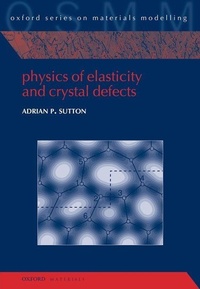
Physics of Elasticity and Crystal Defects
Published on 25. June 2020
Book
Hardback
288 pages
978-0-19-886078-5 (ISBN)
Description
This textbook is a modern take on an old subject at the heart of materials physics. Properties of crystalline materials are almost always controlled by structural defects within them. Until relatively recently these defects were studied theoretically using continuum elasticity theory which ignores the atomic structure of the host material. This book introduces the concepts of elasticity in the traditional continuum way and also in terms of atomic interactions. It goes on to present point (impurities, missing atoms), line (dislocations) and planar (faults, cracks) defects at both the continuum level and the atomic level. This novel approach will be new to most engineers and it will appeal to physicists. There are exercises for the student to work through, with complete solutions free to course instructors from the OUP website.
Reviews / Votes
Adrian Sutton's Physics of elasticity and crystal defects is a concise, modern and refreshing introduction to a topic that is key to all of materials science and engineering. It is a great textbook to teach from as well as for those who want to learn the material on their own. * Contemporary Physics, February 2022 * Sutton is a giant in the field... I am certain this book will be a classic. * Craig Carter, MIT * Superb... and written in an excellent, engaging style Sutton is an internationally respected expert in structural materials science and condensed matter physics, one of very few people to have such status in these two domains simultaneously. * T D Swinburne, CNRS, Aix-Marseille Universite * Sutton emphasizes the physical meaning behind the mathematical models he clearly introduces. The style is simple, didactic, and effective. The coverage of some of the Open Questions in Chapter 10 (e.g. electroplasticity) is entirely unique to this book. * Benat Gurrutxaga-Lerma, University of Cambridge * Although there are other relevant texts in this field, this book includes connections to atomic treatments of defects. These are timely additions, and provide new physical insights. Although the book contains much mathematics, it is essentially readable, and stimulating. * Sir Peter Hirsch, University of Oxford * This is an outstanding book. Students will appreciate the clarity of the arguments, including careful derivations of some important formulas for elasticity. * Robert Rudd, Series Editor, Oxford Series on Materials Modelling * The book is highly accessible, and provides the level of insight into the subject that you would rarely find in academic literature It is particularly significant that the author has made a clear connection between Physics and Elasticity and Defects in this book. There is an established element of tradition here, where L. D. Landau and E. M. Lifshitz included Theory of Elasticity in their famous Course in Theoretical Physics. This new book by Adrian Sutton matches the Landau-Lifshitz book extremely well, providing new, modern insights into the phenomena, and matching the needs of contemporary generations of students and researchers. * Sergei Dudarev, UK Atomic Energy Authority * It is quite obvious that the majority of the content is material that the author has worked through from scratch, much of it original, and this is especially reflected in the problems, which are detailed and novel. * Tony Paxton, King's College London *More details
Series
Edition
1
Language
English
Place of publication
Oxford
United Kingdom
Target group
College/higher education
Product notice
sewn/stitched
Cloth over boards
Illustrations
38 color line figures
Dimensions
Height: 247 mm
Width: 179 mm
Thickness: 20 mm
Weight
712 gr
ISBN-13
978-0-19-886078-5 (9780198860785)
Copyright in bibliographic data and cover images is held by Nielsen Book Services Limited or by the publishers or by their respective licensors: all rights reserved.
Schweitzer Classification
Other editions
Additional editions
Adrian P. Sutton
Physics of Elasticity and Crystal Defects
E-Book
06/2020
1st Edition
OUP eBook
€56.49
Available for download
Person
Educated in materials science at the Universities of Oxford and Pennsylvania, Adrian P. Sutton has worked for more than 40 years on theory and simulation of defects in crystalline materials. He has published more than 230 papers on electronic, atomistic and continuum level modelling of defects. In 2005 he was appointed to a Chair in the Department of Physics at Imperial College London. In 2009 he established and led the renowned Centre for Doctoral Training (CDT) on Theory and Simulation of Materials at Imperial College. This book is based in part on a course he gave in the CDT for 10 years. He was elected to the Royal Society in 2003.
Content
1: Strain 2: Stress 3: Hooke's Law and Elastic Constants 4: The Green's Function in Linear Elasticity 5: Point Defects 6: Dislocations 7: Hybrid Models of Dislocations 8: The Force on a Defect 9: Cracks 10: Open Questions