

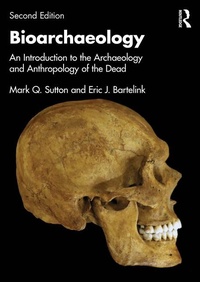
Bioarchaeology
An Introduction to the Archaeology and Anthropology of the Dead
2nd Edition
Published on 21. May 2025
Book
Paperback/Softback
282 pages
978-1-032-72495-9 (ISBN)
Description
Bioarchaeology covers the history and general theory of the field plus the recovery and laboratory treatment of human remains.
Bioarchaeology is the study of human remains in context from an archaeological and anthropological perspective. The book explores, through numerous case studies, how the ways a society deals with their dead can reveal a great deal about that society, including its religious, political, economic, and social organizations. It details recovery methods and how, once recovered, human remains can be analyzed to reveal details about the funerary system of the subject society and inform on a variety of other issues, such as health, demography, disease, workloads, mobility, sex and gender, and migration. Finally, the book highlights how bioarchaeological techniques can be used in contemporary forensic settings and in investigations of genocide and war crimes.
In Bioarchaeology, theories, principles, and scientific techniques are laid out in a clear, understandable way, and students of archaeology at undergraduate and graduate levels will find this an excellent guide to the field.
Bioarchaeology is the study of human remains in context from an archaeological and anthropological perspective. The book explores, through numerous case studies, how the ways a society deals with their dead can reveal a great deal about that society, including its religious, political, economic, and social organizations. It details recovery methods and how, once recovered, human remains can be analyzed to reveal details about the funerary system of the subject society and inform on a variety of other issues, such as health, demography, disease, workloads, mobility, sex and gender, and migration. Finally, the book highlights how bioarchaeological techniques can be used in contemporary forensic settings and in investigations of genocide and war crimes.
In Bioarchaeology, theories, principles, and scientific techniques are laid out in a clear, understandable way, and students of archaeology at undergraduate and graduate levels will find this an excellent guide to the field.
More details
Edition
2nd edition
Language
English
Place of publication
London
United Kingdom
Publishing group
Taylor & Francis Ltd
Target group
College/higher education
Postgraduate and Undergraduate Advanced
Illustrations
80 s/w Abbildungen, 7 s/w Tabellen, 80 s/w Photographien bzw. Rasterbilder
11 Tables, black and white; 76 Halftones, black and white; 76 Illustrations, black and white
Dimensions
Height: 246 mm
Width: 174 mm
Weight
520 gr
ISBN-13
978-1-032-72495-9 (9781032724959)
Copyright in bibliographic data and cover images is held by Nielsen Book Services Limited or by the publishers or by their respective licensors: all rights reserved.
Schweitzer Classification
Other editions
Additional editions
Mark Q. Sutton | Eric J. Bartelink
Bioarchaeology
An Introduction to the Archaeology and Anthropology of the Dead
E-Book
05/2025
2nd Edition
Routledge
€55.49
Available for download
Mark Q. Sutton | Eric J. Bartelink
Bioarchaeology
An Introduction to the Archaeology and Anthropology of the Dead
E-Book
05/2025
2nd Edition
Routledge
€55.49
Available for download
Mark Q. Sutton | Eric J. Bartelink
Bioarchaeology
An Introduction to the Archaeology and Anthropology of the Dead
Book
05/2025
2nd Edition
Routledge
€215.41
Shipment within 10-20 days
Previous edition
Book
11/2020
1st Edition
Routledge
€47.50
Article exhausted; check for reprint
Persons
Mark Q. Sutton received his PhD in Anthropology from the University of California, Riverside, in 1987. He taught at California State University, Bakersfield, from 1987 to 2007 where he retired as Emeritus Professor of Anthropology. He now teaches at the University of San Diego. Dr. Sutton has worked with a variety of human remains in western North America and has published more than 250 books, monographs, articles, and reviews in archaeology.
Eric J. Bartelink received his PhD in Anthropology from Texas A&M University in 2006. He has taught at California State University, Chico, since 2006, where he is currently full professor and co-director of the Human Identification Laboratory. Dr. Bartelink is a diplomate of the American Board of Forensic Anthropology, a certified instructor for California's Peace Officers Standards and Training, and current chair of the Organization of Scientific Area Committees' Anthropology Subcommittee administered by the National Institute of Standards and Technology (NIST). He has authored and co-authored over 150 professional works, including journal articles, edited book chapters, and encyclopedia articles. His research focuses on the bioarchaeology of Native California, reconstruction of diet and migration patterns, taphonomy, trauma analysis, and paleopathology.
Eric J. Bartelink received his PhD in Anthropology from Texas A&M University in 2006. He has taught at California State University, Chico, since 2006, where he is currently full professor and co-director of the Human Identification Laboratory. Dr. Bartelink is a diplomate of the American Board of Forensic Anthropology, a certified instructor for California's Peace Officers Standards and Training, and current chair of the Organization of Scientific Area Committees' Anthropology Subcommittee administered by the National Institute of Standards and Technology (NIST). He has authored and co-authored over 150 professional works, including journal articles, edited book chapters, and encyclopedia articles. His research focuses on the bioarchaeology of Native California, reconstruction of diet and migration patterns, taphonomy, trauma analysis, and paleopathology.
Content
List of figures; Preface to the second edition; Acknowledgments; Chapter 1: The discipline of bioarchaeology; Chapter 2: In the field; Chapter 3: In the laboratory; Chapter 4: Treating the dead: The funerary system; Chapter 5: Paleopathology I: Metabolic, nutritional, and occupational stress; Chapter 6: Paleopathology II: Disease and abnormalities; Chapter 7: Trauma; Chapter 8: Specialized studies; Chapter 9: Interpretive theory and data integration; Chapter 10: Lives once lived: The anthropology of the dead; Chapter 11: Contemporary application: Forensic anthropology; References; Glossary; Index.