

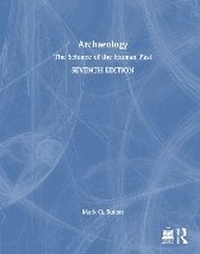
Archaeology
The Science of the Human Past
7th Edition
Published on 22. January 2025
Book
Hardback
420 pages
978-1-032-75665-3 (ISBN)
Description
Archaeology: The Science of the Human Past introduces students to the wide-ranging and fascinating world of archaeology and provides them with a comprehensive understanding of fundamental archaeological concepts and methods.
The seventh edition keeps pace with the developments in archaeological science with up-to-date information on dating, artifact analyses, and remote sensing. Theoretical developments in power, gender, and cognition are also included. Introducing the key components of archaeology, including sites, artifacts, ecofacts, remote sensing, and excavation, it discusses the ways archaeologists obtain, analyze, and interpret evidence. Varying perspectives are considered to provide holistic coverage of how archaeological techniques and methods are used to formulate and test models of what happened in the past. Cultural resource management and the laws and regulations that deal with archaeology around the world are described. Archaeology is placed in the context of current topics, from environmental problems to issues affecting Indigenous populations.
Archaeology: The Science of the Human Past remains an ideal introduction to archaeology by offering students a broad and clear understanding of the theoretical and scientific aspects of archaeology and how various archaeological perspectives and techniques help us comprehend not just the past but the contemporary world as well.
The seventh edition keeps pace with the developments in archaeological science with up-to-date information on dating, artifact analyses, and remote sensing. Theoretical developments in power, gender, and cognition are also included. Introducing the key components of archaeology, including sites, artifacts, ecofacts, remote sensing, and excavation, it discusses the ways archaeologists obtain, analyze, and interpret evidence. Varying perspectives are considered to provide holistic coverage of how archaeological techniques and methods are used to formulate and test models of what happened in the past. Cultural resource management and the laws and regulations that deal with archaeology around the world are described. Archaeology is placed in the context of current topics, from environmental problems to issues affecting Indigenous populations.
Archaeology: The Science of the Human Past remains an ideal introduction to archaeology by offering students a broad and clear understanding of the theoretical and scientific aspects of archaeology and how various archaeological perspectives and techniques help us comprehend not just the past but the contemporary world as well.
More details
Edition
7th edition
Language
English
Place of publication
London
United Kingdom
Publishing group
Taylor & Francis Ltd
Target group
College/higher education
Undergraduate Advanced and Undergraduate Core
Illustrations
135 s/w Abbildungen, 135 s/w Photographien bzw. Rasterbilder, 24 s/w Tabellen
24 Tables, black and white; 135 Halftones, black and white; 135 Illustrations, black and white
Dimensions
Height: 254 mm
Width: 203 mm
Weight
1180 gr
ISBN-13
978-1-032-75665-3 (9781032756653)
Copyright in bibliographic data and cover images is held by Nielsen Book Services Limited or by the publishers or by their respective licensors: all rights reserved.
Schweitzer Classification
Other editions
Additional editions
Book
01/2025
7th Edition
Routledge
€148.68
Shipment within 10-20 days
E-Book
01/2025
7th Edition
Routledge
€132.99
Available for download
E-Book
01/2025
7th Edition
Routledge
€132.99
Available for download
Previous edition
Book
03/2021
6th Edition
Routledge
€272.36
Article exhausted; check for reprint
Person
Mark Q. Sutton is an emeritus professor of anthropology at California State University, Bakersfield, USA.
Content
Acknowledgments; About the Author; To the Instructor; To the Student; Part I What is Archaeology? - Chapter 1 The Science of Archaeology; Chapter 2 Background of Archaeology; Chapter 3 The Development of Contemporary Archaeology; Part II Obtaining Information About the Past - Chapter 4 The Archaeological Record; Chapter 5 Conducting Fieldwork; Chapter 6 Classification and Analysis of Artifacts; Chapter 7 Determining Time; Chapter 8 Bioarchaeology: Human Remains; Part III Interpreting the Past - Chapter 9 Environment and Adaptation; Chapter 10 Understanding Past Settlement and Subsistence; Chapter 11 Interpreting Past Cultural Systems; Chapter 12 Understanding Change; Part IV Public Archaeology - Chapter 13 Cultural Resource Management; Chapter 14 Archaeology in Today's World; Glossary; References; Index.